The little Wusel story
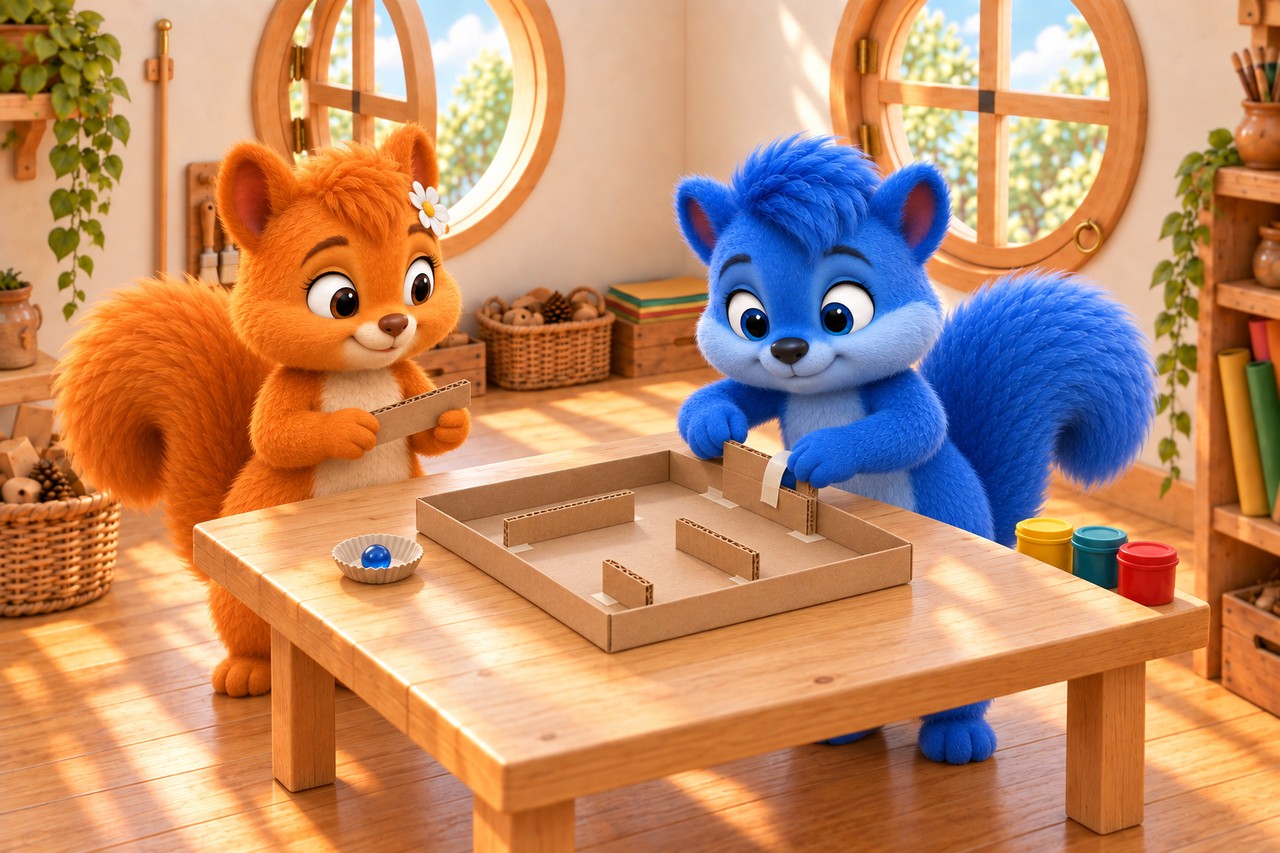
Puschel placed a blue marble in an empty cardboard lid and lifted one side. Clack! It reached the other edge. Puschel“My woodland has a very short path today,” he observed.
Flauschi laid a folded strip of card across it, leaving a wide gap beside the end. Flauschi“What happens if a tree trunk lies here?” Puschel tilted the lid again. The marble rolled against the card and stopped.
Puschel“The tree trunk is in the way,” Puschel said. Flauschi“Can you guide it around the end?” Flauschi asked. Puschel tipped the lid sideways. The marble followed the card and rolled through the gap. Puschel“It can turn corners!”
They laid a second strip from the opposite side. Before fixing it down, they rolled the marble through the whole route. One gap was too narrow. Puschel moved the strip back. Puschel“Our woodland needs adventures. But no trapped marbles.”
With help, they fixed down the folded feet of the card walls. While everything dried, they drew a tree and a little house on paper. The pictures went on the walls so the path stayed clear.
On his first attempt, Puschel lifted his edge far too high. The marble rushed into the next wall. Puschel“That hill was more of a mountain.” On his second try, he moved the lid just a little. Now he could follow the marble to the next bend.
Flauschi took the other edge. Together they guided the marble past the tree. Once it rolled backwards. Puschel was about to tip faster, but Flauschi steadied her side. Flauschi“We have time.”
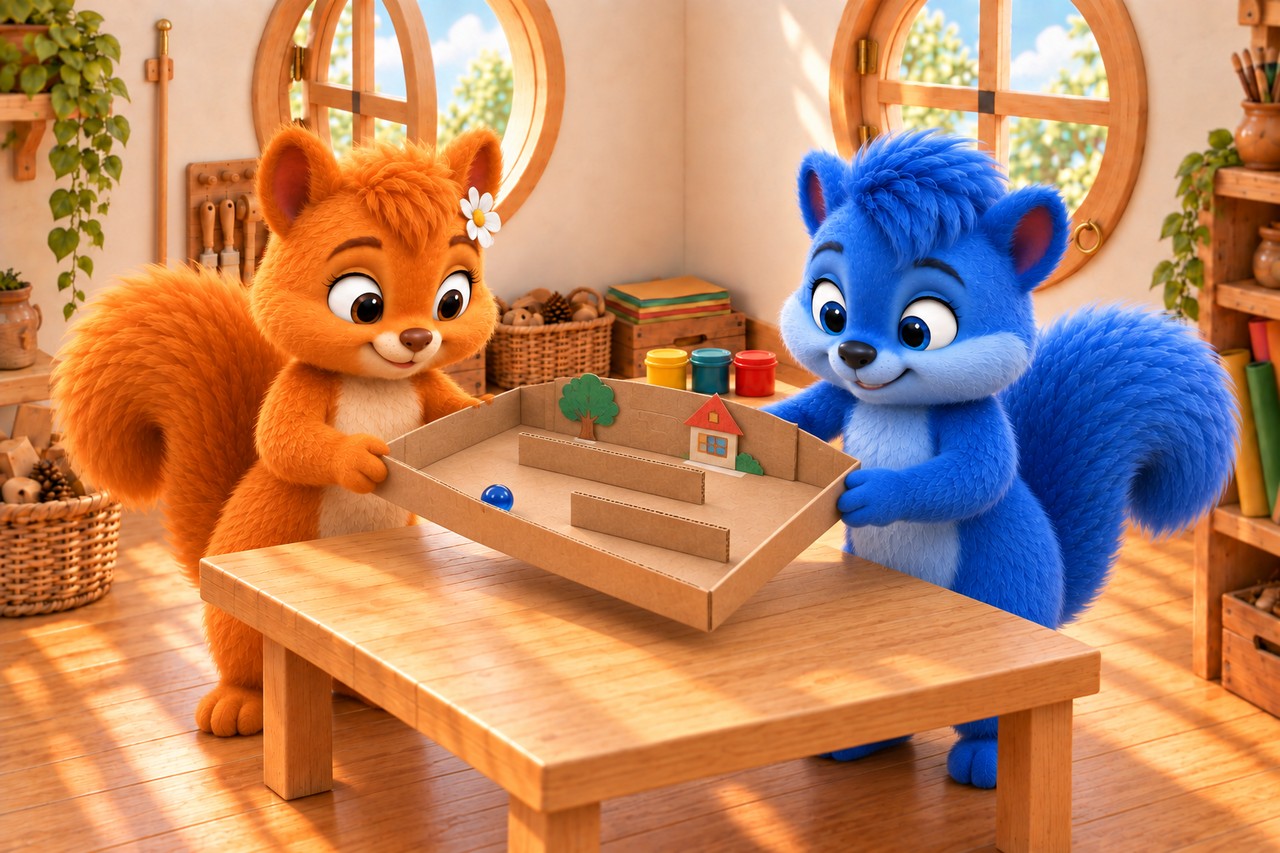
The marble stopped beside the paper house. Puschel breathed out. Puschel“Arrived! And I haven’t even left the woodland.” Flauschi set the lid flat again. Flauschi“Another round?” Puschel grinned. Puschel“Yes. This time you can make the first hill.”
What you need
- a sturdy cardboard lid with a rim all around, about 30 × 20 cm
- thin sturdy card for two or three walls
- one undamaged marble, about 16 mm across, and a little storage dish
- ruler, pencil, children’s scissors and strong paper tape; optionally suitable craft glue
- paper scraps for a tree and a little destination house
- a protected work surface; an adult helps cut firm card
How it works
- Check the lid for strength and sharp edges. Set it flat and choose opposite corners as start and finish. Do not cut holes in it.
- An adult first cuts two card strips about 3 cm wide. Fold a roughly 1 cm flap along each strip; the upright wall will be about 2 cm high.
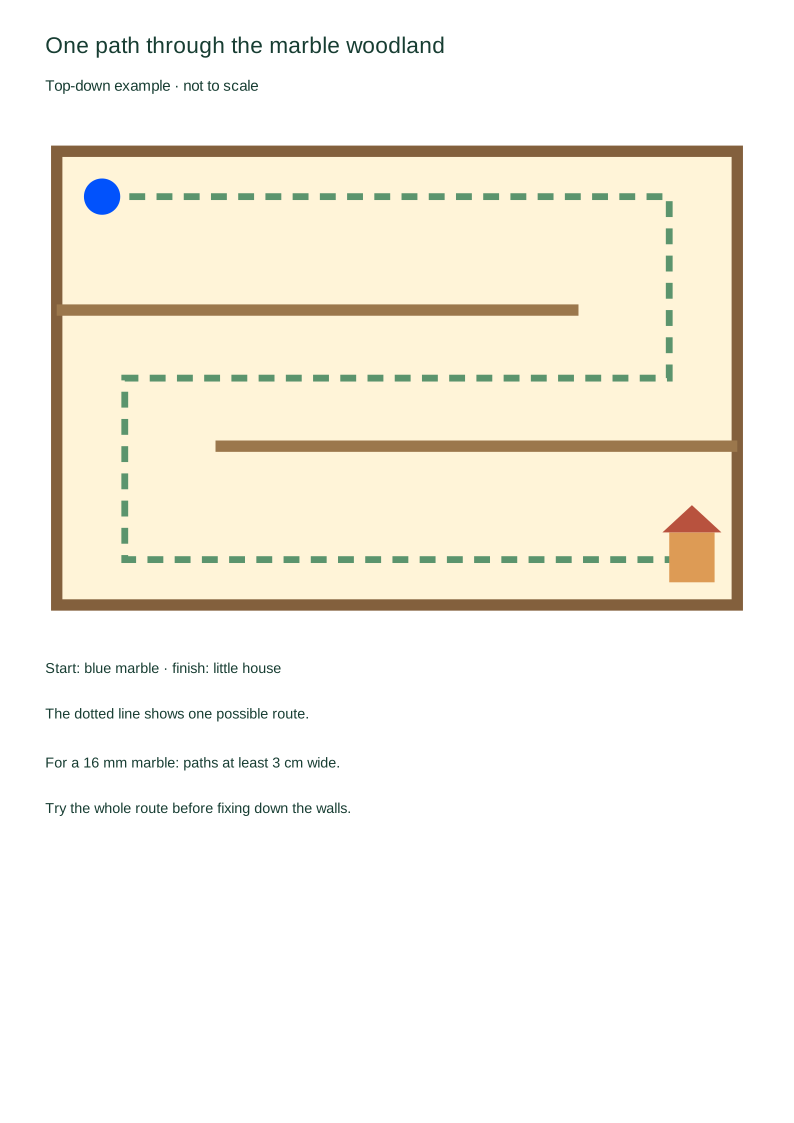
- Lay the first wall across the lid from one side and the second from the opposite side. Leave paths at least 3 cm wide beside each free end and between walls for a 16 mm marble. Larger marbles need wider paths.
- Try the entire route before fixing anything down; an adult can hold the walls. The marble must be able to travel from start to finish without getting stuck. Shorten or move strips as needed.
- Tape the folded feet flat to the base, preferably outside the rolling path. Cover protruding edges. If using glue, let it dry completely according to its packaging before playing.
- Draw a tree and house on small paper pieces. Glue them flat onto walls without narrowing gaps. Start with two walls; add a third only after another complete rolling test.
- Place one marble at the start. Hold the lid with both hands at its outer edges above the table and tilt gently. Two players move it together. Afterwards return the marble to its dish and put it out of younger children’s reach.
Adult help: Marbles are small choking hazards: supervise play, keep away from children under three and anyone who mouths objects. Adults cut firm card and check edges and joins. Do not throw or shake strongly. For a version without a glass marble, use a crumpled paper ball and much wider paths; that ball must not go into mouths either.
One more idea
- A few wide paths work better for beginners than many narrow dead ends.
- The drawing shows one top-down example. You do not need to copy its exact scale.
Keeping the marble paths open
Top view with two alternating walls and a clear route from the start to the house.
Preview the printable
To print, open in a new tab and choose Print in your browser. For the circle template use A4 portrait, actual size / 100%.