How do researchers check Yeti and Nessie stories?
A drawing, a sample and its examination are different things. Good research also explains what a result cannot tell us.
The short answer
Stories, blurry photographs and tracks are attributed to these creatures. Investigators ask whether other explanations fit and independent checks are possible. Yeti, Nessie and Bigfoot have not been confirmed as the claimed animal species.
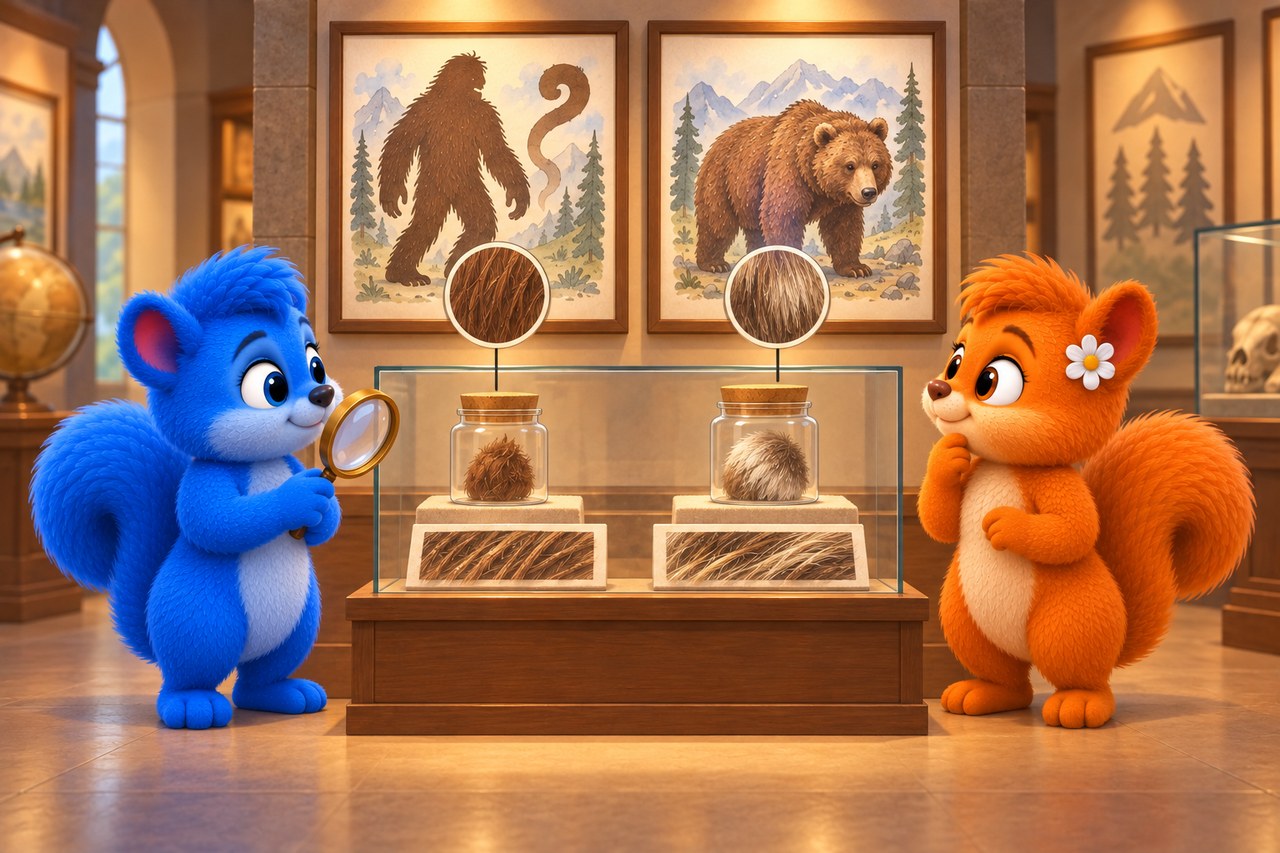
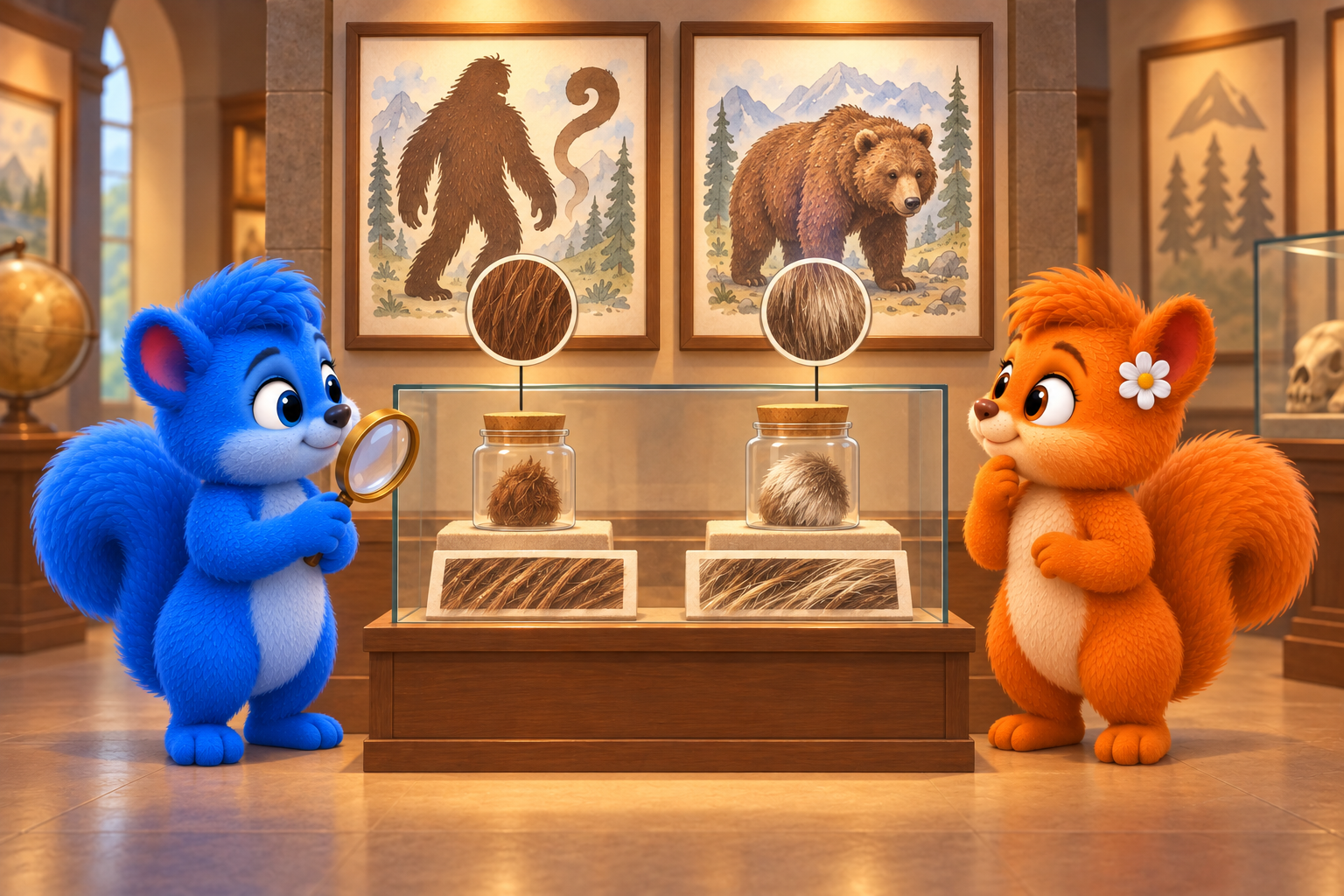
Puschel and Flauschi in the museum. Museum comparison between a creature claim, hair samples and a known bear. An invented learning comparison, not a report of an actual examined specimen. AI-created illustration, not a photograph of nature.
Explained in three pictures
1 A claim
Someone claims this sample came from an unknown creature.
2 Comparison in a lab
Experts compare the sample with known species. Colours are comparison symbols.
3 What follows?
Many tested Yeti samples matched known animals, such as bears.
More about the picture
A story alone is not enough. Origin, methods and reference data must be checked. The colour sequences are invented comparison symbols. Bear or eel evidence does not prove a Yeti or Nessie. An inconclusive sample does not automatically rule out every imaginable creature.
An imagined Wusel scene
Puschel and Flauschi investigate
Puschel thinks a blurry shadow shows an unknown animal. Flauschi places other possible outlines beside it. Several fit roughly. Instead of choosing a name, they record what new picture or trace could help distinguish them.
Look closely
Compare the museum model with the three picture steps. Experts compare the sample with known species. Colours are comparison symbols.
An example to help you understand
Draw an invented creature and label it drawing. Put a question card beside it: what checkable trace would support the claim? A third card says result. For this example, an adult writes that eel DNA was found in the examined water samples. Now test: therefore we know the eels’ size. It does not follow. The card game explores a conclusion’s limits; it replaces no DNA analysis.
Try explaining it
Is a blurry picture enough to confirm a new animal species?
Choose a), b) or c), then explain your choice.
- a)Yes, if the blurry shape does not resemble a known animal.
- b)No, alternatives and further evidence need checking.
- c)Yes, if several people retell the same story.
Show the explanation
Correct: b): No, alternatives and further evidence need checking.
Stories, blurry photographs and tracks are attributed to these creatures. Investigators ask whether other explanations fit and independent checks are possible. Yeti, Nessie and Bigfoot have not been confirmed as the claimed animal species.
Word help
- cell
- A tiny living unit. Living things are made of cells.
- DNA
- A very long strand whose sequence of building blocks carries information for living things.
- molecule
- A small group of connected atoms, tiny building blocks of matter.
Explore in more detail
Here you will find longer explanations and further details. You can explore them together.
1. Recognise story creatures
Bigfoot is described as a large hairy forest creature, Yeti as a creature of Asian high mountains, and Nessie as a creature of Scotland’s Loch Ness. In Scottish usage, loch can mean a lake. Our pictures are invented drawings of these ideas, not records of a verified animal. These investigations concern particular claimed traces, not the value of storytelling traditions.
2. Examine a sample carefully
In 2017 a team examined nine purported Yeti samples. Eight were assigned to Asian bears and one to a dog. Researchers studied DNA, a molecule carrying inherited information: instructions passed on for living things’ construction and functioning. Comparing suitable DNA sections helps identify sample origins. This result applies to the samples examined.
Checked against: [1]
3. Water contains biological traces
A team studied 250 Loch Ness water samples for research presented in 2019. Water may contain organisms’ DNA traces, including from shed cells. The samples contained eel DNA among other findings. This indicates eels, not their body size. The study did not establish a giant eel.
Checked against: [2]
4. Do not enlarge the conclusion
A sample from a known animal does not establish a new story creature. Conversely, one unsuccessful search is not a complete view of everything that ever lived anywhere. Specify the sample, location and method investigated. This separates a question, a limited finding and a further claim.
An optional question for further exploration
You can use the longer explanation above. This is extra, not needed for the first quiz.
An extra question
Does finding eel DNA establish that an eel was enormous?
Discover the answer
No. Those water samples reveal eel DNA, not body size. A relevant clue does not justify an additional unchecked claim.
Pictures and sources for adults
Sources for further reading
Facts checked against the specialist sources below on 12 October 2026. The Wusel scene is fictional; comparisons and simplified models are explicitly explained. Sources are in English.