How did a woolly mammoth stay warm?
Fur, small ears and food: a body suited to a cold landscape.
The short answer
A woolly mammoth lost less heat thanks to thick fur, body fat and small ears. Think of a warm coat: it helps retain your body heat. A mammoth still needed food for the energy to stay warm and move.
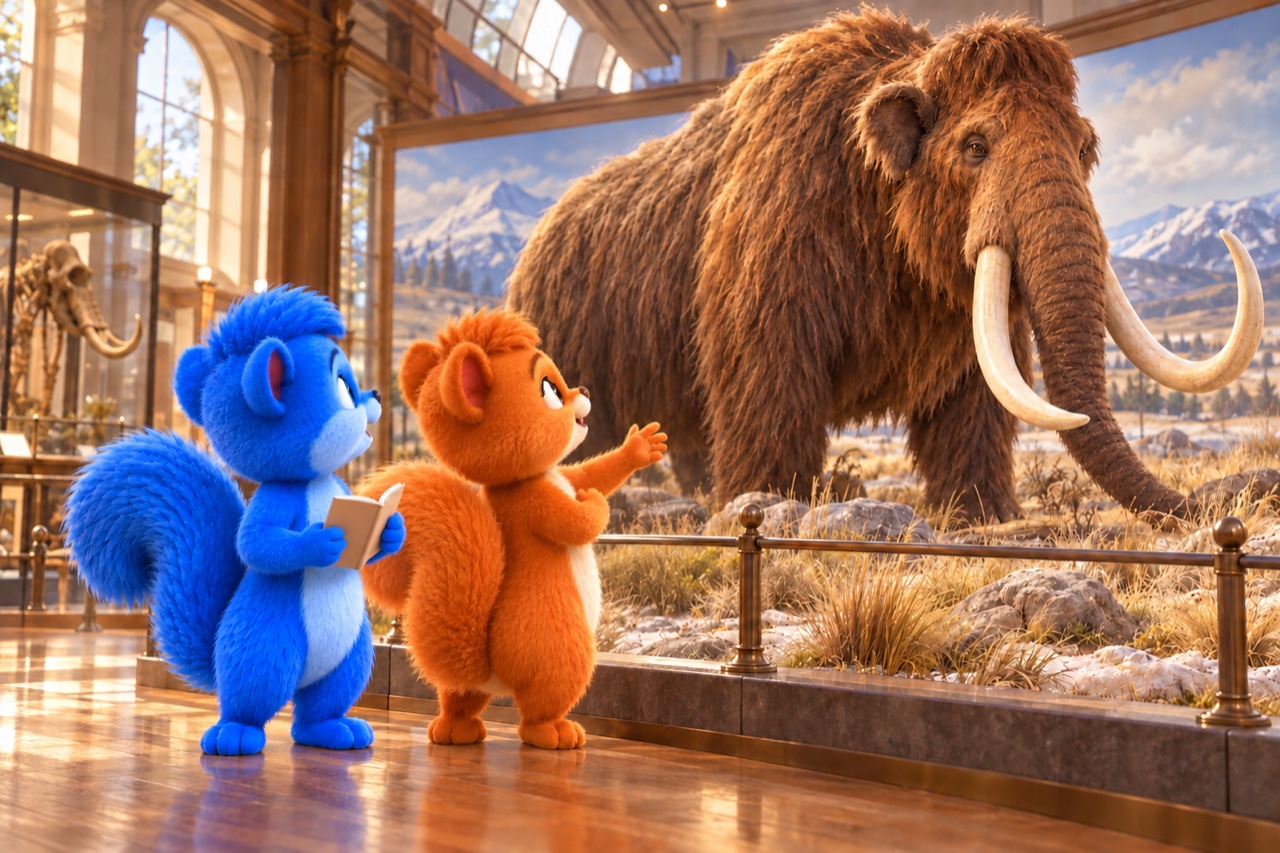
The two admire a woolly mammoth model with thick fur and curved tusks in a grassland exhibit. The museum model depicts a woolly mammoth. Look for its fur and the grass in the exhibit. Its size relative to the Wusels is not to scale. AI-created museum illustration, not a photograph of a real exhibit.
An imagined Wusel scene
Puschel and Flauschi investigate
At the mammoth model, Puschel first copies only the tusks. Flauschi points to fur layers and small ears. They mark features that could help retain warmth. His second drawing explains cold adaptation rather than only the most striking body part.
An example to help you understand
Think of a warm coat: it does not make heat, but slows how quickly your body loses it. Fur helped the mammoth in a similar way. Find the grass in the picture: the animal needed food to keep its body alive.
Try explaining it
How did thick fur help a woolly mammoth?
Choose a), b) or c), then explain your choice.
- a)It mainly warmed the surrounding air.
- b)It slowed the loss of body heat.
- c)It replaced food in winter.
Show the explanation
Correct: b): It slowed the loss of body heat.
Like a warm coat, fur slowed heat loss. The mammoth still needed food.
Explore in more detail
Here you will find longer explanations and further details. You can explore them together.
1. An elephant relative
Mammoths belonged to the elephant family. They were mammals, not dinosaurs. Mammals feed their young milk. Modern elephants did not simply descend from woolly mammoths; they belong to related branches. Imagine their relationship as different branches of a large family tree.
Checked against: [1]
2. Keeping body heat
Woolly mammoths had thick fur and small ears. Fur slows heat loss: body warmth passes into the cold air more slowly. Fur it does not generate warmth like a heater. Small ears lose less heat than comparable large ears. These features helped in cold habitats.
Checked against: [2]
3. Snow alone supplies no lunch
Woolly mammoths needed plants, especially grasses. They lived in cold, dry grasslands too. An ice age does not mean every place was always covered in deep snow. Even a warm coat was insufficient without accessible food.
4. Not every mammoth was alike
There were several mammoth species. The woolly mammoth is the familiar very hairy one, but features and habitats differed. Researchers study bones, teeth and sometimes preserved skin or hair, rather than only guessing.
Checked against: [1]
An optional question for further exploration
You can use the longer explanation above. This is extra, not needed for the first quiz.
An extra question
Why is thick fur alone insufficient for survival?
Discover the answer
Fur slows heat loss, but the animal also needs suitable food and habitat.
Pictures and sources for adults
Sources for further reading
The factual content was checked against these specialist sources on 10 October 2026. The Wusel scene is fictional.