Media & Invention
Why do we see advertising, and how can we recognise it?
The short answer
Advertising seeks your attention and tries to influence you: often to know about or want a product. Businesses pay for adverts or sponsored posts. Advertising may also support an idea. A friendly appearance does not automatically make its claims true.
See how it works
Arrows show a direction or change. Sizes and distances are simplified. Read in order; each explanation belongs to the picture above it.
1. Notice the goal
A toy picture, song or video can advertise something. First ask: what should I think or do afterwards? Encouraging a purchase is different from giving neutral information.
2. Look for clues
Words such as “advertisement” or “ad” can help. Paid posts by familiar people may be advertising too. Not every picture is labelled correctly; a missing label does not prove independence.
3. Understand interests
A business may pay for space or attention. This can help fund services. Content available free of charge can therefore still have an advertising interest.
4. Check claims
A happy child in an advert does not prove a product will make you happy. Compare claims with checkable information. Ask adults when buying, personal data or unfamiliar links are involved.
An imagined Wusel scene
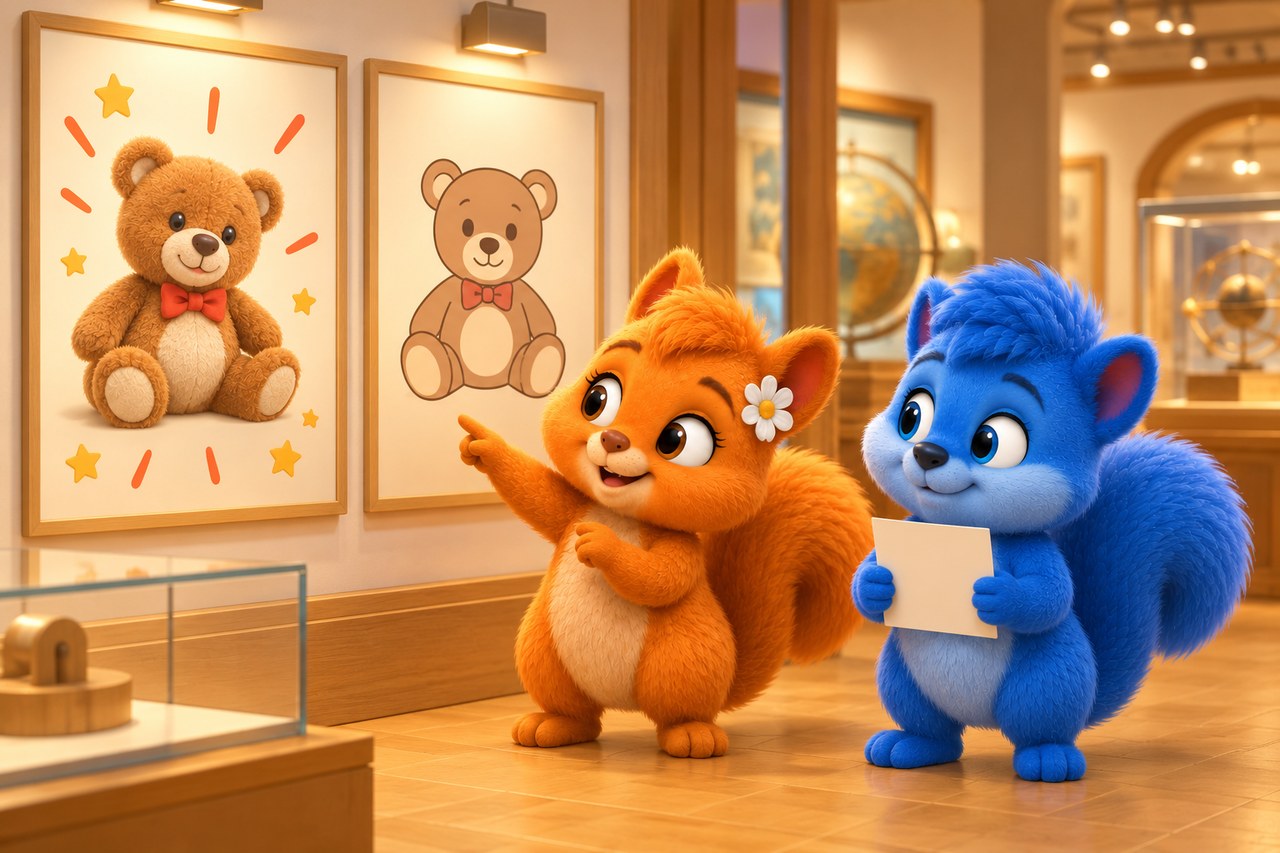
Puschel and Flauschi investigate
Puschel wants the museum’s model toy immediately because its poster looks cheerful. Flauschi shows the same object without the colourful backdrop. He notices that a picture can create a wish without proving its promise.
Word help
- Advertisement
- A published promotional message, on paper or online.
- Evidence
- Checkable information that can support a claim.
Your activity
Make two paper posters for one imaginary object: one with checkable information and one with a big promise. Ask what can be checked. Nothing is bought or posted online.
Quiz: understand the idea
A free video promotes a product. What is possible?
Choose a), b) or c), then explain your choice.
- a)Advertising may help pay for making it.
- b)Free means nobody has an advertising interest.
- c)A familiar person can never advertise.
Show the explanation
Correct: a): Advertising may help pay for making it.
Free viewing and advertising funding can go together.
Try a new example
A poster says: “This ball makes you win every time.” What helps check that?
Choose a), b) or c), then explain your choice.
- a)Take the happy faces as proof of the promise.
- b)Ask for checkable reasons and limits to the claim.
- c)Believe it because the words are printed very large.
Show the explanation
Correct: b): Ask for checkable reasons and limits to the claim.
Design can strengthen an impression. A claim needs suitable evidence.
Explore in more detail
Here you will find longer explanations and further details. You can explore them together.
More to discover
Different kinds of messages
A personal recommendation may be sincerely meant and still contain advertising. Consider the situation, possible payment and interests. Some adverts support a cause rather than a purchase. Asking about their goal helps in both cases.
Other labels
Online promotions may also use labels such as “sponsored” or “paid partnership”. A missing label does not prove that a message is independent.
Pictures and sources for adults
Sources
Museum scene: AI-generated illustration, checked separately from the factual diagram. The diagrams simplify the process. Editorial source check: 19 October 2026.