Media & Invention
What does a password protect?
The short answer
A password helps check whether someone may use an account. It protects things such as messages and settings against unauthorised access. It needs to be hard to guess and kept private. Different accounts need different passwords.
A password alone does not make everything safe.
See how it works
Arrows show a direction or change. Sizes and distances are simplified. Read in order; each explanation belongs to the picture above it.
1. Check access
When you sign in, a service checks your login details. Someone who knows the password may be able to act as the account holder. A password is therefore different from a public username.
2. Make guessing hard
Length helps. Predictable words, names, birthdays and simple patterns make poor secrets. A long randomly generated combination is harder to guess than a familiar short sequence.
3. Avoid reuse
Using one password for many accounts means a stolen password may endanger other logins. Adults can help with different passwords and a suitable password manager.
4. Use more protection
An additional sign-in step can better protect an account. Still watch for fake login pages. A strong password helps little if you reveal it on an impostor site.
An imagined Wusel scene
Puschel and Flauschi investigate
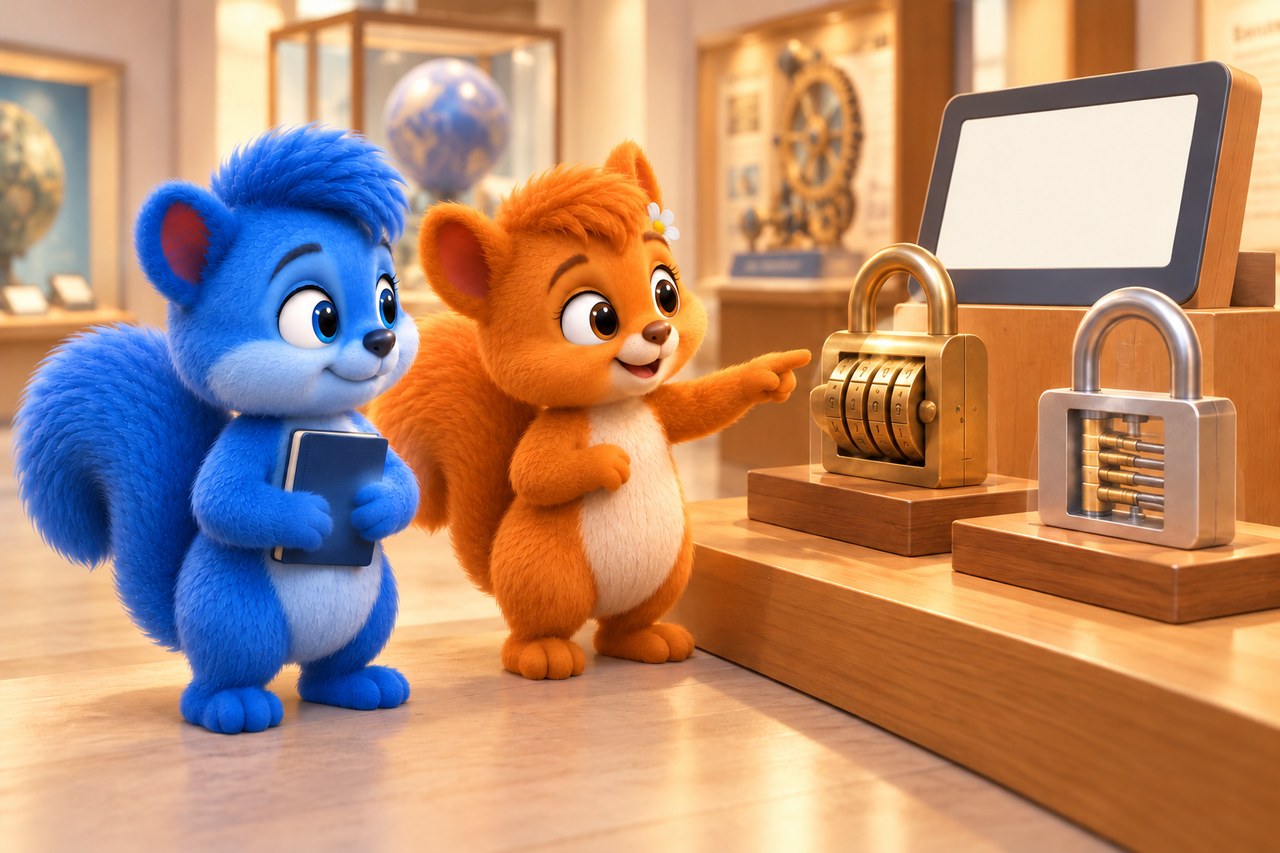
At the museum, Puschel wants one model key to open every door. Flauschi puts different locks beside it. He understands that one lost shared secret could put many doors at risk.
Word help
- Account
- A personal login to a service and its associated data.
- Password manager
- A program that can manage different passwords in protected storage.
Your activity
Compare invented paper cards only: a short name, familiar number sequence and long random mixture. Explain what is easier to predict. Never later use a shown example as a real password.
Quiz: understand the idea
Why is one password for many accounts a poor choice?
Choose a), b) or c), then explain your choice.
- a)A leaked password could endanger several accounts.
- b)Repeating a password makes it longer.
- c)Many accounts automatically make an easy password hard to guess.
Show the explanation
Correct: a): A leaked password could endanger several accounts.
Reuse links the risks: one stolen secret can be tried in several places.
Try a new example
An unfamiliar page asks for your real password. What makes sense?
Choose a), b) or c), then explain your choice.
- a)Enter it if the form shows a picture of a lock.
- b)Enter nothing and check with a trusted adult.
- c)Enter it because a long password cannot be stolen.
Show the explanation
Correct: b): Enter nothing and check with a trusted adult.
A lock picture is not proof of safety. Long passwords can also be requested and misused.
Explore in more detail
Here you will find longer explanations and further details. You can explore them together.
More to discover
What a password cannot replace
Updates, safe devices and care with messages still matter. A password manager can store suitable separate passwords. Its own access also needs protection and adult help.
Pictures and sources for adults
Sources
Museum scene: AI-generated illustration, checked separately from the factual diagram. The diagrams simplify the process. Editorial source check: 19 October 2026.