Why can identical patches look different?
Perception takes the surroundings into account. A checkable comparison separates appearance from properties.
The short answer
The brain interprets signals from the eyes using context and experience. Equal areas can therefore look different. Measuring or comparing them directly can check the impression.
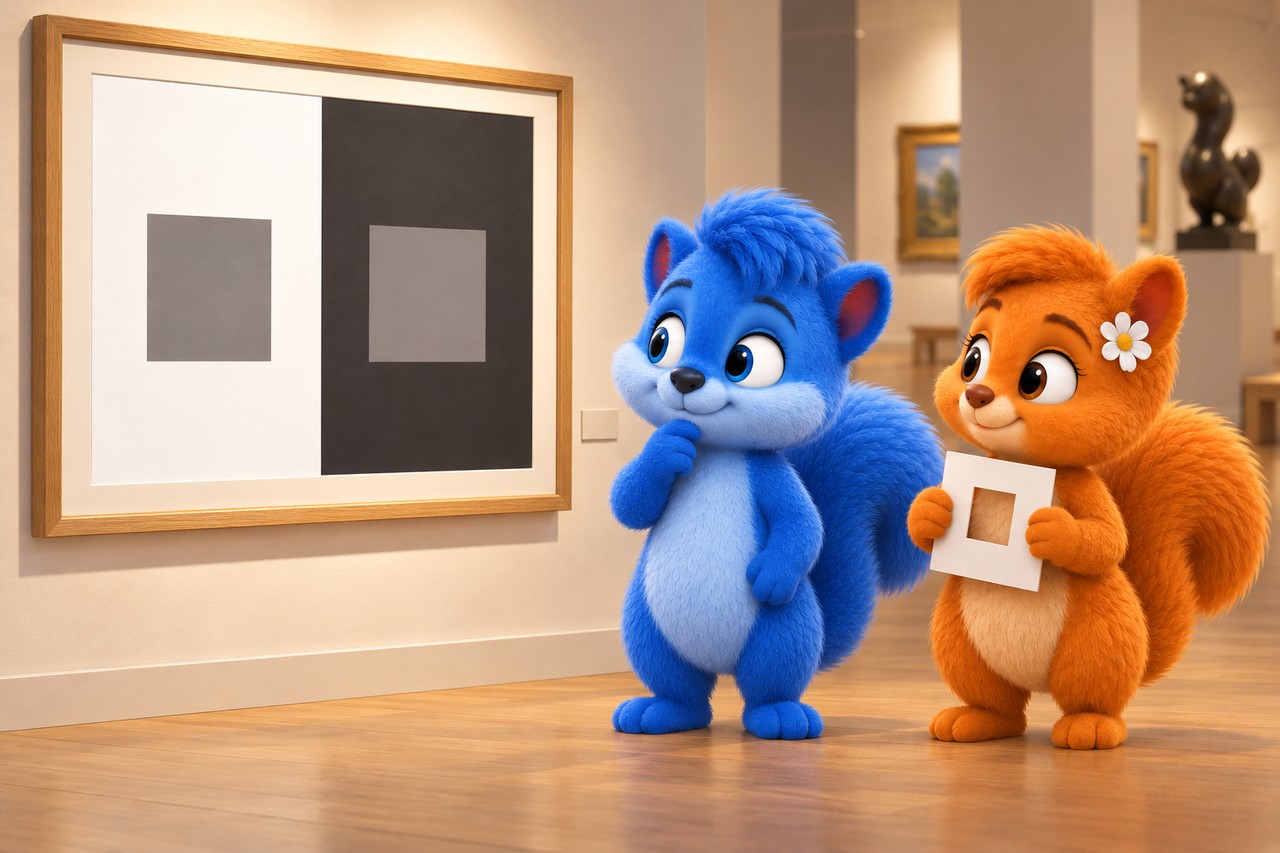
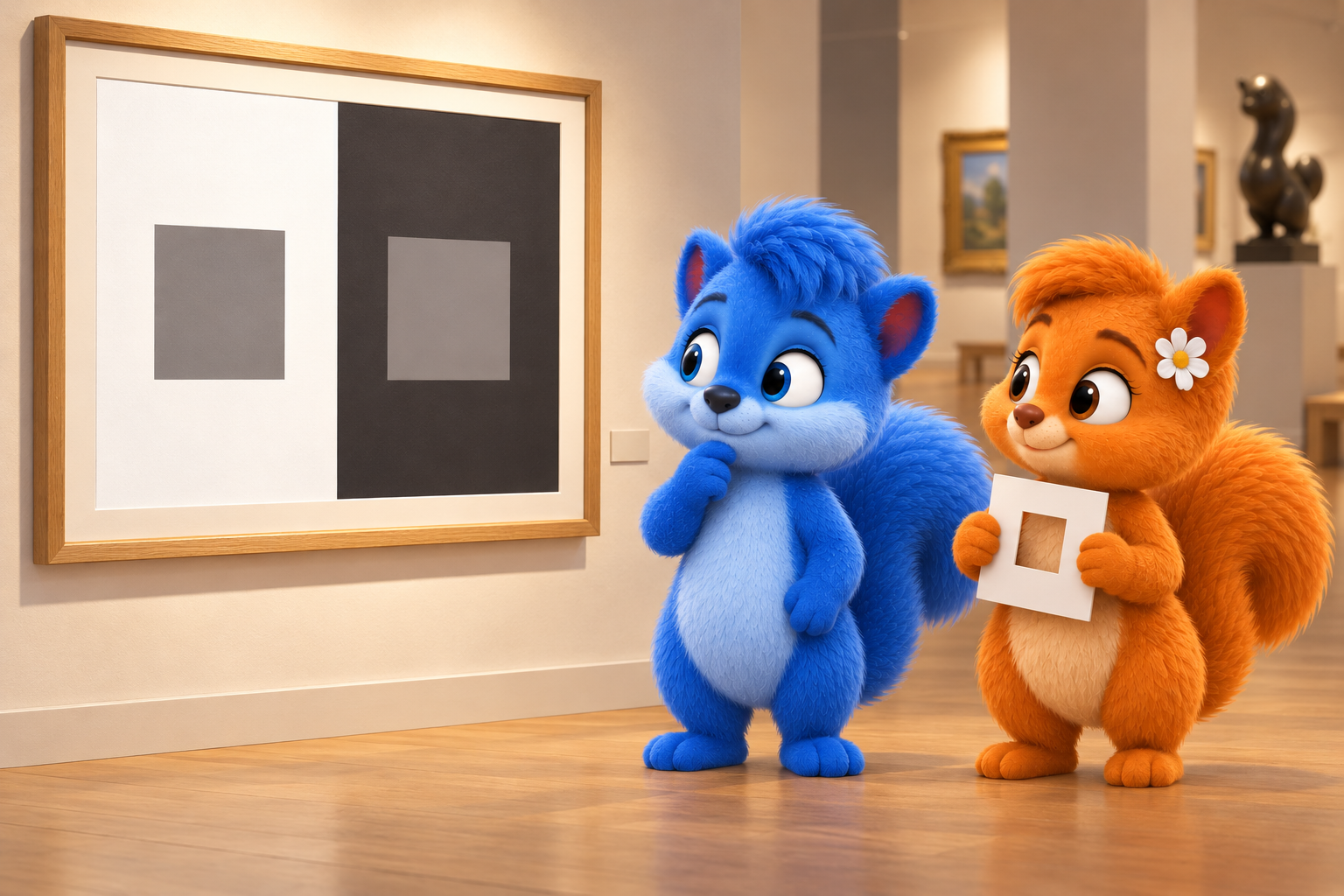
Equal-sized Wusels compare grey patches; Flauschi holds a paper mask. Artistic illustration. Only the native labelled diagram uses precisely identical grey values; the museum scene is not a precise colour test. AI-created illustration, not a photograph of nature.
What the diagram shows
The diagram simplifies the process. First compare its shapes and arrows. You can read its labels in larger text below.
Read the picture labels
These are the words and sentences from the diagram above. The full explanation follows below.
- Same grey values, different surroundings
- Both inner squares: exactly the same colour value #808080.
- They may look different; the image does not move or change.
An imagined Wusel scene
Puschel and Flauschi investigate
Puschel says the right patch is darker. Flauschi covers the surroundings of both patches. Now they look equal. They compare again with and without context and record what changed: the impression, not the patches.
Look closely
Find the two grey patches in the museum picture and Flauschi’s paper mask. Artistic lighting is imprecise. Use the labelled diagram below for a comparison with exactly matching colour values.
An example to help you understand
An adult cuts two equal pieces from the same sheet of grey paper. Place one on white paper and one on dark paper under the same lighting. Swap the grey pieces. Does your impression follow the background? Both pieces still come from the same paper. Shadows and lighting can also matter; this is a comparison, not a full explanation of every illusion.
Try explaining it
How can we check whether two areas really differ in size?
Choose a), b) or c), then explain your choice.
- a)Glance at the shapes against the same background and estimate.
- b)Treat the shape with the brighter edge as larger.
- c)Compare directly or measure.
Show the explanation
Correct: c): Compare directly or measure.
The brain interprets signals from the eyes using context and experience. Equal areas can therefore look different. Measuring or comparing them directly can check the impression.
Word help
- cell
- A tiny living unit. Living things are made of cells.
- retina
- The light-sensitive layer at the back of the eye where signals are produced.
Explore in more detail
Here you will find longer explanations and further details. You can explore them together.
1. Seeing is more than recording
Light enters the eye and reaches the retina, a layer containing light-sensitive cells. Signals are processed there and passed to the brain. Perception results from this processing. Seeing is not simply an unchanged copy of a picture.
Checked against: [3]
2. The surroundings matter
A grey patch can seem lighter on a dark background than on a light one. Contrast is a difference, such as between light and dark. The visual system takes such differences into account. Images affect us differently; the exact causes of some complex illusions are still being researched.
3. Here the patches stay the same
The two inner squares in the labelled diagram have exactly the same colour value. Only their backgrounds differ. The picture does not change as you look. If the squares appear different, the difference is in your impression. The effect may also seem weak to you.
4. Check an impression
Covering the different surroundings often makes comparison easier. A ruler can check drawn lengths; our digital squares have the same specified colour value. An illusion does not mean your eyes are broken. It illustrates a feature of perception.
An optional question for further exploration
You can use the longer explanation above. This is extra, not needed for the first quiz.
An extra question
Does a grey patch really change colour merely because its background changes?
Discover the answer
The same material under the same lighting need not change colour. Its appearance may change because the surroundings affect perception. That is why we compare carefully.
Pictures and sources for adults
Sources for further reading
Facts checked against the specialist sources below on 12 October 2026. The Wusel scene is fictional; comparisons and simplified models are explicitly explained. Sources are in English.