What happens during a visit to the vet?
Share observations, let professionals examine the animal and ask questions: a visit involves cooperation.
The short answer
A vet first asks and observes: what has changed in the animal? Then an appropriate examination follows. Tests or treatment depend on the findings. One sign does not always reveal the cause.
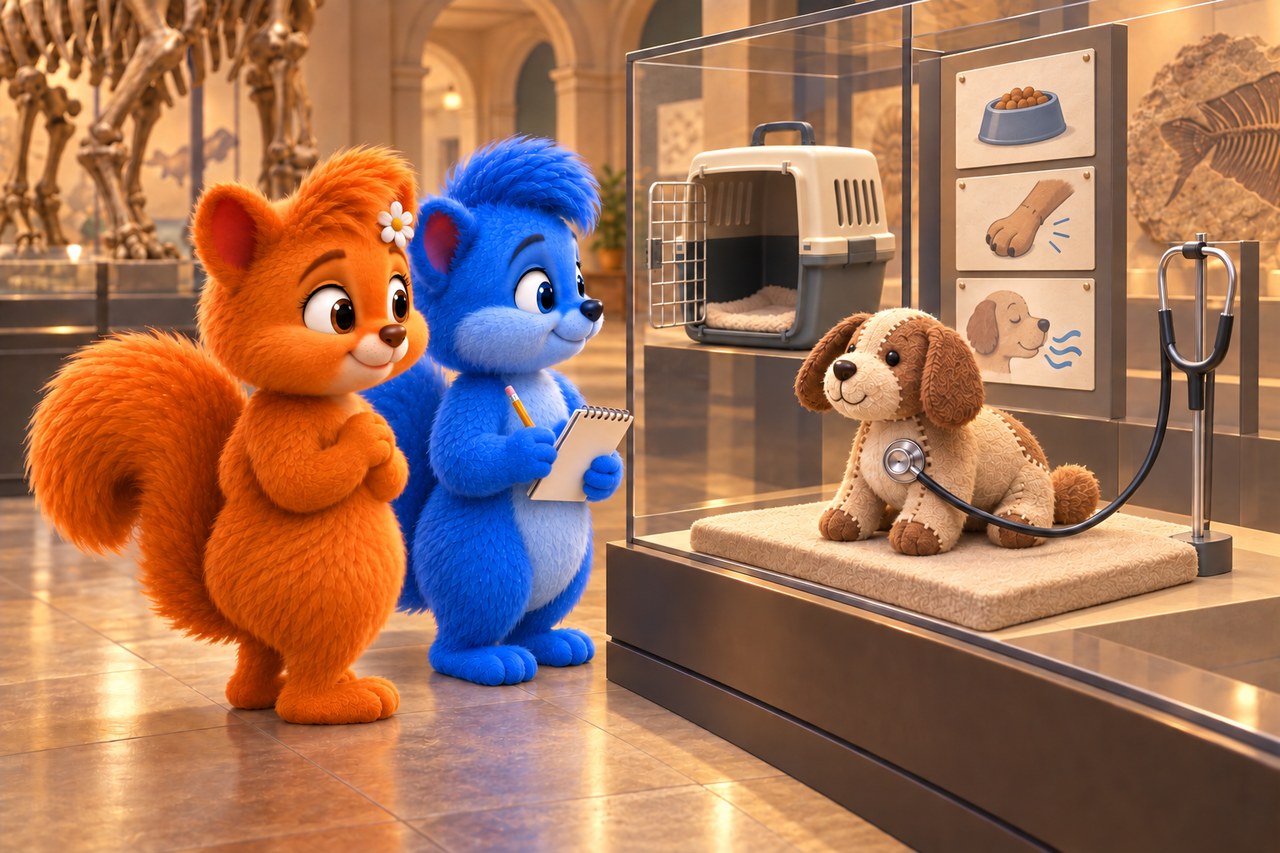
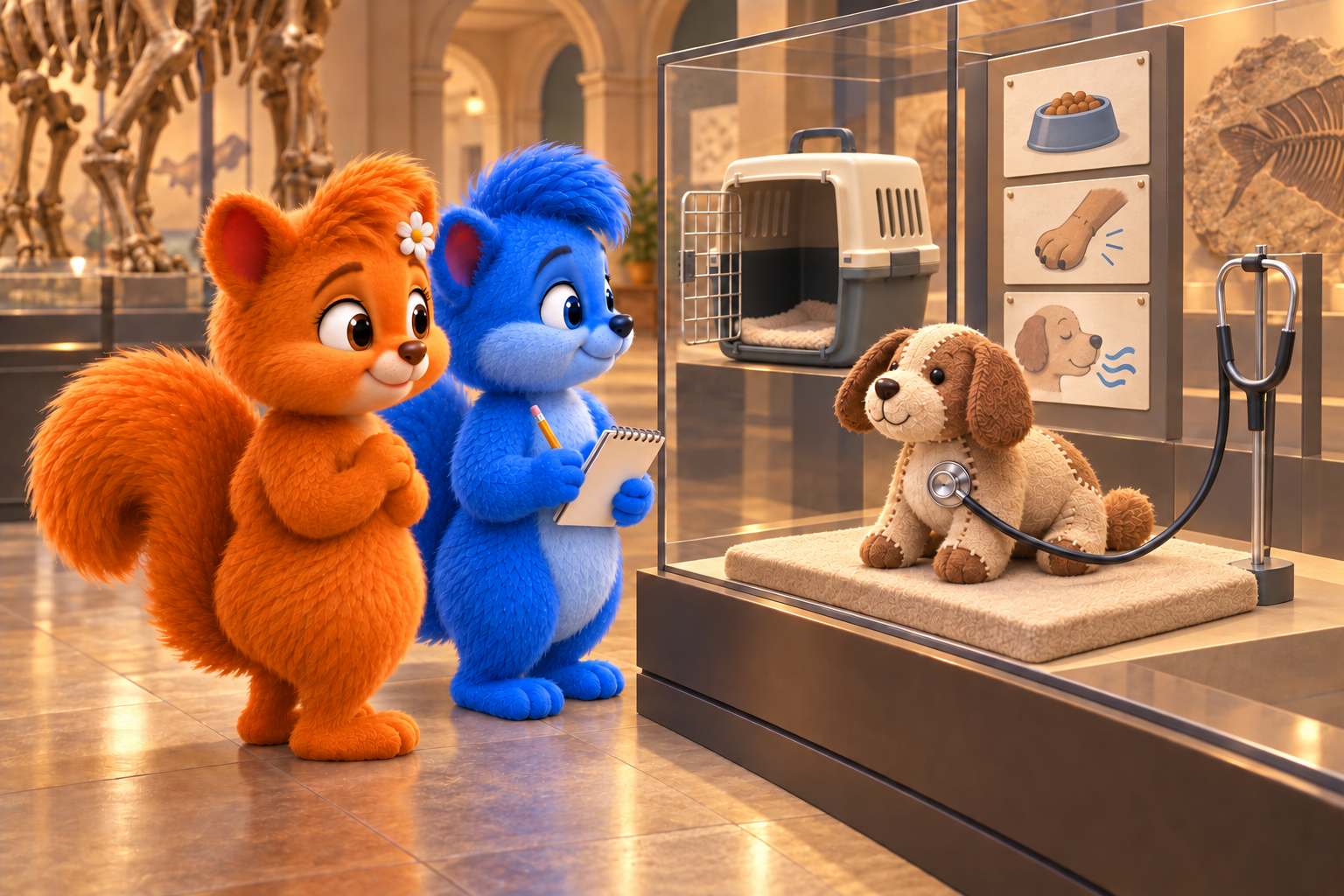
Puschel and Flauschi in the museum. Veterinary learning station with a plush dog, stethoscope chest piece and carrier. A learning model, not treatment of a live animal. AI-created illustration, not a photograph of nature.
Explained in three pictures
1 Report observations
Adults describe what has changed in the animal.
2 Professionals examine
Professionals examine it, for example by listening to heart sounds.
3 Findings and next steps
The practice explains the findings and next steps.
More about the picture
A planned visit connects information from adults, examination and professional decisions. Not every animal needs every test. These examples are not instructions for playing vet with an animal. For illness or injury, adults arrange timely veterinary help.
An imagined Wusel scene
Puschel and Flauschi investigate
In their pretend game, Puschel immediately points to a medicine picture. Flauschi puts observation cards first: what changed, when, and what was examined? They reorder the cards. Their sequence now begins with listening instead of a guessed treatment.
Look closely
Compare the museum model with the three picture steps. Professionals examine it, for example by listening to heart sounds.
An example to help you understand
Find three objects in the museum case: carrier, stethoscope and soft toy dog. On permitted paper draw one and collect questions with adults. For example: “How can an animal travel safely to the practice?” or “Who decides on an examination?” The toy dog remains an exhibit. Never act out an examination on a real animal.
Try explaining it
Why is an animal examined appropriately before treatment?
Choose a), b) or c), then explain your choice.
- a)One sign does not always reveal the cause.
- b)A similar sign has the same cause in different animals.
- c)Treatment can be chosen from the animal's name without further observation.
Show the explanation
Correct: a): One sign does not always reveal the cause.
A vet first asks and observes: what has changed in the animal? Then an appropriate examination follows. Tests or treatment depend on the findings. One sign does not always reveal the cause.
Explore in more detail
Here you will find longer explanations and further details. You can explore them together.
1. Veterinary medicine has many tasks
Veterinarians help prevent, recognise and treat animal disease. Their work also includes animal protection. Some work in small-animal practices, others with horses, in research or in public veterinary services. Veterinary means concerned with animal medicine; public services carry out official work for animal health and welfare. Not every practice treats every species. Adults therefore check which practice suits a particular animal.
2. Observations and questions help
For a planned visit, adults can write down important observations and questions. What changed, and when was it noticed? This describes an observation rather than diagnosing a disease. The practice decides which examinations are needed. Children may ask suitable questions; professionals and responsible adults bear responsibility for medical decisions. A stethoscope can help listen to heart sounds and rhythm. Ultrasound can show moving images of the heart, while an ECG records its electrical activity. ECG means electrocardiogram: it shows the electrical signals controlling the heartbeat as curves. These tools answer different questions. The vet chooses what the particular animal needs examined; not every visit requires every device.
3. A quieter journey may help
Unfamiliar smells, sounds and other animals can make a practice visit difficult. For planned visits, discuss with the practice how transport and waiting could work better. Cats can calmly become familiar with a suitable carrier beforehand. In waiting areas, never crowd unfamiliar animals; leave them in their designated safe spaces. Not every animal reacts identically.
Checked against: [3]
4. Getting help comes before an activity
Preparation concerns planned visits. If an animal is ill or injured, necessary help must not be delayed by preparation. For suspected poisoning, adults contact the veterinary practice immediately and follow its instructions. Never attempt your own treatment. The museum’s soft toy explains the difference between a learning object and a real animal needing expert care.
An optional question for further exploration
You can use the longer explanation above. This is extra, not needed for the first quiz.
An extra question
May we simply give a sick animal a human medicine?
Discover the answer
No. Medicines and treatments belong under veterinary responsibility. For illness, injury or suspected poisoning, adults contact the practice and follow professional instructions. A learning game cannot replace an examination.
Pictures and sources for adults
Sources for further reading
Facts checked against the specialist sources below on 12 October 2026. The Wusel scene is fictional; comparisons and simplified models are explicitly explained. Sources are in English.