Video editing: clips become a sequence
Which shot comes first? How long does it stay visible? Editing involves decisions for our story.
The short answer
Film a closed door, then a waving hand. Shown in that order, it may seem that someone is waving behind that door. Video editing means choosing and arranging shots.
Their order changes what viewers understand, so we make clear what really belongs together.
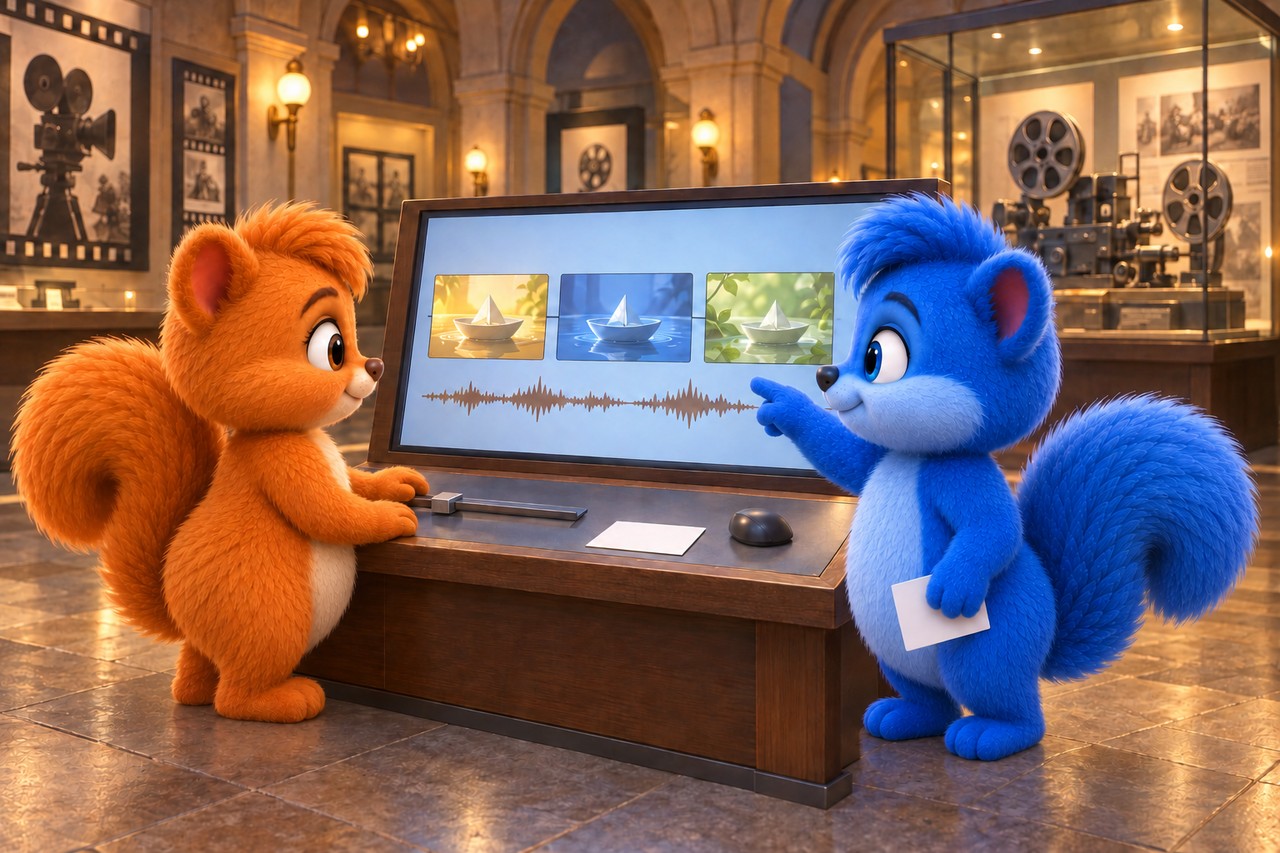
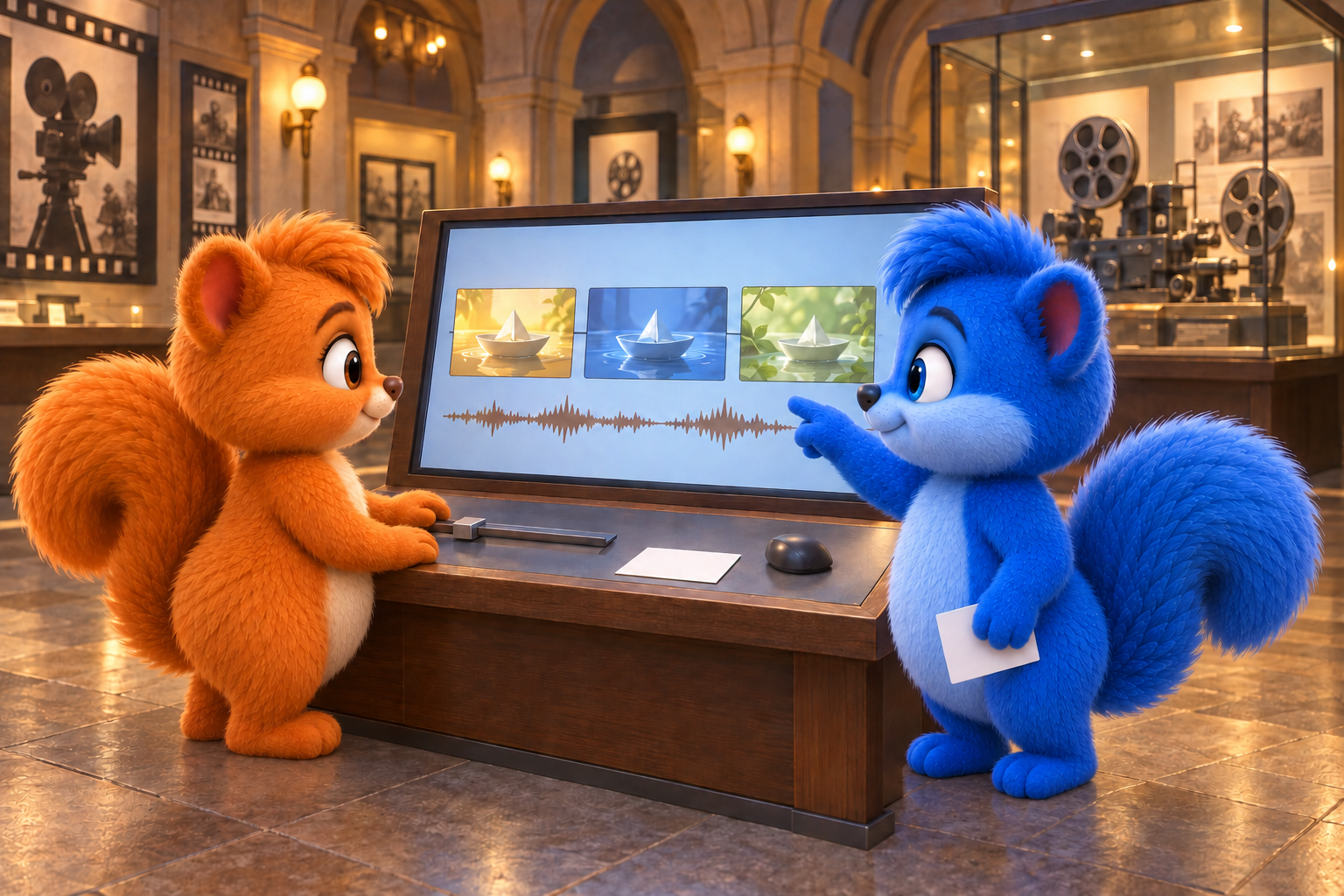
Flauschi and Puschel examine a simplified picture sequence and audio track at a museum editing station. Original learning scene with a symbolic timeline; no exact editing-software interface. AI-created illustration, not a photograph of nature.
What the diagram shows
The diagram simplifies the process. First compare its shapes and arrows. You can read its labels in larger text below.
Read the picture labels
These are the words and sentences from the diagram above. The full explanation follows below.
- Three clips on a timeline
- A: Paper
- 2 seconds
- B: Folding
- 4 seconds
- C: Boat
- 2 seconds
- Two plus four plus two: eight seconds altogether
- Audio track: consider and check it separately from pictures.
- Order and duration influence the story.
- Preserve originals; watch the whole draft.
- Original timeline with no extra transitions; the audio line is a symbol.
An imagined Wusel scene
Puschel and Flauschi investigate
Puschel places a reaction before the event it answered. Flauschi understands a different connection. They restore the original order and compare both versions. Editing changed their interpretation, not the recorded event.
Look closely
Puschel and Flauschi stand at a permitted editing station in the film museum. The screen shows a simplified sequence of three picture fields with a separate audio track below. Flauschi examines the controls; Puschel holds a small paper card.
An example to help you understand
Original paper plan: clip A shows a paper sheet, B the folding and C the finished paper boat. In our imaginary timeline A lasts two seconds, B four and C two: eight seconds altogether, with no extra transitions. Swap B and C: now we see a result before its creation. This can deliberately work as a flashback but should remain understandable to viewers.
Try explaining it
What can changing the order of shots change?
Choose a), b) or c), then explain your choice.
- a)What viewers understand or infer.
- b)What actually happened in front of the camera at the time.
- c)The camera position in footage already recorded.
Show the explanation
Correct: a): What viewers understand or infer.
Film a closed door, then a waving hand. Shown in that order, it may seem that someone is waving behind that door. Video editing means choosing and arranging shots.
Their order changes what viewers understand, so we make clear what really belongs together.
Explore in more detail
Here you will find longer explanations and further details. You can explore them together.
1. Select and connect shots
A shot is a continuous recording section without a cut. Editing selects shots or parts of them and connects them into a sequence. Selection and order guide attention and may shape mood and action. Recording and later assembling are different stages of work.
Checked against: [1]
2. Set suitable beginnings and endings
Here, a clip means a video excerpt we work with. Trimming adjusts its used beginning or ending. Check whether an action remains understandable and an unwanted pause should be shortened. Save another version before major changes, so earlier drafts remain available for comparison.
Checked against: [2]
3. Order changes understanding
Connecting two shots may suggest meaning that one picture alone does not show. A reaction after an object, for example, may appear to concern it. Check what connection your edit creates. An image sequence alone cannot prove a real cause-and-effect relationship.
Checked against: [1]
4. Check picture, sound and the final file
A timeline orders clips in sequence; sound can be edited too. After selecting and trimming pictures, original sounds, permitted narration and credits may be added. Export means creating a playable finished file from the project. Check it again from beginning to end.
Checked against: [3]
An optional question for further exploration
You can use the longer explanation above. This is extra, not needed for the first quiz.
An extra question
Why check more than individual shots when editing a video?
Discover the answer
Because order, duration and sound influence the connections viewers understand. A clear shot by itself may gain a new meaning in another sequence. Check the whole draft and preserve the originals.
Pictures and sources for adults
Sources for further reading
Facts checked against the specialist sources below on 12 October 2026. The Wusel scene is fictional; comparisons and simplified models are explicitly explained. Sources are in English.