How does a carved shape emerge?
Explore the difference between removing and adding material — without using a blade yourself.
The short answer
Carving removes wood bit by bit until a shape remains. Grain direction affects how the wood separates. Plan first and learn only with a knowledgeable adult and suitable tools.
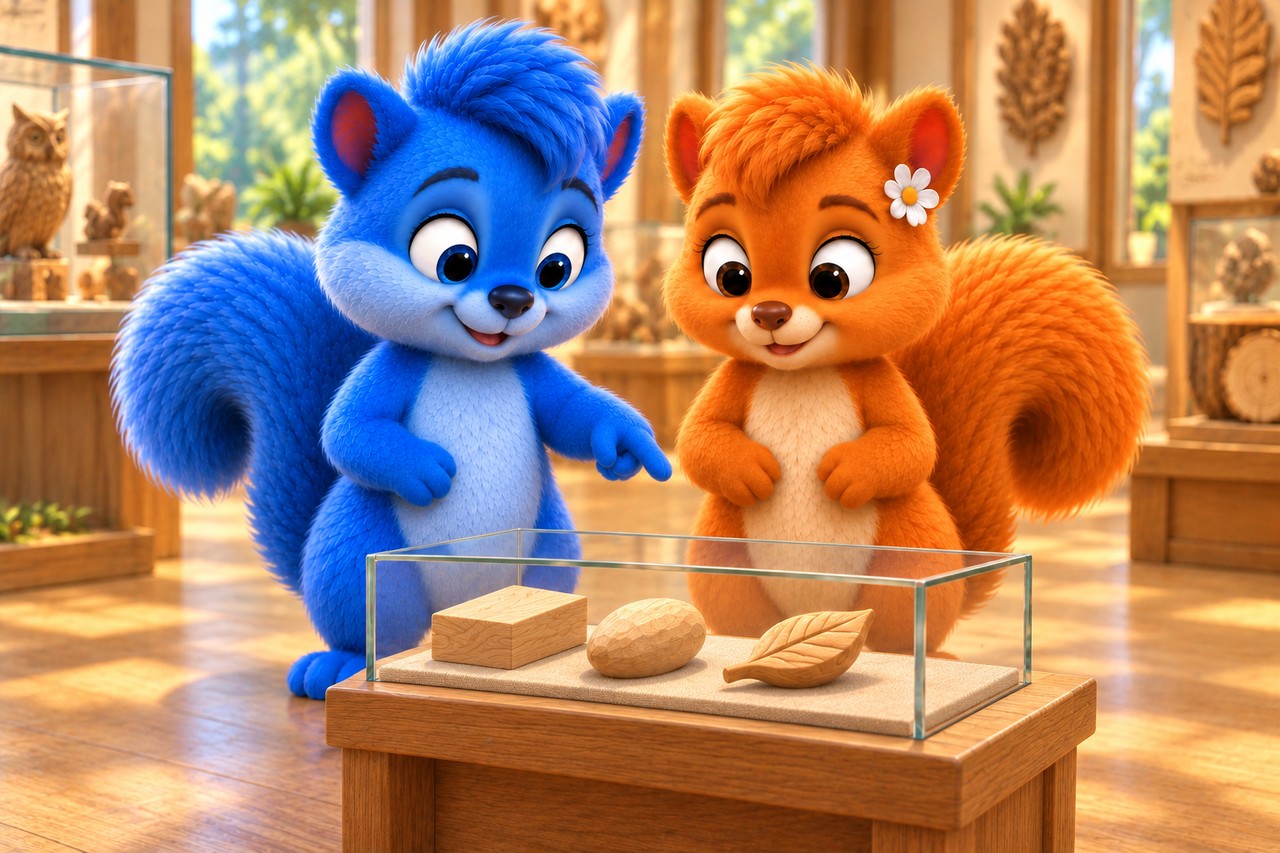
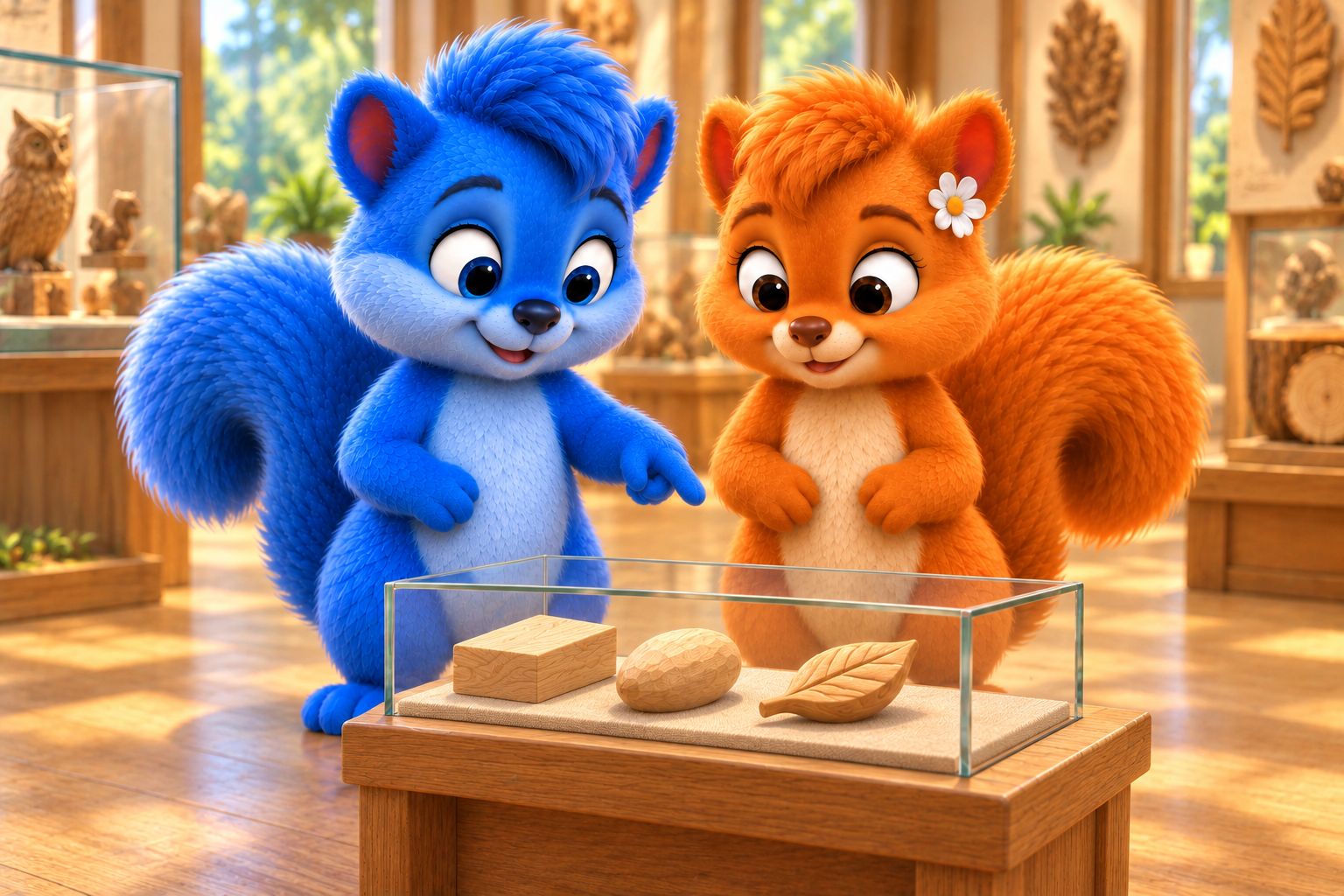
Puschel and Flauschi examine wooden blanks and a small finished wooden shape under a glass cover at a craft museum. Invented exhibit; not a tool, gripping or carving guide. AI-created illustration, not a photograph of nature.
What the diagram shows
The diagram simplifies the process. First compare its shapes and arrows. You can read its labels in larger text below.
Read the picture labels
These are the words and sentences from the diagram above. The full explanation follows below.
- Carving: remove material, a shape remains
- Design in an imagined blank
- Imagined remaining shape
- Hatched: imagined removal
- Clear: should remain
- The shape on the right matches the clear area on the left.
- Paper design and comparison only; no wood is worked.
- A flat view: a real wooden form also has depth.
- No blade, grips or cutting directions shown; not a tool lesson.
- Invented shape without dimensions; hatching does not show wood grain.
An imagined Wusel scene
Puschel and Flauschi investigate
Puschel first marks the desired outline on a soft model. Flauschi shows which parts would need removal. They notice removed material does not simply grow back. Before real tool use, they discuss the plan and rules with Lumi.
Look closely
At an invented craft museum, Puschel and Flauschi see a wood blank and already-shaped exhibits under glass. Nobody uses a tool. These illustrative objects show neither a verified working sequence nor safe gripping techniques.
An example to help you understand
Draw a large rectangle as an imagined wood blank: a starting piece not yet finished. Inside it, draw a simple rounded leaf shape that fits completely. Hatch the area between the leaf and rectangle edge: hatching means drawing short lines beside one another. Here the hatching represents imagined material that would be removed. The clear inner area should remain. Draw that remaining shape beside it. You need neither scissors nor a knife; this shows flat planning only, not a carving technique.
Try explaining it
How does carving create a shape?
Choose a), b) or c), then explain your choice.
- a)Only compress the wood until a new shape stays.
- b)Shape it by adding more layers of wood.
- c)Material is deliberately removed.
Show the explanation
Correct: c): Material is deliberately removed.
Carving removes wood bit by bit until a shape remains. Grain direction affects how the wood separates. Plan first and learn only with a knowledgeable adult and suitable tools.
Explore in more detail
Here you will find longer explanations and further details. You can explore them together.
1. The shape is worked out of the material
Woodcarving deliberately removes wood until a desired shape remains. This is called subtractive shaping: material is taken away. Modeling, by contrast, may add and press together soft material. A carved shape therefore does not emerge by gluing shavings onto it. A shaving is a small removed piece of wood. Not every sculpture is carved; there are different ways to create a three-dimensional object.
2. A plan identifies what should remain
Artists consider which shape fits within the starting piece before removing material. A sketch is a simple design drawing. It can show outlines and important areas. An outline is a shape’s outer boundary in one view. Removed material no longer belongs to the original piece; it cannot simply be pushed back. Checking the design gradually therefore makes sense. Our paper idea shows a flat view. A real wooden figure also has depth and needs planning from several sides.
3. Wood has direction
Wood is not identical throughout. Grain direction describes the orientation of its elongated structures. This path may be straight, wavy or irregular. It affects workability; unfavourable grain can cause tearout. Tearout means more material breaks out than intended. Knowledgeable people therefore consider both material and grain. An attractive visible pattern alone cannot tell us how to guide a tool safely. Our learning picture represents planned removal only, not a cutting direction.
4. Small changes and calm checking
In skilled work, small amounts are deliberately removed and the shape is examined repeatedly. Pressing too hard can cause loss of control; faster is therefore not automatically better. Wood type, suitable tools, a safe workspace and instruction belong together. Not every found wood species suits every project. The finished shape may later be smoothed. Today we compare only the design and remaining shape on paper. Understanding the principle does not establish safe tool handling.
An optional question for further exploration
You can use the longer explanation above. This is extra, not needed for the first quiz.
An extra question
Does a carved shape mainly emerge by gluing material onto a blank?
Discover the answer
No. Carving removes material so the planned shape remains. Modeling may instead add material. Our hatched paper area represents imagined removal; the drawing is not instructions for using a blade.
Pictures and sources for adults
Sources for further reading
Facts checked against the specialist sources below on 12 October 2026. The Wusel scene is fictional; comparisons and simplified models are explicitly explained. Sources are in English.