Why do tigers have stripes?
The pattern helps with camouflage. Specialists can also recognise individual tigers by their stripes.
The short answer
Dark stripes break up a tiger's visible outline among plants, light and shadow. This can help it stay unnoticed. Against another background, the same stripes may stand out.
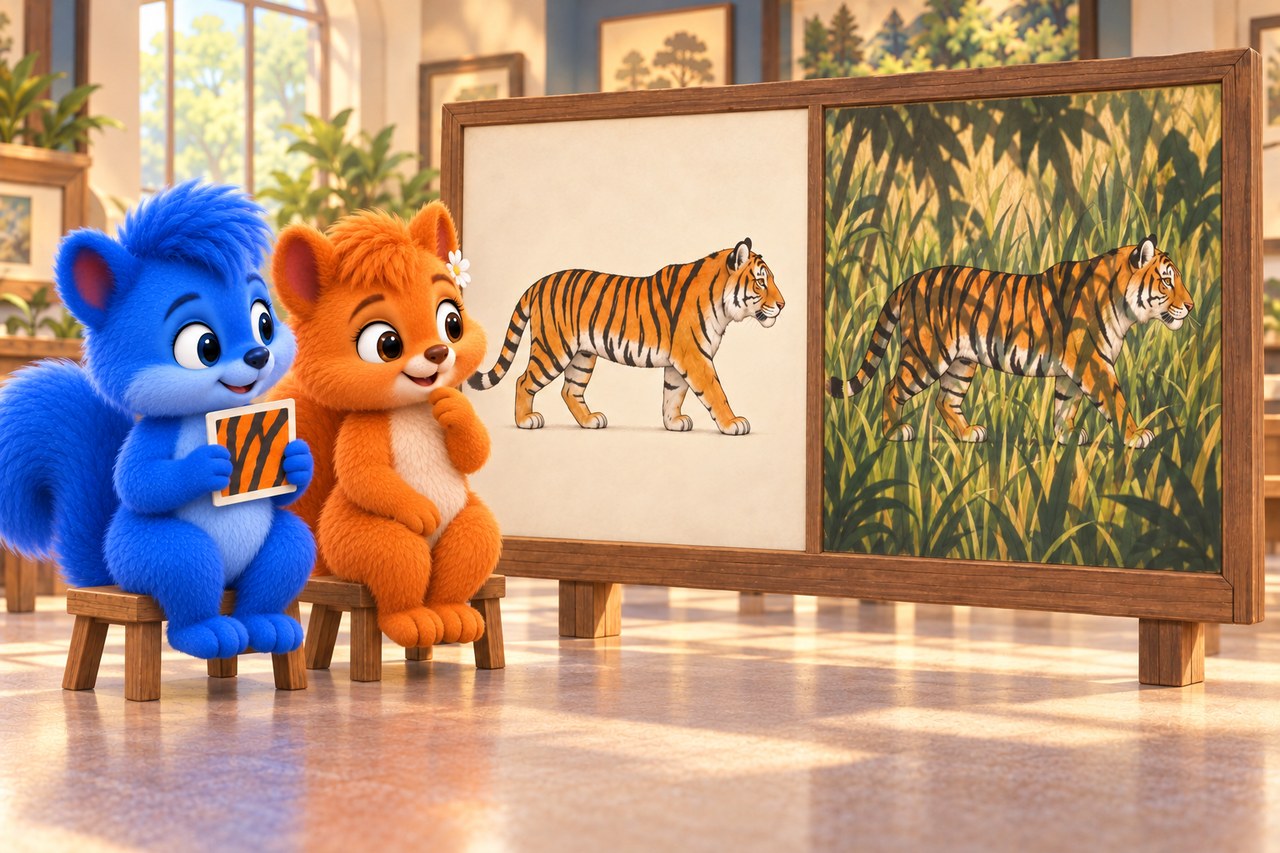
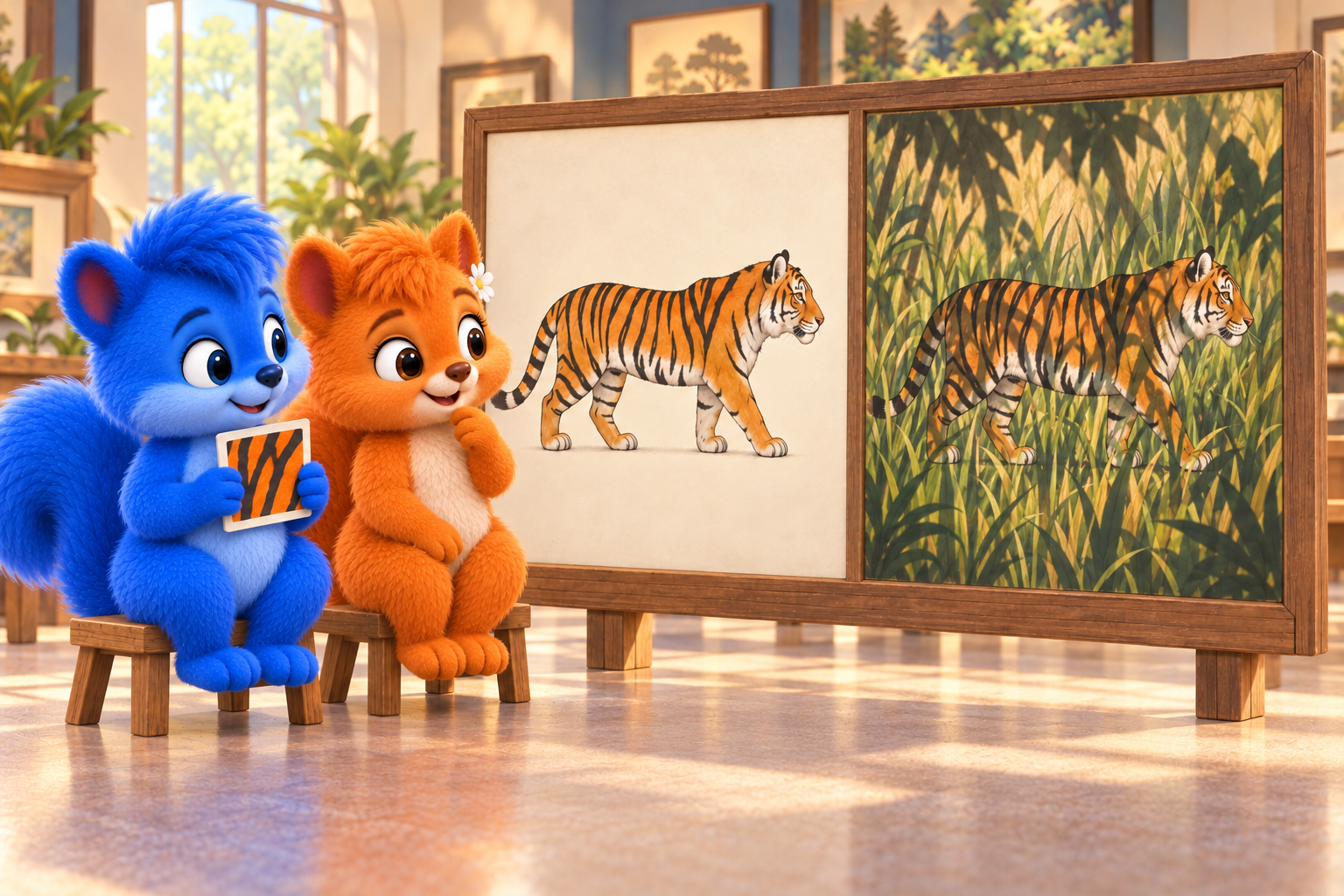
Puschel and Flauschi in the museum. The same tiger against a plain background and among plants and shadows. Simplified inanimate museum model; arrows and colours help explain it. AI-created illustration, not a photograph of nature.
Explained in three pictures
1 Against a plain background
Against a plain background, the tiger’s outline is easy to see.
2 Against stripes and shadows
Among plants and shadows, stripes break up the visible outline.
3 Same tiger, different view
Camouflage makes recognition harder. It does not make the tiger invisible.
More about the picture
Stripes help break up the outline among plants, shadows and light. This can support camouflage; it does not make a tiger invisible. This original drawing illustrates the principle, not how a particular prey animal sees the tiger.
An imagined Wusel scene
Puschel and Flauschi investigate
Puschel finds the stripes conspicuous in the tiger picture. Flauschi places the same outline against plants and shadows. They search for its edge. He takes longer and notices how much the background changes the impression.
Look closely
Compare the museum model with the three picture steps. Among plants and shadows, stripes break up the visible outline.
An example to help you understand
Draw three equally sized orange paper cards: one plain, one with straight black stripes and one with branching stripes. Place them in turn against a light and a busy patterned paper background. What do you notice? Then compare just the pattern cards with each other. This is an original design activity, no proof of how a prey animal sees a real tiger.
Try explaining it
What can tiger stripes help with?
Choose a), b) or c), then explain your choice.
- a)They instantly change to match the ground colour at each step.
- b)Making the outline less conspicuous among plants and shadows.
- c)They reveal the exact body outline to prey among shadows.
Show the explanation
Correct: b): Making the outline less conspicuous among plants and shadows.
Dark stripes break up a tiger's visible outline among plants, light and shadow. This can help it stay unnoticed. Against another background, the same stripes may stand out.
Word help
- tides
- The regular rise and fall of seawater caused by the interplay of gravity and motion.
Explore in more detail
Here you will find longer explanations and further details. You can explore them together.
1. Stripes can break up an outline
A tiger usually has orange fur with dark stripes and lighter body areas. Among plants, light and shade, stripes can make its body outline less distinct. This camouflage can help when stalking prey. It does not make a tiger invisible: background, movement and viewing angle also matter.
Checked against: [1]
2. Each tiger has its own pattern
Stripes are not arranged identically on every tiger. Specialists compare suitable images to recognise individuals. This helps observation over time. Our drawn pattern cards merely explain comparison. They depict no real tigers and cannot prove which animal appears in a photograph.
3. Tigers do not live only in warm jungle
Wild tigers occur in parts of Asia. Habitats include tropical forests, mangrove areas and cooler forests in northeast Asia. Mangroves are trees and shrubs growing along warm sea coasts in areas reached by tides. Tides are the regular rise and fall of sea level. Adult tigers often spend time alone; mothers live with their cubs. “Solitary” therefore does not mean a tiger never meets another tiger. Sounds and scents are part of their communication.
4. Protection needs connected habitats
Tigers need suitable habitats and prey. Poaching, habitat loss and fragmentation, and conflict with people threaten them. With partners, Panthera works to protect and connect habitats and prevent poaching, among other efforts. Local communities belong in such solutions. An animal picture alone cannot protect a forest, but may help discuss these connections.
Checked against: [3]
An optional question for further exploration
You can use the longer explanation above. This is extra, not needed for the first quiz.
An extra question
Do all tigers have exactly the same stripe pattern?
Discover the answer
No. Their stripe patterns differ. Specialists can compare suitable images and recognise individual tigers by them. An imaginary pattern card cannot replace such images.
Pictures and sources for adults
Sources for further reading
Facts checked against the specialist sources below on 12 October 2026. The Wusel scene is fictional; comparisons and simplified models are explicitly explained. Sources are in English.