Earth & Space
Is the Sun a star too?
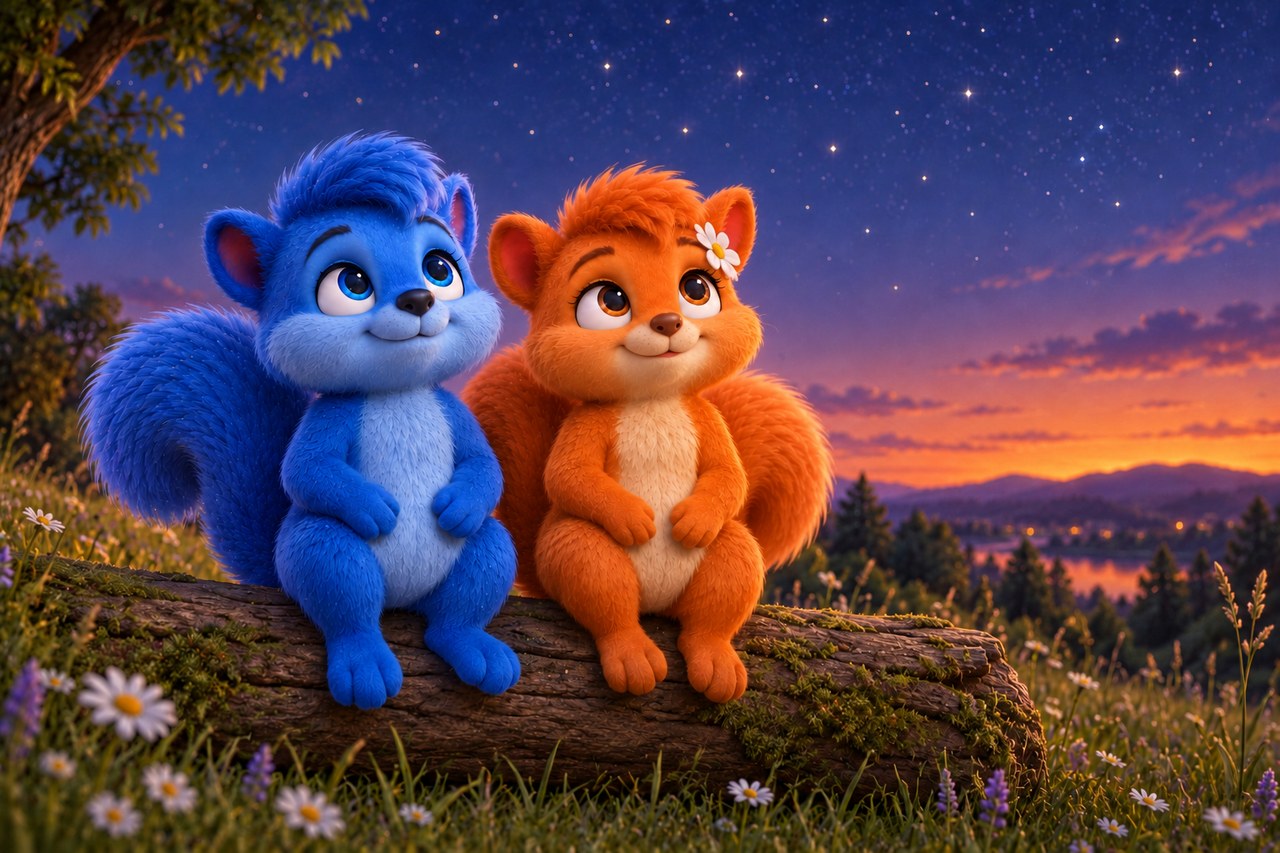
After sunset, the two marvel at distant starlight.
The short answer
Yes. The Sun is a star and produces its own light. Energy released inside eventually reaches the outside as light and heat. Other stars look small because they are much farther away.
An imagined Wusel scene
Puschel and Flauschi investigate
After sunset, the two sit on a log. The first lights appear in the sky. Puschel“The Sun looked much bigger than these dots.”
Flauschi“The Sun is a star itself. It is just much closer to us.”
Puschel“So some dots are huge distant suns?” Flauschi“Yes, other stars can be enormous. We also sometimes see planets in the sky.”
They leave the torch off. Gradually they notice more points of light.
Puschel“Distance makes things look very small.” Flauschi“To our eyes. The stars themselves are not shrinking.”
Little Wusel quiz
What is the Sun?
Choose one answer: a), b).
- a)A star.
- b)A planet.
Show answer
Correct answer: a): A star. The Sun is a star.
Is every point of light in the sky a star?
Choose one answer: a), b).
- a)No.
- b)Yes.
Show answer
Correct answer: a): No. No. We can also see planets, aircraft or satellites. A star chart helps identify them.
Word help
- oxygen
- A gas in air that our bodies take in through breathing and need for their work.
Explore in more detail
Here you will find longer explanations and further details. You can explore them together.
Understand step by step
How it works – simply explained
A star shines itself
The Sun is a huge ball of hot gas and plasma. In plasma, electrons have separated from atoms. Electrons are tiny electrically charged particles.
Energy begins inside
Small atomic nuclei, the tiny centres of atoms, merge. This nuclear fusion releases energy that eventually reaches the outside as light and heat.
Distance changes appearance
Other stars are much further away and appear as dots. The Sun looks large and bright because it is nearer. It is a star, not a lamp-like planet.
Why the Sun is not a campfire
A wood fire involves substances reacting with oxygen in air. Energy in the Sun mainly comes from nuclear fusion, where small atomic nuclei merge. Atoms are tiny building blocks of substances with a central nucleus. This differs from burning wood: no stockpile of wood or campfire-like air flow is needed. Never look at the Sun, including through magnifiers or binoculars.
References for this explanation: [1], [2]
Additional specialist reference: NASA: Sun Facts
The key points again
Discovery 1
The Sun is a star and is much closer to Earth than any other star.
Discovery 2
Inside the Sun, tiny particles join together. This releases energy. The process is called nuclear fusion. The energy eventually travels outwards as light and heat.
Source: [1]
Discovery 3
Other stars mostly look like tiny points of light because they are very far away.
Source: [2]