Earth & Space
Who are Earth’s planetary neighbours?
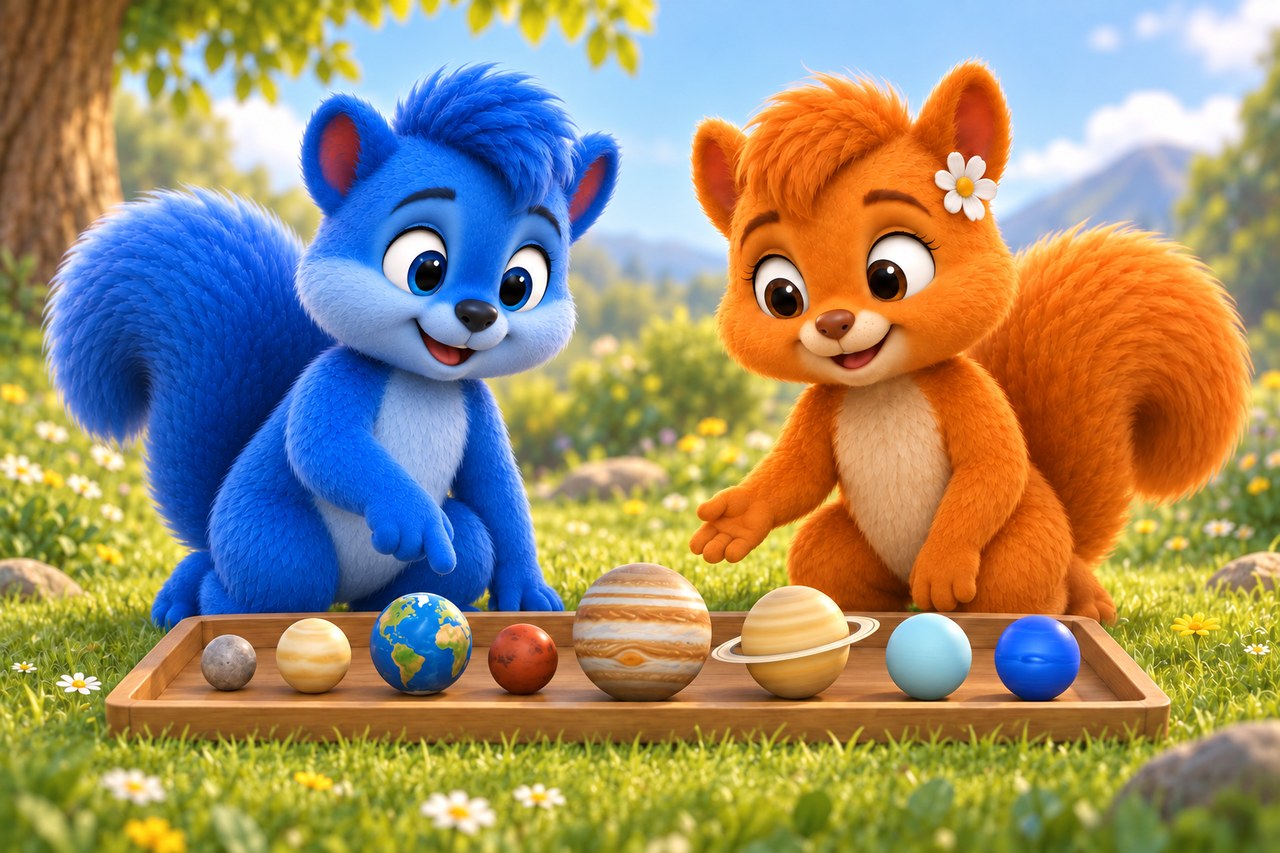
Eight model planets are waiting for their places.
The short answer
Eight planets orbit our Sun: Mercury, Venus, Earth, Mars, Jupiter, Saturn, Uranus and Neptune. Earth is third from the Sun. Planets do not shine like stars; they reflect sunlight.
An imagined Wusel scene
Puschel and Flauschi investigate
Eight model balls lie before the two. Puschel“A game of space marbles?”
Flauschi“A model of our planets. These sizes and distances do not match the real solar system.”
They arrange Mercury, Venus, Earth and Mars. Puschel“Our Earth is third from the Sun.”
Jupiter, Saturn, Uranus and Neptune come next. Flauschi“Eight planets. Today we call Pluto a dwarf planet.”
Puschel studies large Jupiter. Puschel“What different neighbours!” Together they say the order slowly once more.
Little Wusel quiz
Which planet is third from the Sun?
Choose one answer: a), b).
- a)Earth.
- b)Mars.
Show answer
Correct answer: a): Earth. Earth is third from the Sun.
Which is the largest of the eight planets?
Choose one answer: a), b).
- a)Jupiter.
- b)Saturn.
Show answer
Correct answer: a): Jupiter. Jupiter is the largest planet in our solar system.
Word help
- orbit
- The path of one body around another.
Explore in more detail
Here you will find longer explanations and further details. You can explore them together.
Understand step by step
How it works – simply explained
A family around the Sun
Eight planets follow orbits around the Sun. An orbit is a repeatedly followed path through space.
Earth belongs too
From the Sun come Mercury, Venus, Earth, Mars, Jupiter, Saturn, Uranus and Neptune. Neighbours here are not close together.
Pictures use different scales
Some planets are far larger than Earth and distances are enormous. A picture showing them together usually is not to scale. Pluto is classified as a dwarf planet.
Why a line in a book is not a real sky view
Learning pictures line planets up for comparing names. Real planets move on different orbits and are not constantly arranged like beads on a string. True sizes and distances rarely fit together on a page. Ordering them from the Sun explains their orbits, not today’s view of the sky.
The key points again
Discovery 1
Our solar system has eight planets. Outwards from the Sun: Mercury, Venus, Earth, Mars, Jupiter, Saturn, Uranus and Neptune.
Source: [1]
Discovery 2
Earth is the third planet from the Sun. All eight planets orbit the Sun.
Discovery 3
Pluto is a dwarf planet. The planets have different sizes; Jupiter is the largest of the eight.