How does a submarine dive and surface?
A submarine can stay underwater and return to the surface. Weight and buoyancy act together.
The short answer
A submarine can let water into special tanks, increasing its weight without greatly changing its size. It dives. Pushing water out with air makes it lighter so it can rise. Buoyancy is the water's upward force.
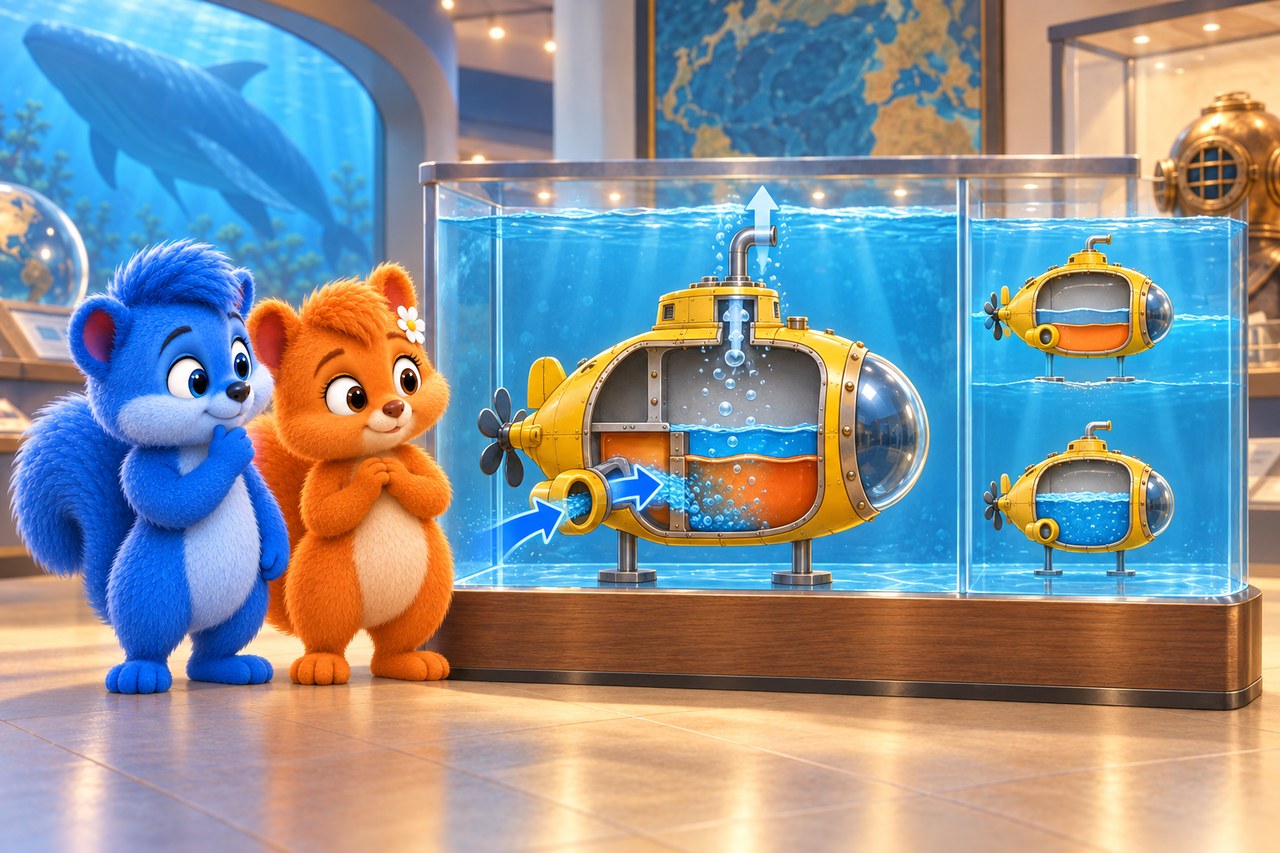
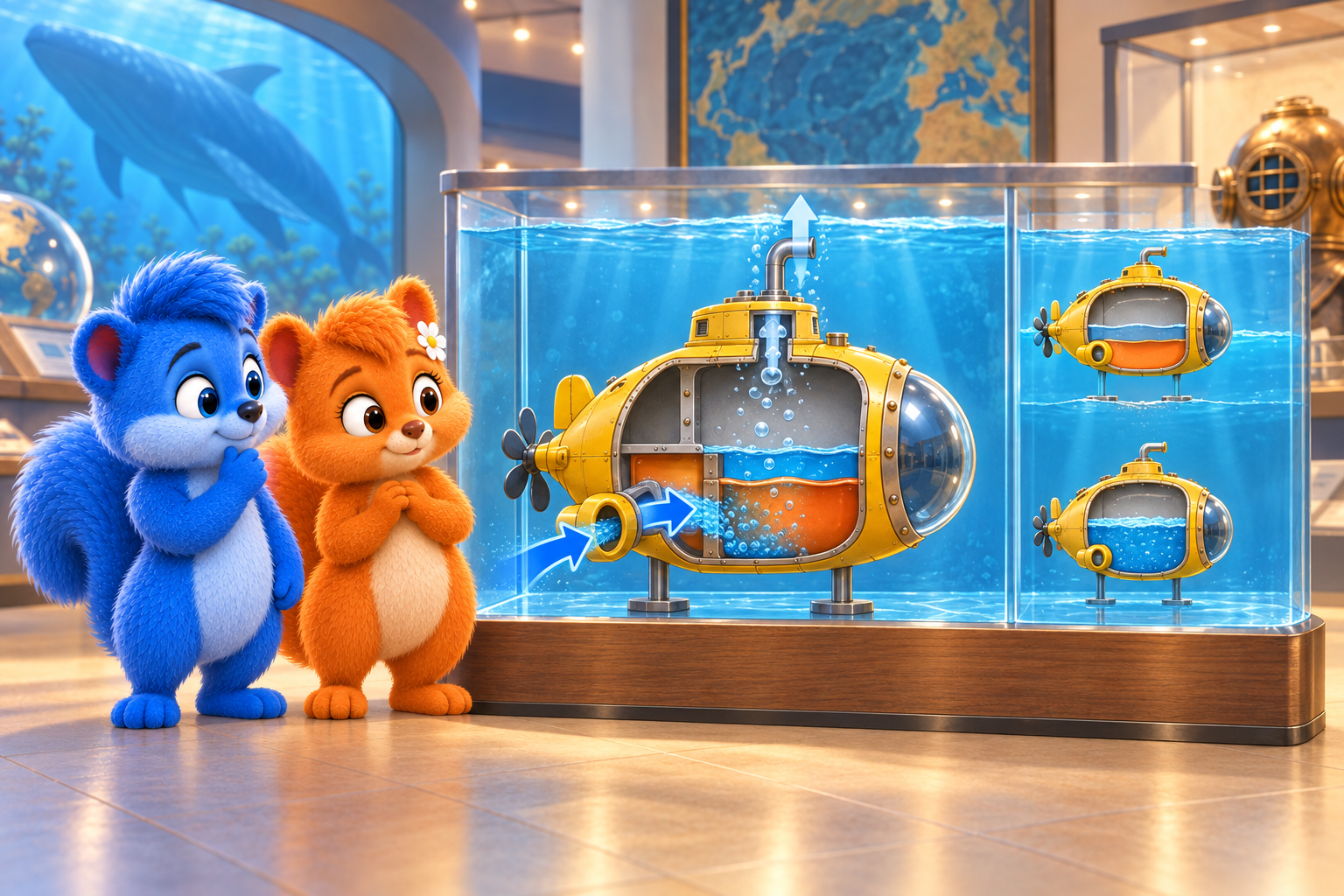
Puschel and Flauschi in the museum. Submarine cutaway with water in the ballast tank and escaping air. Simplified inanimate museum model; arrows and colours help explain it. AI-created illustration, not a photograph of nature.
Explained in three pictures
1 More ballast water
More ballast water makes the fully submerged boat heavier: it can sink.
2 Balanced forces
Weight and buoyancy balance: the boat can hover.
3 Water goes out
Less ballast water makes it lighter: buoyancy can dominate.
More about the picture
Green: upward buoyancy. Red: downward weight. For the same fully submerged hull volume, buoyancy stays roughly the same; ballast water changes weight. Weight dominates on the left, buoyancy on the right. The boxes above are separate ballast tanks; the crew space stays dry. Steering and water drag are not fully shown.
An imagined Wusel scene
Puschel and Flauschi investigate
Puschel wants to give the submarine model heavier fins. Flauschi points to the tanks. They order two pictures: water in and water out. He marks where weight changes while the outer hull stays the same size.
Look closely
Compare the museum model with the three picture steps. Weight and buoyancy balance: the boat can hover.
An example to help you understand
Draw the same closed submarine three times. Beside each one draw a separate ballast tank: mostly air, then water, then more air again. Label the ballast tank; the people’s compartment stays dry. Below, draw a fully submerged submarine with two arrows: weight downward and buoyancy upward. Equal arrows stand for staying at one depth; a longer buoyancy arrow represents a net upward force. The drawing explains forces, not an exact travel speed. It is neither a construction plan nor a diagram of every pipe. Real underwater travel also involves water resistance, currents and steering.
Try explaining it
What can a submarine do to become heavier and dive?
Choose a), b) or c), then explain your choice.
- a)Pump water out of the tanks and reduce the mass.
- b)Let water into special tanks.
- c)Push air into the tanks and force water out.
Show the explanation
Correct: b): Let water into special tanks.
A submarine can let water into special tanks, increasing its weight without greatly changing its size. It dives. Pushing water out with air makes it lighter so it can rise. Buoyancy is the water's upward force. Water entering increases mass.
Water leaving reduces it: that helps rising rather than diving.
Word help
- buoyancy
- The upward force a fluid such as water exerts on an immersed object.
Explore in more detail
Here you will find longer explanations and further details. You can explore them together.
1. Water supports it; Earth pulls it down
A submarine displaces water: it occupies space where water would otherwise be. Water exerts an upward force, buoyancy. Earth pulls the submarine down; that force is weight. A force is a push or pull. For a floating submarine, buoyancy and weight balance. The material alone does not decide whether it floats; the amount of displaced water also matters.
2. Water enters special tanks
Many submarines have ballast tanks: special containers whose water and air contents can change. Diving involves admitting water and letting air leave. This exchange changes the balance between weight and buoyancy. Water enters the intended tanks, not simply the compartment occupied by people. Our diagram only explains the principle; real vehicles have several tanks and additional equipment.
3. Rising and remaining at one depth
To surface, high-pressure air can push water out of ballast tanks. High-pressure air has been tightly compressed, or squeezed. With less ballast water, buoyancy initially outweighs weight and the submarine rises. To remain still fully underwater, weight and buoyancy must balance. Remaining at one depth means neither rising nor sinking. The crew uses additional equipment to adjust this precisely.
4. Deep water presses harder
Water pressure describes how strongly water pushes on a surface. It increases with depth because more water lies above. Pressure also acts from the sides. A diving vehicle therefore needs a tested pressure-resistant hull: an outer structure able to withstand the intended pressure. It must stay within its approved depth limit. A yellow museum model cannot tell us how deep a real vehicle could dive.
An optional question for further exploration
You can use the longer explanation above. This is extra, not needed for the first quiz.
An extra question
What does remaining still at one depth mean for a fully submerged submarine?
Discover the answer
It neither rises nor sinks. In our simplified case, upward buoyancy balances downward weight. A shorter weight arrow would not represent this balance.
Pictures and sources for adults
Sources for further reading
Facts checked against the specialist sources below on 12 October 2026. The Wusel scene is fictional; comparisons and simplified models are explicitly explained. Sources are in English.