Why are slime and modeling dough different?
Stretching, flowing slowly or holding a shape: a material’s behavior depends on its structure.
The short answer
Press two suitable soft materials equally gently: one may slowly spread, while the other keeps its new shape more readily. Their ingredients and connections cause this difference. Use the same movement for both.
This reveals the difference better than pressing with different forces.
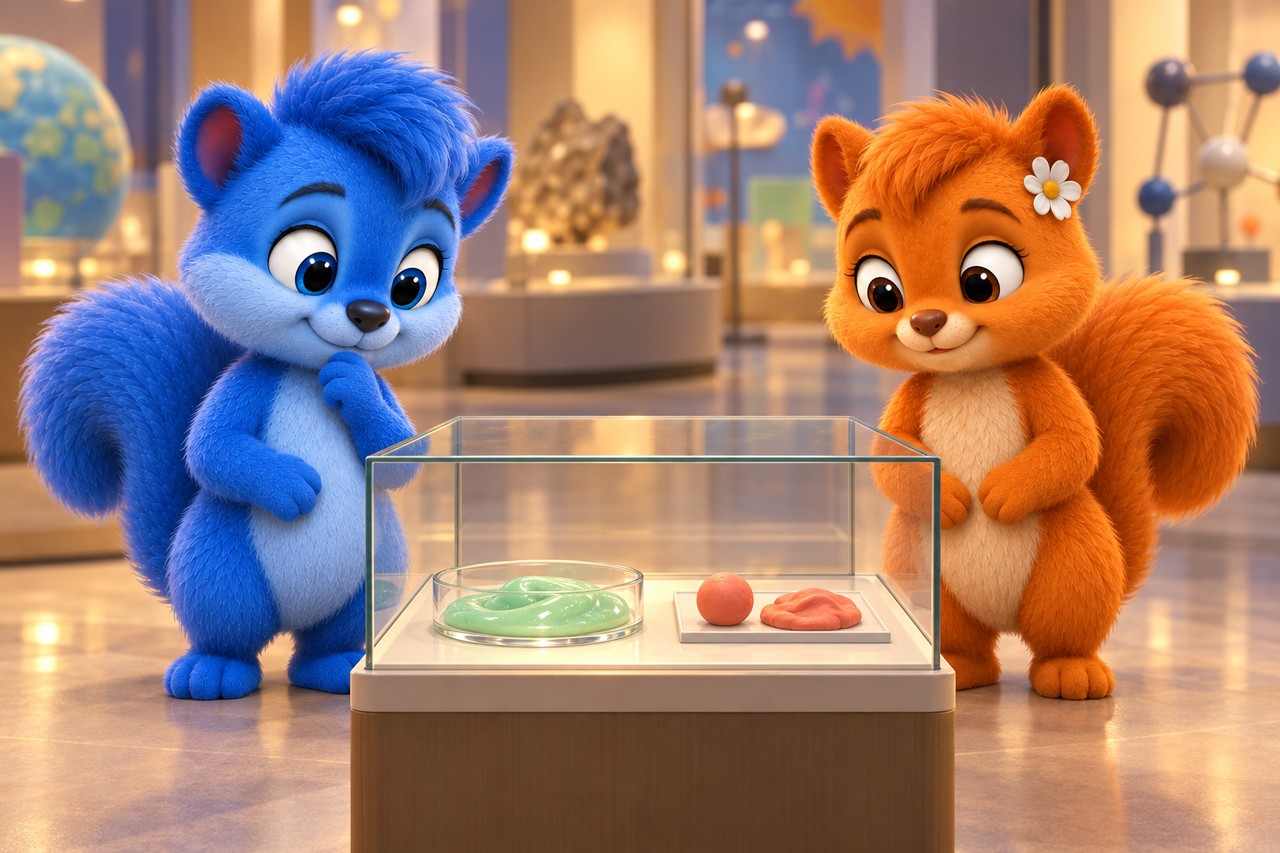
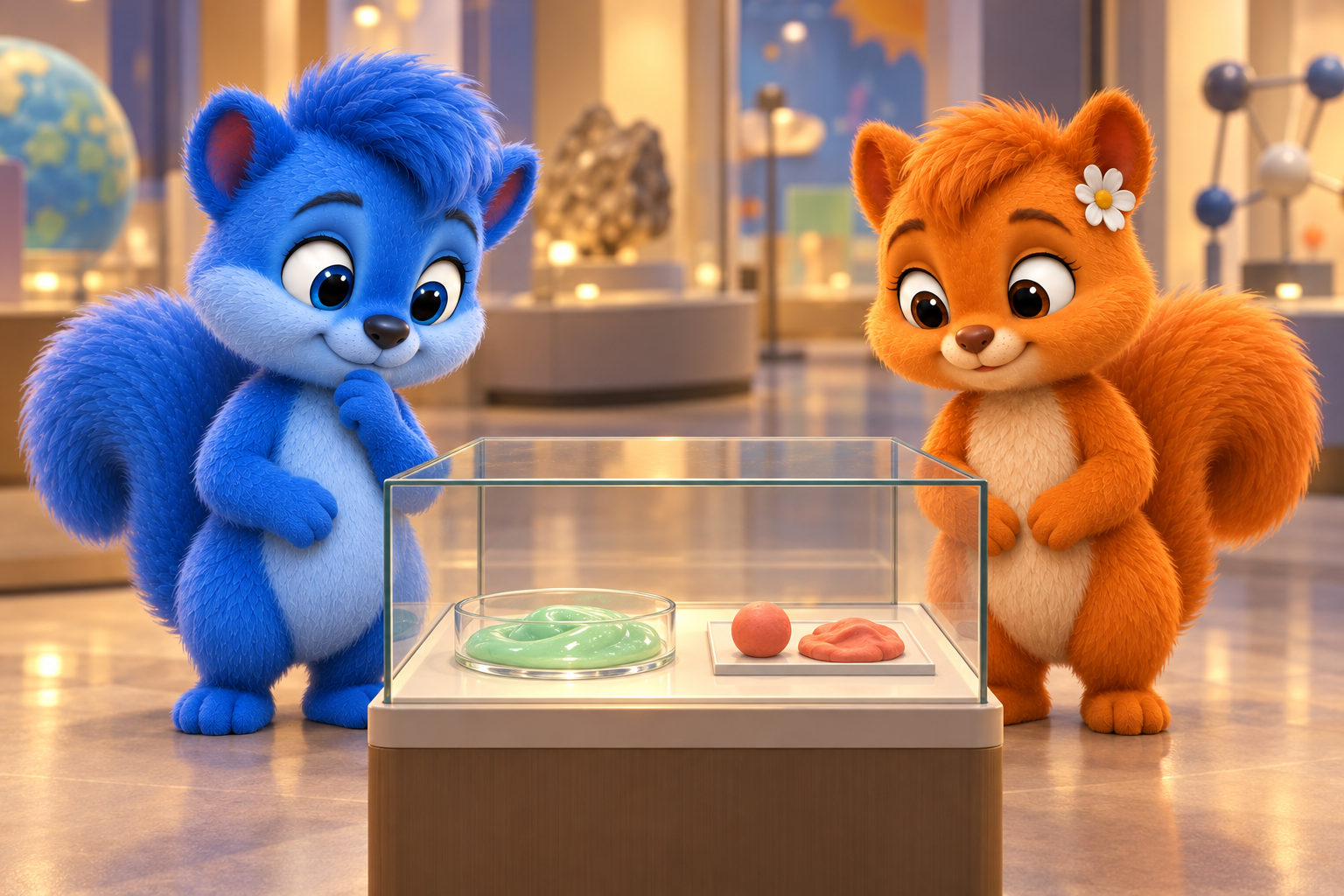
Equal-sized adult Wusels examine a green slime dish and coral modeling dough behind a closed glass display. Invented illustrated materials; their exact mixtures cannot be identified from the picture. The diagram is a comparison, not chemical mixing instructions. AI-created illustration, not a photograph of nature.
What the diagram shows
The diagram simplifies the process. First compare its shapes and arrows. You can read its labels in larger text below.
Read the picture labels
These are the words and sentences from the diagram above. The full explanation follows below.
- Imagined polymer chains: connections form a network
- Without cross-connections
- With some connections
- Lines and dots are a comparison, not visible molecules.
- Modeling dough: same imagined amount, different shape
- Change shape
- The dough comparison does not depict polymer cross-linking. Not to scale; no quantity measurement or chemical mixing instructions.
An imagined Wusel scene
Puschel and Flauschi investigate
Puschel pulls one mixture quickly and presses the other slowly. Flauschi cannot make a fair comparison. With Lumi supervising suitable samples, they use the same movement on both. Now they record which holds its shape and which keeps flowing.
Look closely
The closed museum display contains invented slime and modeling-dough examples. Their colors do not reveal ingredients. Puschel looks at the slime dish; Flauschi studies the dough. Diagram chains are a separate enlarged comparison.
An example to help you understand
Draw several long, wavy lines side by side to represent polymer chains. Connect some with short cross-lines. Compare the pictures: what changed with the added connections? Lines now form a network. This model helps explain cross-linking. It is not a real molecule and calculates neither stretch nor flow speed. Beside it draw a dough ball and a flattened mound made from the same amount. You compare changing shape, not manufacturing slime.
Try explaining it
How can you compare two suitable soft mixtures fairly?
Choose a), b) or c), then explain your choice.
- a)Press or pull both in the same way.
- b)Press one material gently and pull the other apart forcefully.
- c)Use the softer surface to predict behaviour under every movement.
Show the explanation
Correct: a): Press or pull both in the same way.
Press two suitable soft materials equally gently: one may slowly spread, while the other keeps its new shape more readily. Their ingredients and connections cause this difference. Use the same movement for both.
This reveals the difference better than pressing with different forces.
Word help
- friction
- An effect between touching surfaces that resists sliding between them.
- molecule
- A small group of connected atoms, tiny building blocks of matter.
Explore in more detail
Here you will find longer explanations and further details. You can explore them together.
1. Looking alike does not mean matching structure
Two soft materials can look similar but behave differently. Imagine slime slowly spreading and modeling dough remaining as a flattened mound after pressing. Deforming means changing shape. Composition means which substances are present. How they interact matters too. There are different slimes and doughs; products do not all behave alike. A still picture does not show how a material responds to pulling or after a minute.
2. Long chains and connections
Many toy slimes contain very large molecules. Molecules are chemically joined building blocks. Some look like long chains in a model: they are called polymers.
Links between some chains make a loose network. Together with water, the network can hold the material together while allowing slow changes of shape. That is why a material may stretch while staying joined.
The picture enlarges chains and connections into visible lines. It is not a real fishing net. Other soft materials may have different structures and behave differently.
3. Modeling dough does not always have the same mixture
According to its manufacturer, one familiar modeling dough mainly contains water, salt and flour. This is an example, not an explanation of every modeling material in shops. Other compounds have different compositions. Our soft dough example compares a ball with a flattened mound. The same amount can be distributed in different ways. Its shape changes; this does not simply create more material. Some play materials spring back more strongly; others stay deformed. Follow the particular product’s instructions for safe use.
4. Starch and water are different again
A mixture of many small starch particles and water can flow slowly yet resist rapid deformation much more strongly. Under suitable conditions, particles make stronger contact and hinder each other’s movement. This differs from our polymer network. Such mixtures are called non-Newtonian fluids: their resistance to flow changes with stress. Resistance to flow describes how hard it is to make a material flow. The effect is not a permanent transformation into stone. Mixture and movement matter; not all non-Newtonian fluids become thicker under stress.
Checked against: [3]
An optional question for further exploration
You can use the longer explanation above. This is extra, not needed for the first quiz.
An extra question
Why can a starch-and-water mixture resist a quick push more than a slow movement?
Discover the answer
Under suitable conditions, high stress presses more starch particles into contact. Their friction resists motion more strongly, so the mixture can temporarily feel stiffer. It does not turn into a permanently solid stone. This does not automatically apply to every slime or mixture ratio.
Pictures and sources for adults
Sources for further reading
Facts checked against the specialist sources below on 12 October 2026. The Wusel scene is fictional; comparisons and simplified models are explicitly explained. Sources are in German and English.