Samurai and ninja: what do real traces reveal?
Armour and old texts tell us more than film costumes. Historical people did not have magical powers.
The short answer
Samurai and ninja belong to Japanese history, but had different roles. Historical objects and texts help investigate them. Film costumes, superhuman powers and dramatic fights are not reliable evidence of everyday life.
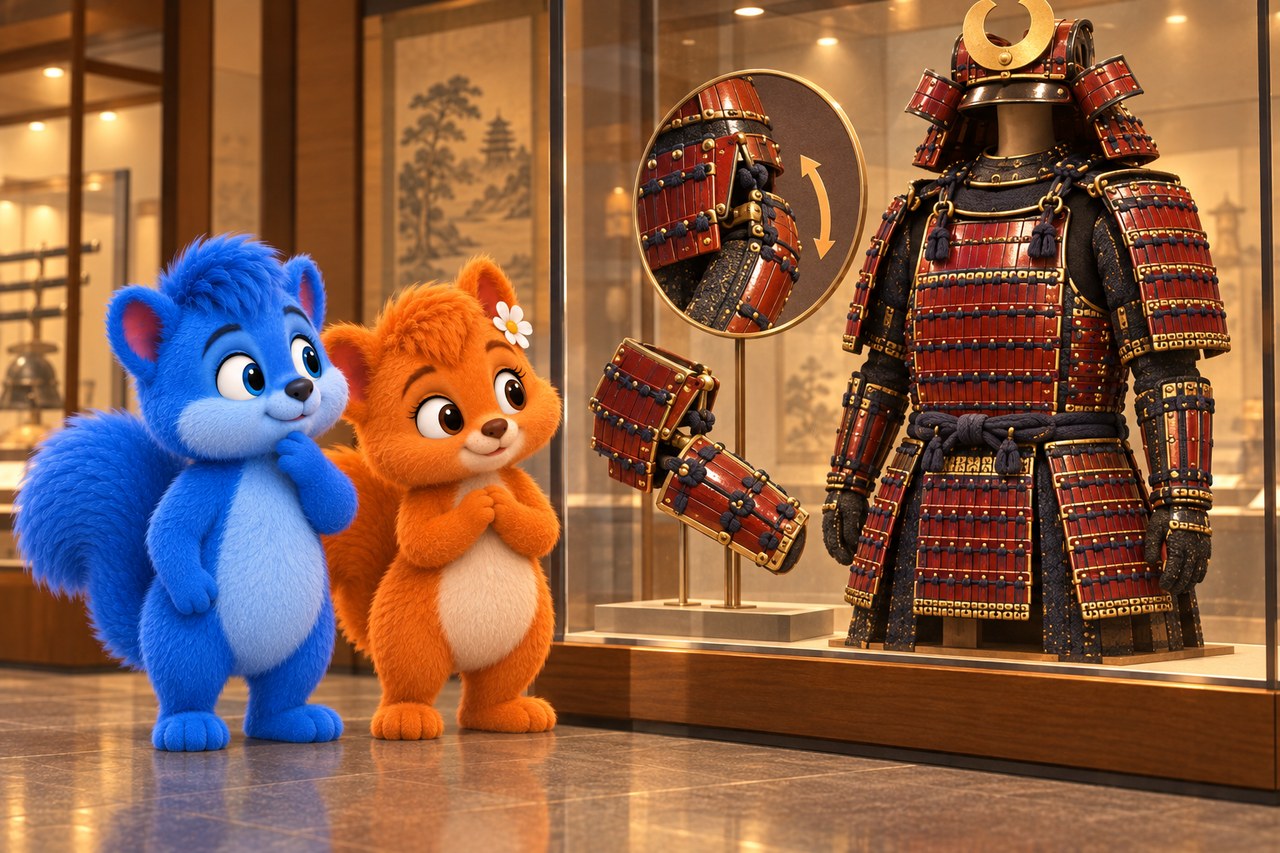
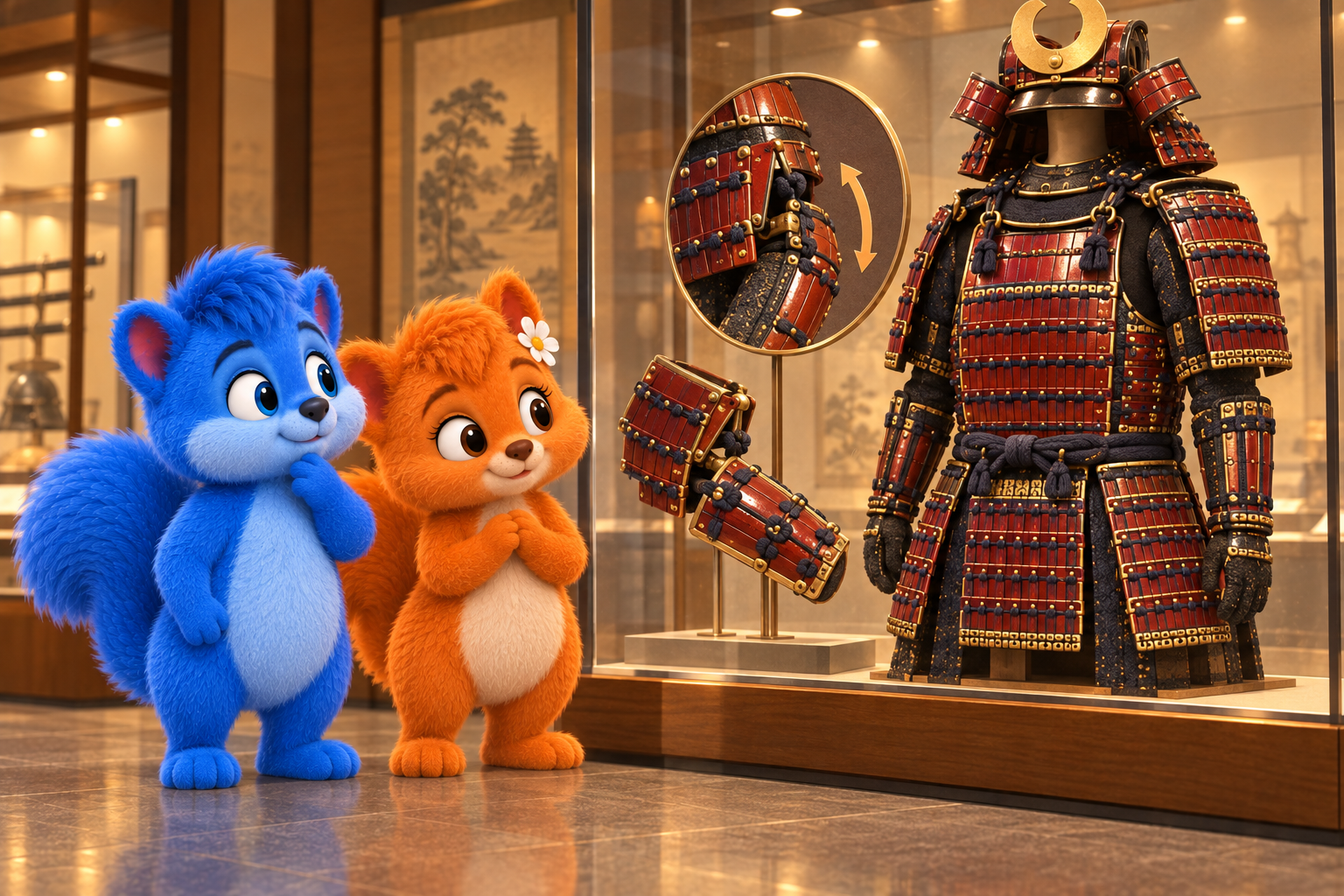
Puschel and Flauschi in the museum. Armour model with overlapping plates and an enlarged moving joint. A schematic reconstruction, not evidence for ninja film costumes. AI-created illustration, not a photograph of nature.
Explained in three pictures
1 Chest and back armour
This armour joins chest and back protection with a hinge.
2 Historical texts
Historical texts can describe spying and gathering information.
3 Film is not evidence
A fictional film does not prove a real ability.
More about the picture
Real objects and datable texts must be examined in context. Samurai and ninja are not interchangeable film characters. Armour or a text answers only certain questions; fantastic abilities in films require separate evidence.
An imagined Wusel scene
Puschel and Flauschi investigate
Puschel recognises a costume from a film story. Flauschi finds the label for the historical object beside it. They make separate cards for film idea and documented find. What they cannot support becomes an open question.
Look closely
Compare the museum model with the three picture steps. Historical texts can describe spying and gathering information.
An example to help you understand
Imagine three cards: surviving armour, an old text and a film with an invisible ninja. Ask what each can show. Armour lets researchers examine shapes. A text records something someone wrote; its date and context matter. A film reveals how a scene was staged for the camera, not proof of invisibility. Draw a costume for your own fictional character and label it imagination. It tells us nothing about how everyone in Japan lived or lives.
Try explaining it
What helps more when investigating past daily life?
Choose a), b) or c), then explain your choice.
- a)Use one fighting game as a source for everyone's everyday life.
- b)Historical objects and texts.
- c)Use a film character's weapons as a complete picture of everyday life then.
Show the explanation
Correct: b): Historical objects and texts.
Samurai and ninja belong to Japanese history, but had different roles. Historical objects and texts help investigate them. Film costumes, superhuman powers and dramatic fights are not reliable evidence of everyday life.
Word help
- joint
- A connection between bones. Many joints allow movement.
Explore in more detail
Here you will find longer explanations and further details. You can explore them together.
1. Samurai belong to Japanese history
Samurai were a warrior group in earlier Japan. Some also had political responsibilities, helping govern territories. Their lives could include more than fighting: some supported art or wrote poetry. Not every samurai had the same duties or interests.
Checked against: [1]
2. Armour protects, but not against everything
Japanese armour could use many small overlapping scales; other designs used larger iron plates. Silk lacing joined parts and also provided decoration. One piece described by The Met has breast and back protection in two large halves joined by a hinge on the left. A hinge is a moving joint that lets parts swing open, as on a door. Armour was therefore a designed assembly of different materials and moving joints, rather than a rigid iron box. Surviving originals help us study these designs. The empty armour in our illustration is an original approximation.
3. Shinobi gathered information
People often called ninja today were historically called shinobi. Mie University’s research identifies gathering information as a central duty: finding out and reporting what happens elsewhere. Activities changed over time. They were not an identically dressed group of film heroes.
Checked against: [2]
4. The black costume has its own history
Black clothing and masks became especially familiar through theatre and stories. Mie University distinguishes those characters from historical shinobi. Old texts also need examination: who wrote them and when? Describing a magical technique does not prove magic works. Depictions and actual abilities are different.
Checked against: [2]
An optional question for further exploration
You can use the longer explanation above. This is extra, not needed for the first quiz.
An extra question
Does a ninja’s black film costume prove historical shinobi always looked exactly like that?
Discover the answer
No. It belongs to a later popular depiction. Historical clothing and duties require appropriate period evidence; a film alone cannot establish them.
Pictures and sources for adults
Sources for further reading
Facts checked against the specialist sources below on 12 October 2026. The Wusel scene is fictional; comparisons and simplified models are explicitly explained. Sources are in English and Japanese.