Why does a roller coaster speed up downhill?
Lift, roll down and climb again: follow the link between height and speed.
The short answer
At the top of a hill, a roller-coaster car stores energy because of its height. Rolling downhill turns this into movement: it speeds up. Braking and rubbing produce heat. Some energy of motion is transformed and the car slows down.
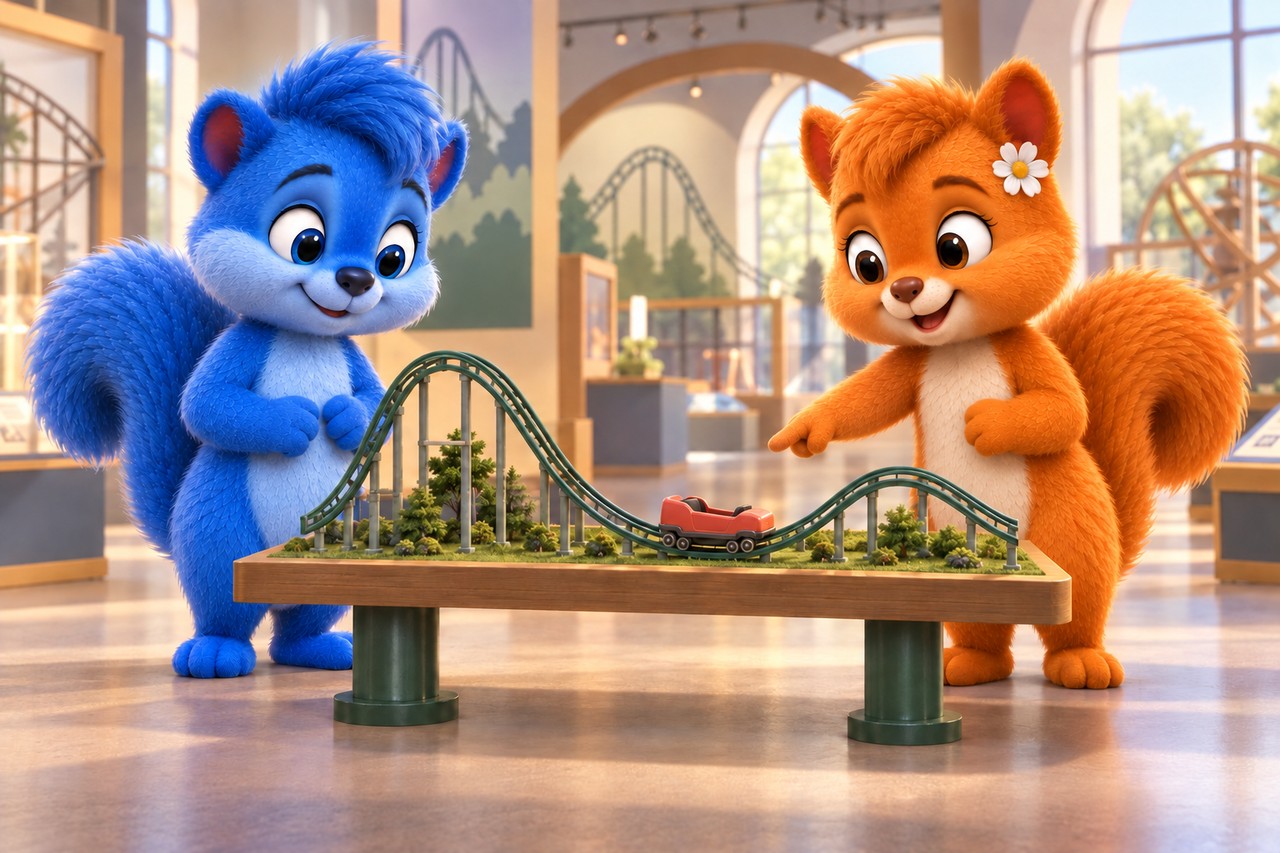
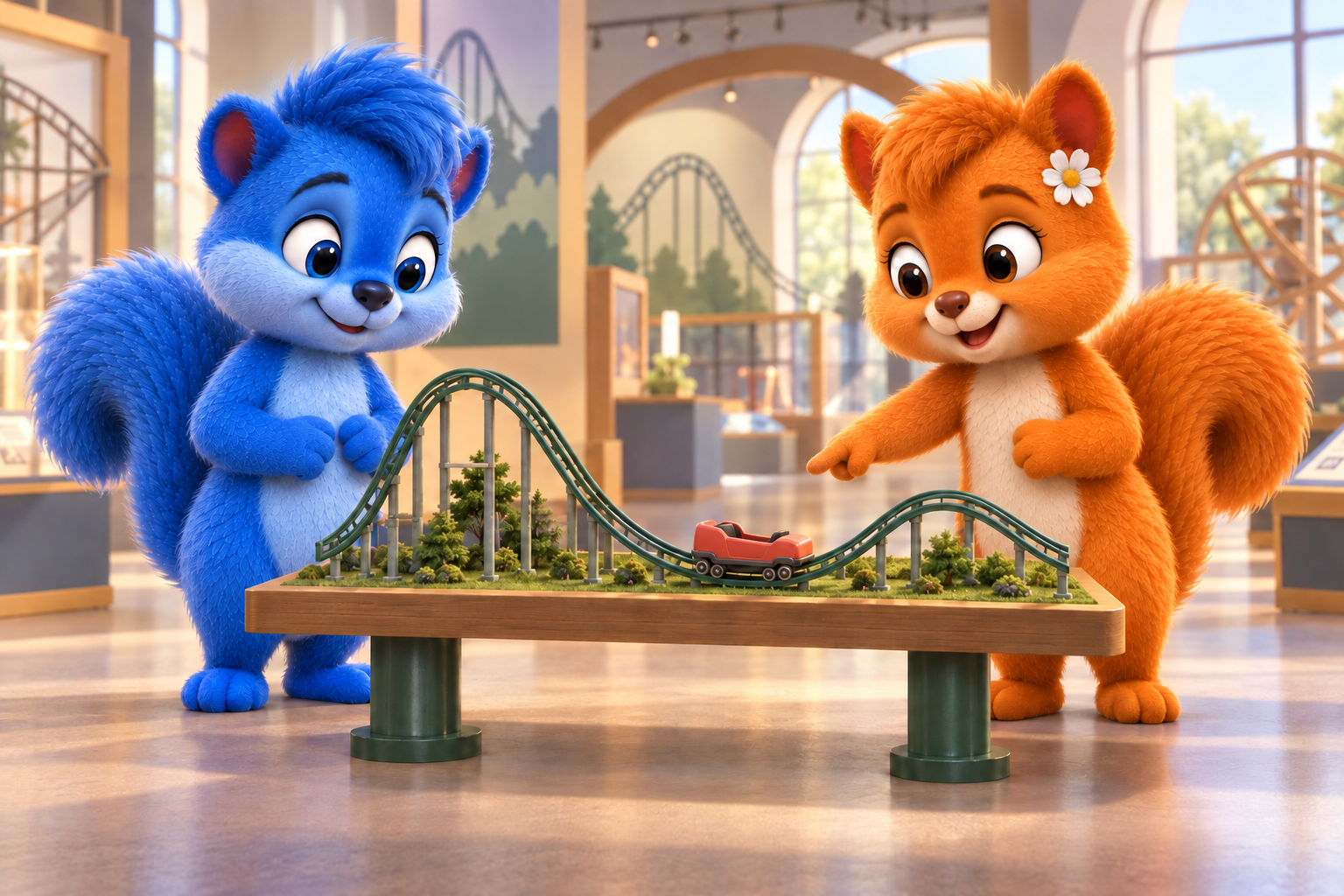
Equal-sized adult Wusels examine an invented museum coaster model; Flauschi points toward the empty car in its valley. Invented museum model. The diagram explains height and motion, not complete mechanics, restraints or construction. AI-created illustration, not a photograph of nature.
What the diagram shows
The diagram simplifies the process. First compare its shapes and arrows. You can read its labels in larger text below.
Read the picture labels
These are the words and sentences from the diagram above. The full explanation follows below.
- One imagined ride – three successive moments
- 1. At the top
- Starts from rest
- 2. Low down
- Faster than at the start
- 3. Higher again
- Slower than low down
- Going down: less position energy, more motion energy Going up: more position energy, less motion energy Friction and air resistance: energy also changes into other forms.
- No further drive. Three car positions represent three moments. Not to scale; no mechanics, restraints or building instructions.
An imagined Wusel scene
Puschel and Flauschi investigate
Puschel draws the car equally fast before and after the slope. Flauschi points to the high start. They arrange cards for stored height energy and increasing motion. His motion arrow now grows downhill, with friction shown as another influence.
Look closely
An empty car stands low between two hills in the museum picture. Flauschi points toward it. The diagram shows the same car at three successive moments of an imagined ride, not three different cars.
An example to help you understand
Draw a high hill, a valley and a lower hill. Imagine the same car starting at rest high up on the descending slope and rolling down without a push. Where would it be faster: at the top or in the valley? In the valley. It would slow again while climbing. Draw another hill higher than the starting point: the car cannot reach it without added energy. Your drawing predicts motion; it is not an experiment or instructions for a real ride.
Try explaining it
Why does a car speed up downhill?
Choose a), b) or c), then explain your choice.
- a)Height provides new energy of motion without reducing stored energy.
- b)Friction gives the car an extra push downhill.
- c)Energy stored in its height becomes motion.
Show the explanation
Correct: c): Energy stored in its height becomes motion.
At the top of a hill, a roller-coaster car stores energy because of its height. Rolling downhill turns this into movement: it speeds up. Braking and rubbing produce heat. Some energy of motion is transformed and the car slows down.
As the car descends, height decreases and speed can increase. Friction converts energy to heat; it does not provide extra drive.
Word help
- friction
- An effect between touching surfaces that resists sliding between them.
Explore in more detail
Here you will find longer explanations and further details. You can explore them together.
1. First the car must go up
We consider a track whose car is pulled slowly up its first hill. This supplies energy. Energy can enable changes, such as lifting something or warming it. Its raised position relative to Earth gives the car more gravitational potential energy: energy stored through this position. The car need not be fast at the top to have it.
2. Going down turns height into motion
Earth pulls the car downward. On the descending track it speeds up as its height decreases. Gravitational potential energy changes into kinetic energy, the energy of motion. The same car has more kinetic energy at a greater speed. Rails guide its path; it is not simply falling freely straight down through the air.
3. Going up slows it again
As the car rolls up the next hill without further power, height increases and speed decreases. Kinetic energy changes back into gravitational potential energy. Without added energy it cannot climb higher than its starting point if it started there from rest. Our thinking model therefore starts at the top. It does not describe how every real coaster is powered.
4. Energy does not disappear
Friction and air resistance change some motion energy into other forms, mainly internal energy of the car, track and surroundings: they become slightly warmer. Friction involves contact and surfaces moving against one another. Air resistance is air’s slowing effect. A real car therefore does not keep rolling forever. A model leaving these effects out simplifies reality; measurements can differ from its predictions.
An optional question for further exploration
You can use the longer explanation above. This is extra, not needed for the first quiz.
An extra question
Why can a car starting from rest not reach a higher hill without added energy?
Discover the answer
A higher position would require more gravitational potential energy than was available at the start. Some energy also changes into other forms along the way. An additional drive could supply energy; our model has none.
Pictures and sources for adults
Sources for further reading
Facts checked against the specialist sources below on 12 October 2026. The Wusel scene is fictional; comparisons and simplified models are explicitly explained. Sources are in English.