Why does a path look different at night?
Less light changes what we can recognise. Discover why eyes need light and night walks need careful planning.
The short answer
In dim light we distinguish colours and fine details less well. Familiar shapes can look strange, and sounds stand out more. Calm observation with an adult helps separate impressions from their actual causes.
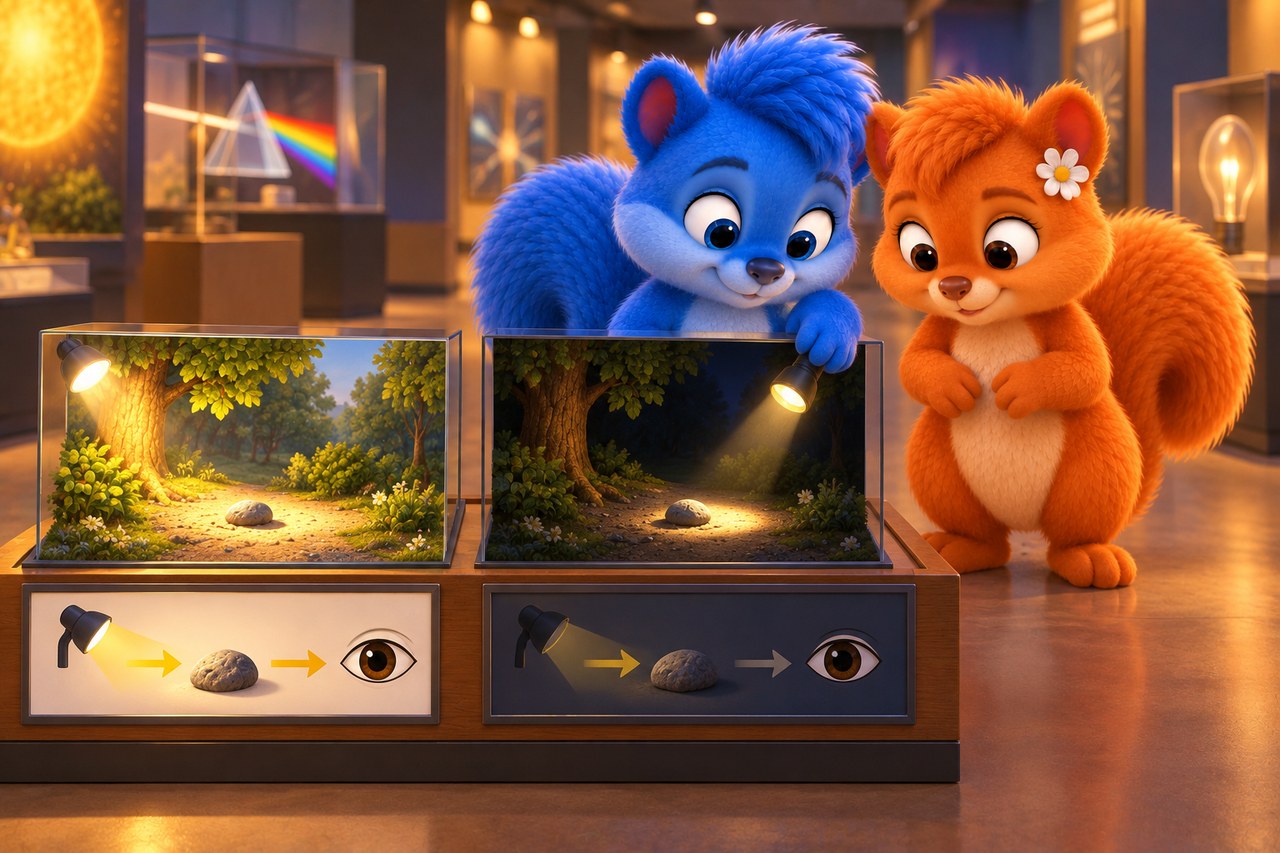
Puschel and Flauschi in the museum. The same model path in bright and dim light; a torch lights only one part. Simplified inanimate museum model; arrows and colours help explain it. AI-created illustration, not a photograph of nature.
Explained in three pictures
1 Day: more light
Light reaches objects and is reflected towards the eye.
2 Night: less light
At night, less light reaches the eye. Colours are harder to distinguish.
3 A lamp helps locally
The torch lights part of the path, not the whole surroundings.
More about the picture
We see objects because light from them reaches our eyes. At night, the eye’s sensitive cells help with dim light but distinguish colours poorly. In total darkness they see nothing either. This drawing compares light, not the safety of a route.
An imagined Wusel scene
Puschel and Flauschi investigate
On their supervised walk, Puschel mistakes a trunk for a strange figure. Flauschi waits with him while Lumi safely lights the path. They compare outline and bark. He recognises the tree and asks which clues were missing in the dark.
Look closely
Compare the museum model with the three picture steps. At night, less light reaches the eye. Colours are harder to distinguish.
An example to help you understand
Draw three boxes: lamp, illuminated object and eye. Add an arrow from the lamp to the object and another from the object to the eye. These arrows describe the light’s path, not a walking direction. Then discuss on paper what adults would need to check before a suitable group outing. You need neither to darken a room nor to go outside at night.
Try explaining it
Why can a familiar tree look strange at night?
Choose a), b) or c), then explain your choice.
- a)Dim light makes colour and detail harder to see.
- b)The tree is harder to see because it changes its own colours at night.
- c)The eye shows missing details especially accurately at night.
Show the explanation
Correct: a): Dim light makes colour and detail harder to see.
In dim light we distinguish colours and fine details less well. Familiar shapes can look strange, and sounds stand out more. Calm observation with an adult helps separate impressions from their actual causes.
Word help
- cell
- A tiny living unit. Living things are made of cells.
- nerve
- A bundle of fibres that carry signals through the body.
- retina
- The light-sensitive layer at the back of the eye where signals are produced.
Explore in more detail
Here you will find longer explanations and further details. You can explore them together.
1. Less light, fewer visible clues
A night walk takes place at least partly after sunset. A familiar path may look different because landmarks are harder to recognise. Landmarks are features that help people find their way, such as a junction. Familiarity in daylight does not automatically make a route suitable at night. Adults check a short, appropriate and permitted route and its conditions beforehand.
Checked against: [1]
2. Light needs to enter the eye
Seeing requires light to enter the eyes. Special cells in the retina, a light-sensitive layer inside the eye, convert light into electrical signals. Signals travel through the optic nerve to the brain, where the visual impression forms. The eye does not send a search beam towards the object. Our picture therefore places a light source, illuminated object and eye in that order.
3. The retina works at different light levels
Two kinds of light-sensitive cells are called cones and rods. Cones help us recognise colours and fine detail with enough light. Rods are especially sensitive in dim light but do not supply the same colour discrimination. A colourful leaf may therefore look greyer at dusk. Dark adaptation takes time: after leaving a bright place we do not immediately recognise every dimly lit object. In complete darkness, waiting does not let humans see.
4. Directed light and shared attention
A lamp should illuminate the needed area rather than shine into somebody’s face. Unnecessary lighting can affect natural darkness and wildlife. Brightness alone does not prove safety. Everyone stays with the adult and watches the path. When standing quietly, sounds may attract more attention; that does not imply suddenly improved hearing. Animals are neither lured nor followed.
An optional question for further exploration
You can use the longer explanation above. This is extra, not needed for the first quiz.
An extra question
Why do colours become less distinct in very dim light even when we can still recognise outlines?
Discover the answer
Rods are especially sensitive to dim light but do not distinguish colours like cones. Cones need more light for good colour vision. In complete darkness rods cannot see either, because no light enters the eye.
Pictures and sources for adults
Sources for further reading
Facts checked against the specialist sources below on 12 October 2026. The Wusel scene is fictional; comparisons and simplified models are explicitly explained. Sources are in English.