How did people reach the Moon?
One spacecraft stayed in lunar orbit. Another took two people down and back up.
The short answer
Rockets sent people and spacecraft towards the Moon. On Apollo 11, two people landed in a separate lunar module while a third orbited the Moon. The spacecraft had to meet again for the journey home.
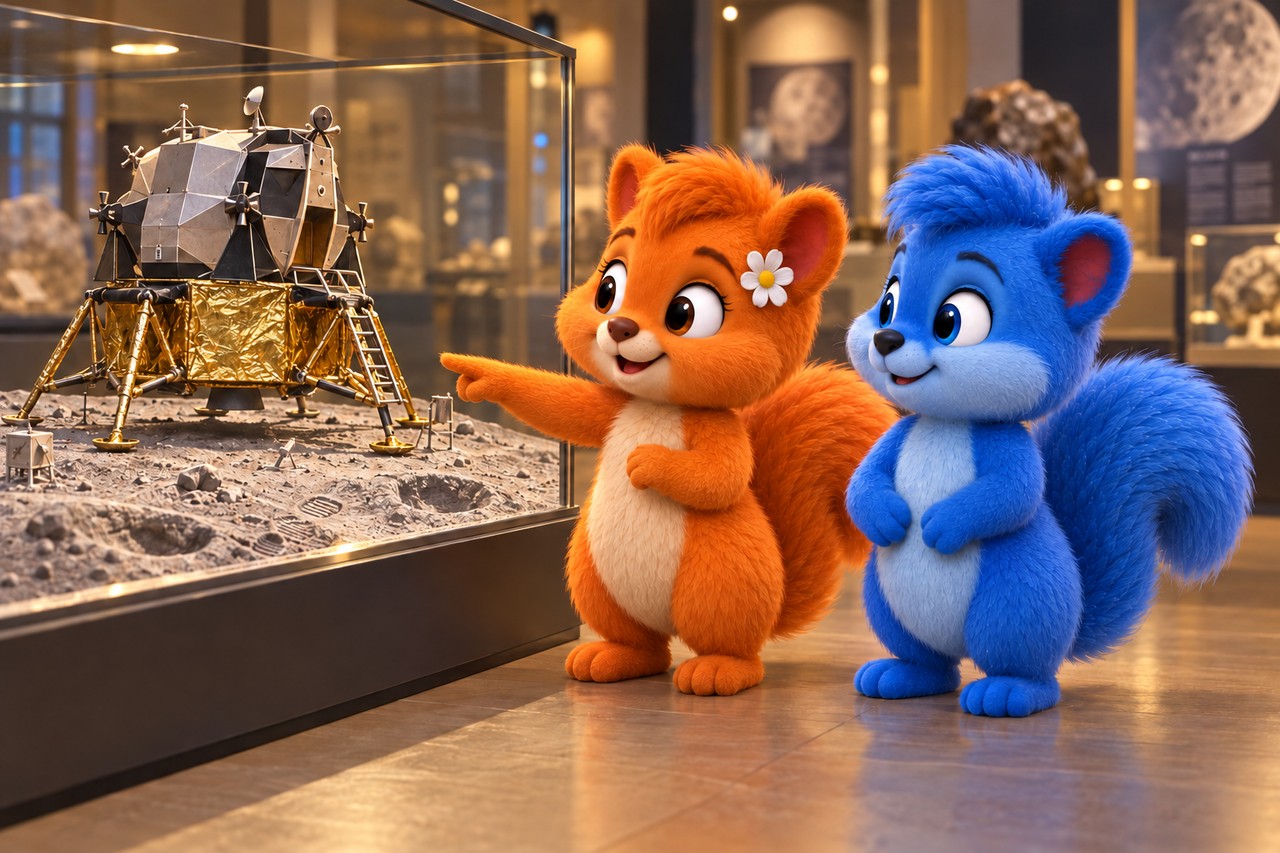
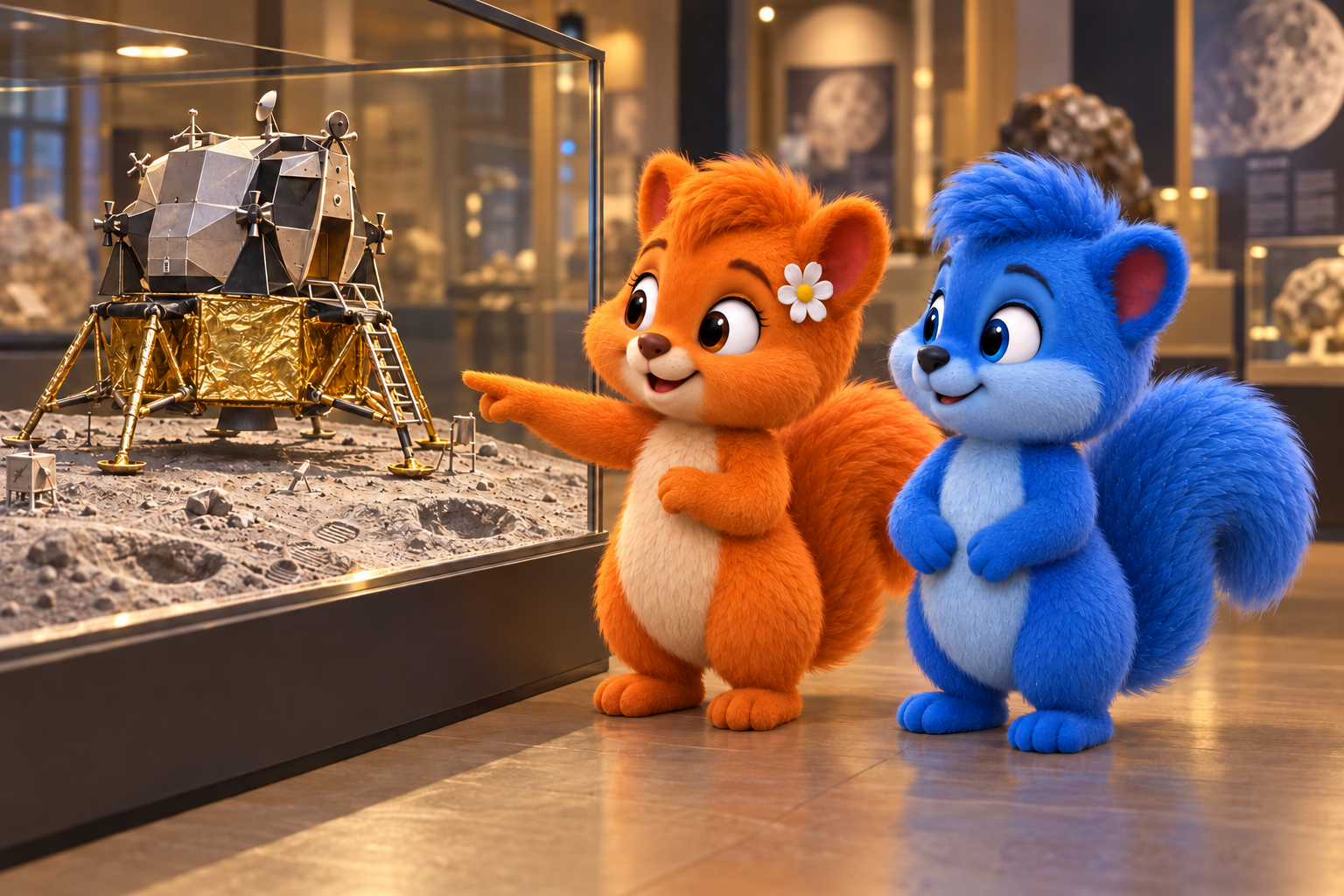
Equal-sized Puschel and Flauschi examine a simplified Apollo lunar-module museum model. Artistic model, not to scale or a historical photograph. The Wusels are in a museum, not outdoors on the Moon without spacesuits. AI-created illustration, not a photograph of nature.
What the diagram shows
The diagram simplifies the process. First compare its shapes and arrows. You can read its labels in larger text below.
Read the picture labels
These are the words and sentences from the diagram above. The full explanation follows below.
- Lunar module: down and back up
- Moon
- Columbia: Collins stays in lunar orbit
- Eagle descends Armstrong and Aldrin
- Upper stage launches and meets Columbia
- All three then return towards Earth aboard Columbia.
- Diagram: sizes, distances and paths are not to scale.
An imagined Wusel scene
Puschel and Flauschi investigate
Puschel wants to put the whole large spacecraft on the Moon. Flauschi finds the separate model parts. They arrange launch, lunar orbit, landing and rendezvous. He leaves the waiting figure in orbit so that person's job stays visible too.
Look closely
Find the round footpads, gold-coloured lower section and ladder. This model explains the landing, not the whole journey.
An example to help you understand
Place three large paper cards on a table: Earth, Moon and lunar orbit. Use folded paper vehicles for Columbia and Eagle. Columbia stays near the orbit card; Eagle goes to the Moon card and its upper paper section returns. This models tasks and sequence, not actual distances, sizes or movements.
Try explaining it
Why does the Moon journey show several spacecraft parts?
Choose a), b) or c), then explain your choice.
- a)The parts did the same job but had different names.
- b)Travel, landing and return had different jobs.
- c)All parts landed together and launched back together.
Show the explanation
Correct: b): Travel, landing and return had different jobs.
Rockets sent people and spacecraft towards the Moon. On Apollo 11, two people landed in a separate lunar module while a third orbited the Moon. The spacecraft had to meet again for the journey home.
Word help
- atmosphere
- The gas layer around a world; on Earth it is the air above us.
- orbit
- The path of one body around another.
Explore in more detail
Here you will find longer explanations and further details. You can explore them together.
1. Different parts for different jobs
Apollo 11 launched on 16 July 1969 with Neil Armstrong, Buzz Aldrin and Michael Collins. A rocket sent their spacecraft towards the Moon. It first entered lunar orbit, moving around the Moon rather than immediately landing. Different parts had different jobs. It was not one aeroplane simply flying there and back.
Checked against: [1]
2. Two landed; one stayed in orbit
Armstrong and Aldrin landed in Eagle on 20 July 1969. Collins stayed aboard Columbia in lunar orbit. Eagle had a lower section with landing legs and an upper section for launching back up. Its rocket engine slowed the descent. An atmosphere is a layer of gases around a world. The Moon has no thick atmosphere like Earth, so a parachute could not perform the landing.
3. Research required special protection
There is no breathable air on the lunar surface, so the astronauts needed spacesuits. They collected rock samples, took photographs and placed scientific instruments. Samples are small amounts of material for study. Surface gravity is about one-sixth of Earth’s. They were not weightless: they stood on the ground and could still fall. One instrument was a panel of special mirrors that send light back towards where it came from. Specialists direct short laser pulses from Earth at the panel and measure their return time. Using the known speed of light, they calculate distance, allowing for the journey to the Moon and back.
4. The return was part of the plan
Eagle’s upper section launched and met Columbia in orbit. The two astronauts rejoined Collins. All three returned to Earth, splashing down in the Pacific on 24 July 1969. Later Apollo missions took more people to the Moon. Getting home safely mattered as much as arriving; the entire lunar module did not return to Earth.
An optional question for further exploration
You can use the longer explanation above. This is extra, not needed for the first quiz.
An extra question
Why did the crew need more than a lunar module?
Discover the answer
Columbia remained in orbit and received the two returning astronauts. Other spacecraft parts handled the outward flight, journey home and Earth landing. Eagle performed only part of the mission.
Pictures and sources for adults
Sources for further reading
Facts checked against the specialist sources below on 12 October 2026. The Wusel scene is fictional; comparisons and simplified models are explicitly explained. Sources are in English.