How can magnets make a train hover?
Magnetic forces can support a train. Speeding up forward needs a different force.
The short answer
Magnets can pull or push without touching each other. On a maglev railway, magnetic forces hold the train a small distance above the track. Their strength is continually adjusted to keep that gap. Other magnetic forces move the train forward.
All this needs energy.
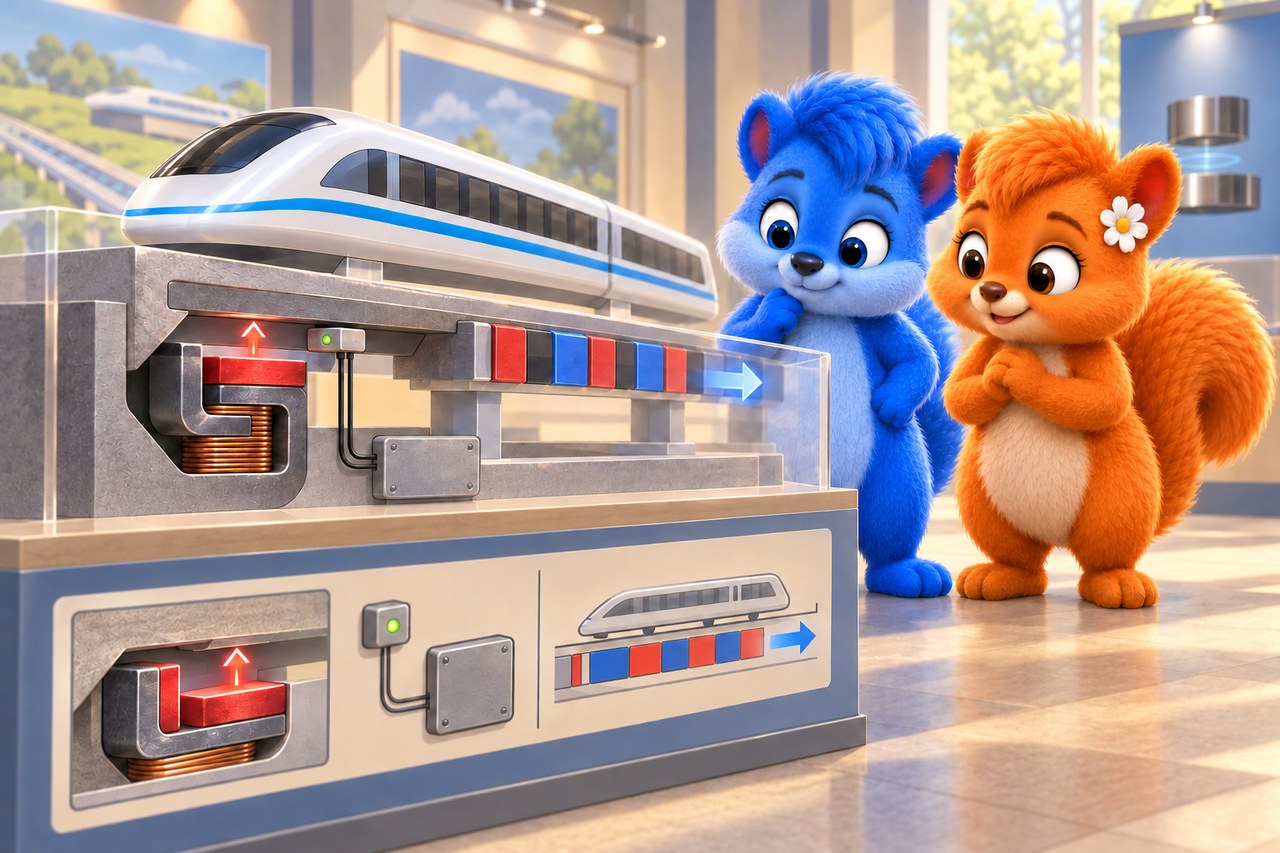
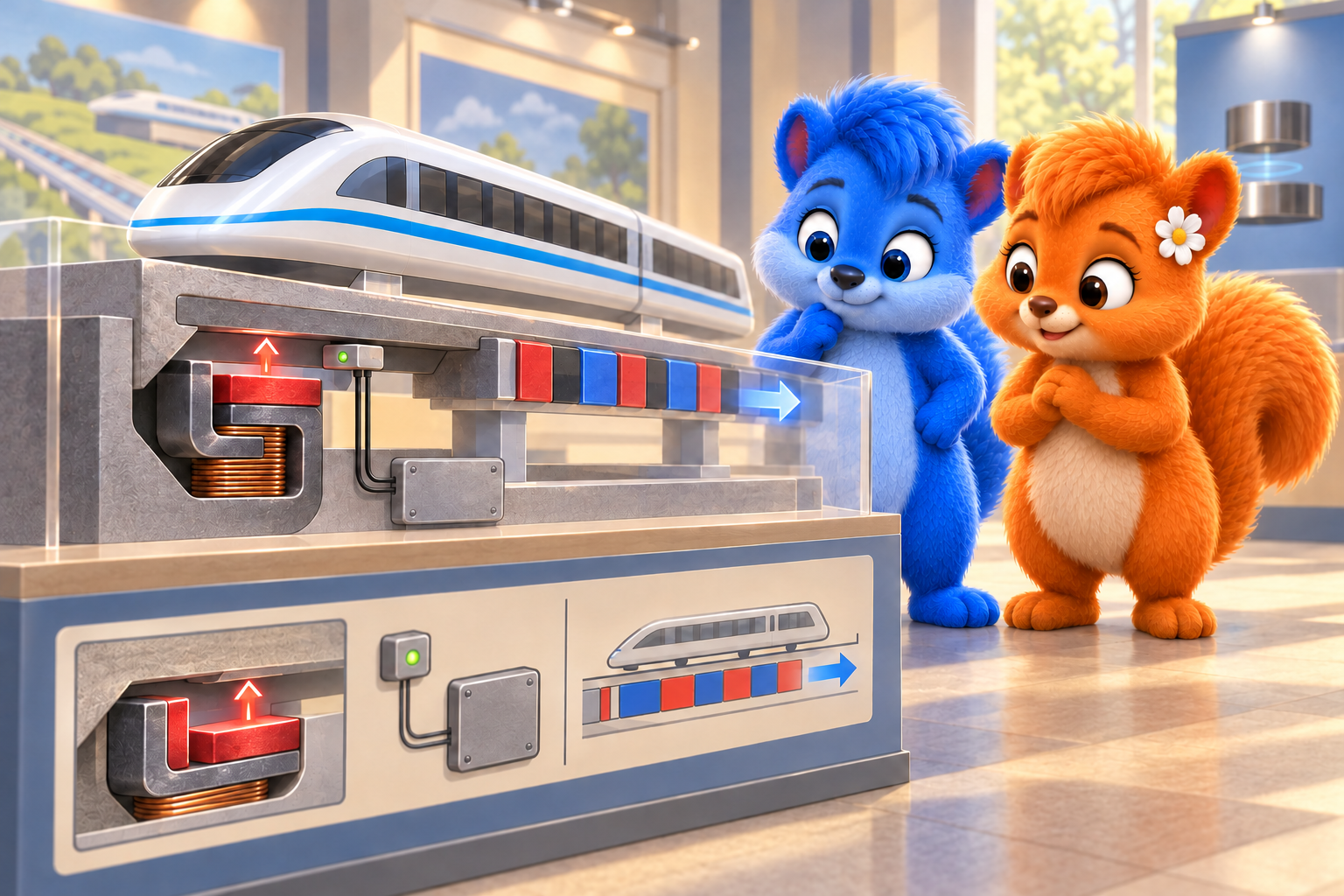
Puschel and Flauschi in the museum. Cutaway with an attracting magnet, a small air gap and separate forward propulsion. Simplified inanimate museum model; arrows and colours help explain it. AI-created illustration, not a photograph of nature.
Explained in three pictures
1 Attraction supports
Example: magnets on the train are attracted towards the rail.
2 Control the gap
Sensors and controls maintain the small gap.
3 Propel forwards
A travelling magnetic field can move the train forwards.
More about the picture
This principle drawing shows a system using controlled magnetic attraction. Other maglev systems use different arrangements, such as repulsion. Supporting, guiding sideways and propulsion are different tasks; a fixed magnet alone does not control a whole train journey.
An imagined Wusel scene
Puschel and Flauschi investigate
Puschel looks for wheels under the train model and finds a gap. Flauschi points out the magnetic parts. They separately check what supports the train and what propels it. His drawing now has two jobs instead of one magical arrow.
Look closely
Compare the museum model with the three picture steps. Sensors and controls maintain the small gap.
An example to help you understand
Draw a rectangle for the train. A downward arrow stands for weight; an equally long upward arrow stands for the supporting magnetic force. These explain hovering at a constant height. Add a different-coloured forward arrow beside it for the drive. Supporting and moving forward are separate tasks. Arrows are not components or invisible ropes, and do not show every force during a journey.
Try explaining it
What supports a maglev train above its guideway?
Choose a), b) or c), then explain your choice.
- a)Airflow underneath, as in a hovercraft.
- b)Energy of motion alone, without a supporting force.
- c)Controlled magnetic forces.
Show the explanation
Correct: c): Controlled magnetic forces.
Magnets can pull or push without touching each other. On a maglev railway, magnetic forces hold the train a small distance above the track. Their strength is continually adjusted to keep that gap. Other magnetic forces move the train forward.
All this needs energy.
Word help
- sensor
- A device part that measures something, such as light or distance.
- coil
- Wire wound into several turns. Current through it creates a magnetic field.
Explore in more detail
Here you will find longer explanations and further details. You can explore them together.
1. Magnets act across a gap
Magnetic forces can act without objects touching. A force is a push or pull. A magnet has a north and a south pole, its two magnetic poles. Like poles repel; opposite poles attract. Electric current produces the magnetic effect of an electromagnet. It often flows through a coil: wire wound into many turns.
Checked against: [1]
2. Support needs the right force
Earth pulls the train downward. At constant hovering height, the upward magnetic force must balance its weight. Parts of the vehicle and a special guideway work together. A guideway is the route supporting and guiding the vehicle. In the Transport System Bögl, vehicle electromagnets attract suitable steel rails in the guideway. Sensors observe the small gap and a control system adjusts the magnetic effect. Here control means measuring and making ongoing adjustments.
3. Hovering does not mean moving forward
An upward force does not automatically make the train speed up forward. A linear motor provides the drive. Here linear means along a line. Unlike an ordinary motor with a rotating shaft, it creates drive along the guideway. Changing magnetic fields interact with the vehicle to move it forward. A magnetic field is a region where magnetic forces can act. Vehicle and guideway must be technically compatible.
4. Maglev designs differ
Other designs use different magnetic arrangements. In Japan’s SCMAGLEV, fast movement past guideway coils produces electric currents that generate magnetic forces. Its powerful magnets are kept very cold: certain materials then carry current without electrical resistance. Resistance opposes current flow and can warm a material. Carrying current without this resistance is called superconducting. At low speed this design runs on rubber wheels; it levitates at higher speed. Hovering removes wheel contact, but not air resistance: a floating train still has to move air aside.
An optional question for further exploration
You can use the longer explanation above. This is extra, not needed for the first quiz.
An extra question
Why does the supporting magnetic force not automatically speed the train up forward?
Discover the answer
The supporting force acts upward and balances downward weight. Speeding up forward needs a force in the direction of travel, supplied by the linear motor. At constant speed, a real train’s drive must balance air resistance and other opposing effects.
Pictures and sources for adults
Sources for further reading
Facts checked against the specialist sources below on 12 October 2026. The Wusel scene is fictional; comparisons and simplified models are explicitly explained. Sources are in German and English.