How do you solve a puzzle using clues?
Instead of guessing, rule out possibilities. Each conclusion must fit the agreed information.
The short answer
In a logic puzzle, test each possibility against every clue. Eliminate a possibility if it contradicts a clue. Only choices fitting all the rules may remain.
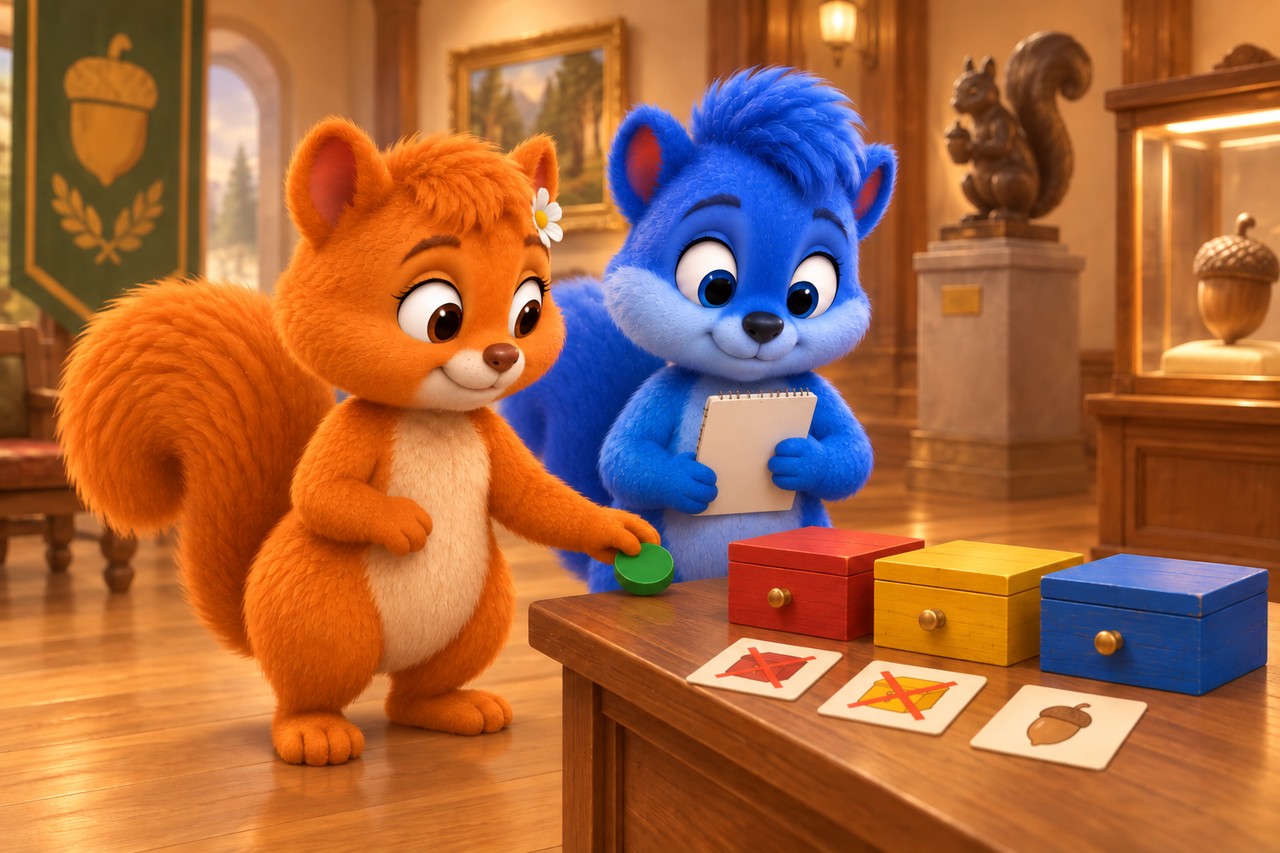
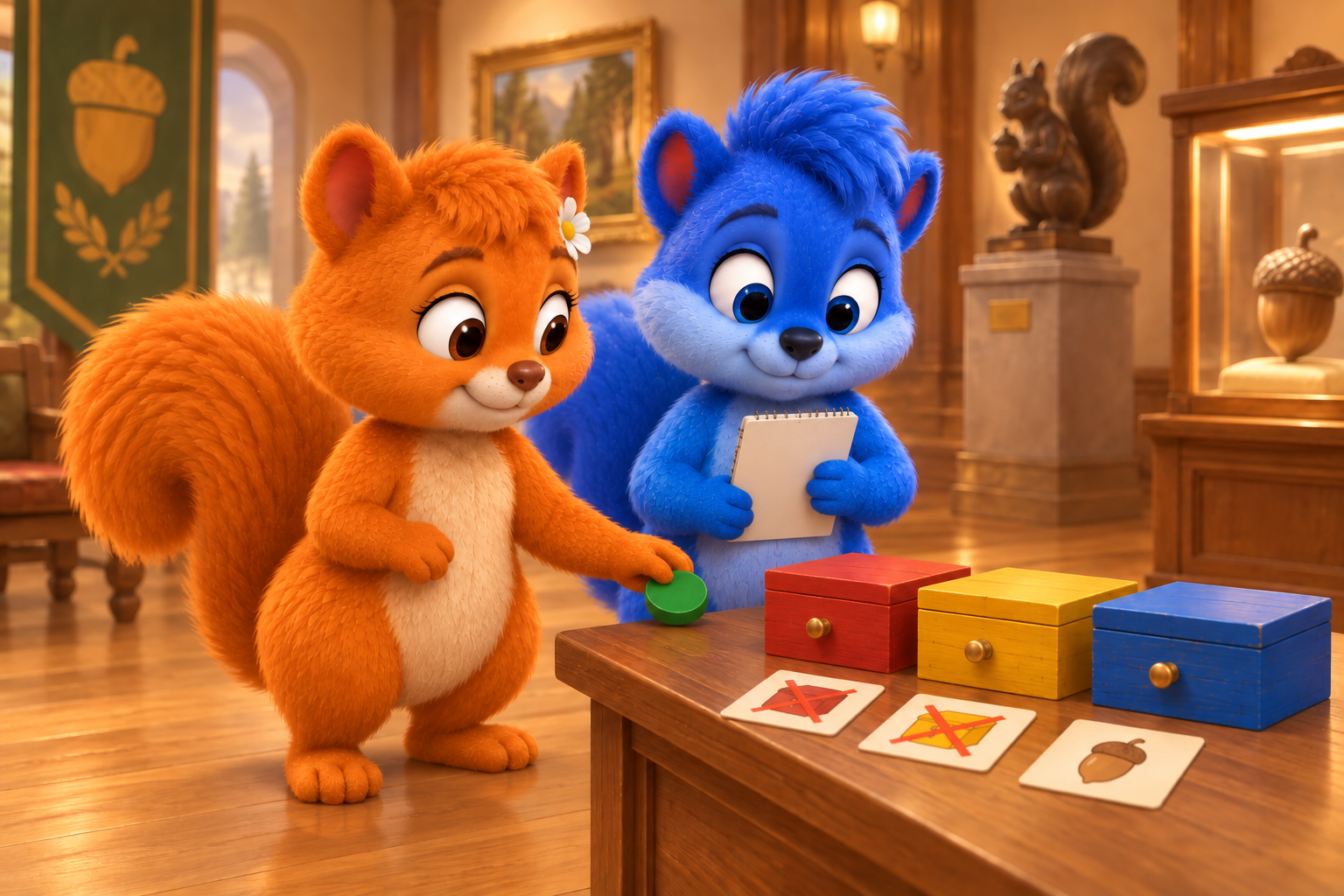
Equal-sized Wusels examine three closed coloured boxes and symbol cards. Invented puzzle. Picture symbols do not replace precise statements or reveal the contents of the boxes. AI-created illustration, not a photograph of nature.
What the diagram shows
The diagram simplifies the process. First compare its shapes and arrows. You can read its labels in larger text below.
Read the picture labels
These are the words and sentences from the diagram above. The full explanation follows below.
- Which possibility remains?
- Not here
- Not here
- Remains
- Rule: exactly one of these three boxes contains the acorn.
- Both clues are true. Without the second, two possibilities remain.
An imagined Wusel scene
Puschel and Flauschi investigate
Puschel immediately guesses his favourite box. Flauschi lays out each clue. One contradicts his guess, so they cross it out. They test the remaining possibilities against all the cards, not just the first matching one.
Look closely
Find the three coloured boxes and green token in Flauschi’s paw. Picture cards are only symbols. The precise valid clues are in the text and labelled diagram; the illustration does not reveal the contents.
An example to help you understand
Draw the three box colours on cards and initially hide an acorn token under blue. Read the two clues aloud and cross out excluded choices on another sheet. Reveal the answer afterwards. For a new puzzle, change the hiding place and clues together. Check that every clue is true and exactly one possibility remains. This is an original thinking game, not a copied NRICH task. For a second, harder puzzle, make three places from left to right, containing one leaf, one acorn and one stone. Two clues apply: the leaf is immediately left of the acorn; the acorn is not at the far right. Which order remains? Leaf–acorn–stone. The leaf–acorn pair can only occupy the first two places. Compare this with the boxes: this clue connects two objects rather than only ruling out a colour.
Try explaining it
When does a solution fit a logic puzzle?
Choose a), b) or c), then explain your choice.
- a)When it fits most clues and the rest are skipped.
- b)When it fits every clue.
- c)When it fits the first clue even though another contradicts it.
Show the explanation
Correct: b): When it fits every clue.
In a logic puzzle, test each possibility against every clue. Eliminate a possibility if it contradicts a clue. Only choices fitting all the rules may remain.
Explore in more detail
Here you will find longer explanations and further details. You can explore them together.
1. Read the rules first
There are exactly three boxes: red, yellow and blue. Exactly one contains an acorn. All the following clues are true in our invented puzzle. These rules define the possibilities. Without exactly one, several boxes could contain an acorn.
2. The first clue rules out red
Clue one says the acorn is not in the red box. Red is excluded, leaving yellow and blue. Guessing blue now would not establish an answer. Notice both what the clue says and what it does not say.
Checked against: [1]
3. The second clue decides
Clue two says the acorn is not in the yellow box. Together with the first clue, only blue remains. This follows because exactly one of the three contains the acorn. Logic here means drawing explainable conclusions from agreed statements.
4. Explain and check the answer
Do not just say blue. Explain: red is excluded, yellow is excluded, and one must contain it. A missing clue may leave several answers. Contradictory clues may make a task impossible. Outside a puzzle, you must also check whether the information itself is true.
An optional question for further exploration
You can use the longer explanation above. This is extra, not needed for the first quiz.
An extra question
What remains possible if all you know is not in the red box?
Discover the answer
Yellow and blue. Another suitable clue is needed to distinguish them. Without it, do not claim a unique answer.
Pictures and sources for adults
Sources for further reading
Facts checked against the specialist sources below on 12 October 2026. The Wusel scene is fictional; comparisons and simplified models are explicitly explained. Sources are in English.