Why does liquid nitrogen make mist?
A substance in our air can become liquid through strong cooling. Explore pictures to discover why it still boils and where the white mist comes from.
The short answer
At a demonstration, white mist can form beside liquid nitrogen. The nitrogen is extremely cold and cools the nearby air. Water from that air forms tiny droplets or ice particles: that is what we see. Nitrogen gas itself is invisible.
Only specialists demonstrate such experiments.
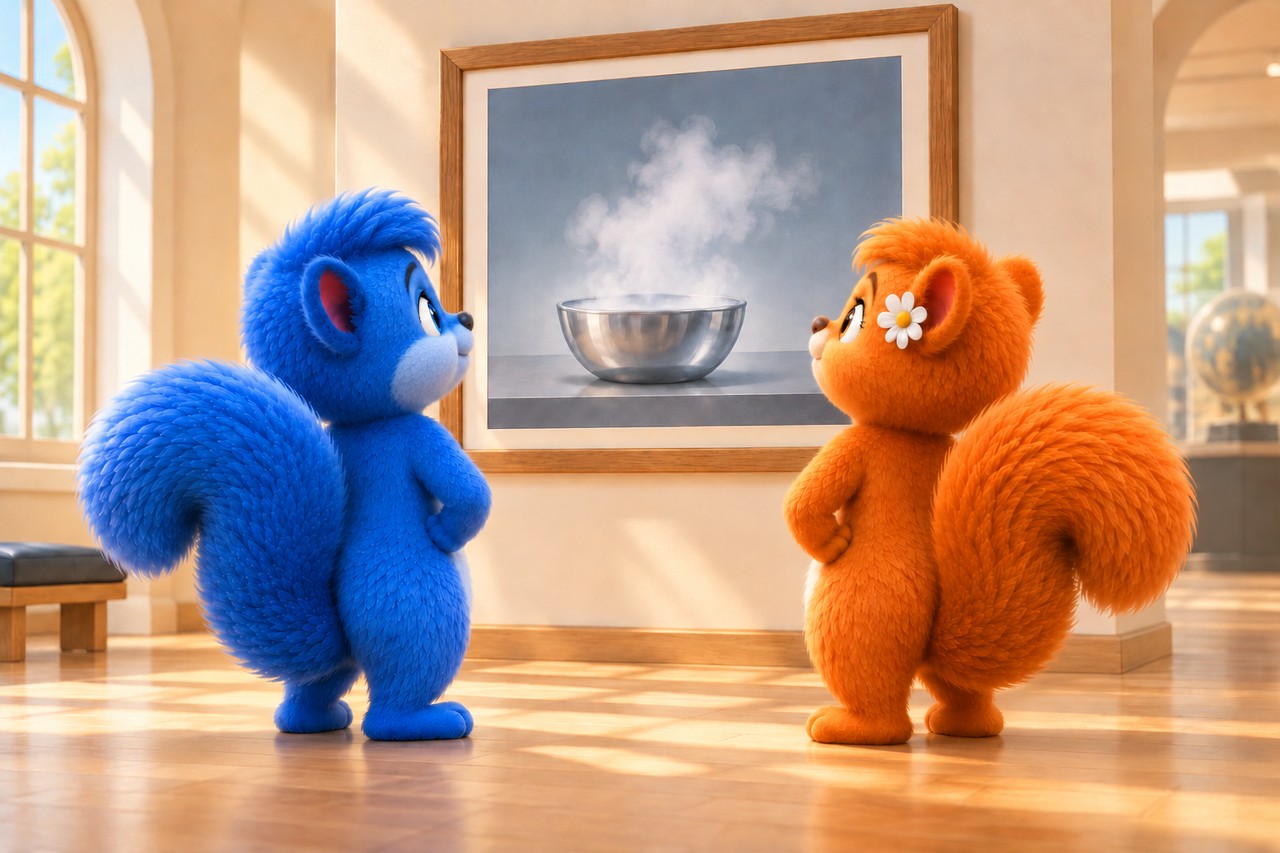
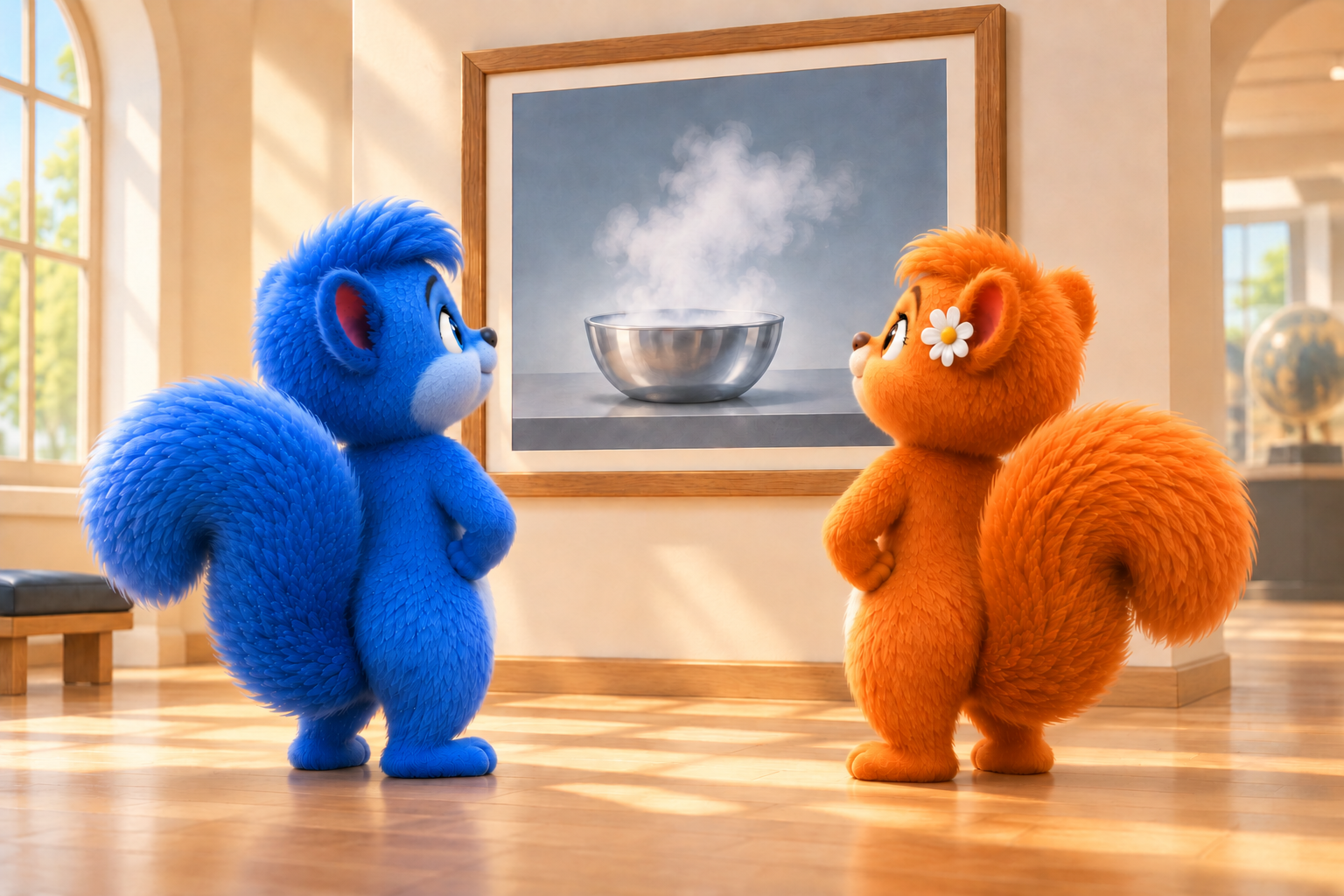
Equal-sized adult Puschel and Flauschi examine a framed museum picture of a demonstration vessel and white mist. Invented museum scene: the Wusels look at a picture, not a real demonstration. The illustrated vessel is not verified equipment or a safety blueprint. AI-created illustration, not a photograph of nature.
What the diagram shows
The diagram simplifies the process. First compare its shapes and arrows. You can read its labels in larger text below.
Read the picture labels
These are the words and sentences from the diagram above. The full explanation follows below.
- Nitrogen and water remain different substances
- 1. Nitrogen: liquid → gas
- Liquid nitrogen
- Heat enters
- Nitrogen gas invisible
- Boiling point: about −196 °C at ordinary atmospheric pressure
- 2. Water from the air: gas → liquid
- Water vapor invisible
- Cooling
- Water droplets together: visible mist
- Cold nitrogen gas cools the nearby air.
- Circles represent water droplets, not nitrogen particles. Simplified relationship; amounts and temperatures are not drawn to scale. A thinking model only: no equipment, quantities or experimental instructions.
An imagined Wusel scene
Puschel and Flauschi investigate
Behind the museum safety barrier, Puschel mistakes the mist for visible nitrogen gas. Flauschi finds the explanation about water from the air. He draws invisible air and visible droplets separately. Experts remain in charge of the demonstration.
Look closely
Puschel and Flauschi look at a framed picture of a demonstration vessel with white mist in an invented museum. There is no real nitrogen vessel near them. The illustration does not explain safe equipment selection; the labeled diagrams show changes between liquid and gas.
An example to help you understand
Draw two separate arrow paths on paper. Above: liquid nitrogen → invisible nitrogen gas. Add: heat from the surroundings. Below: invisible water vapor from the air → tiny visible water droplets. Add: cooling. Explain to each other which substance belongs to each arrow. Water does not turn into nitrogen here. Then draw a temperature line marking zero and minus 196 degrees; the lower value belongs on the colder side. This is a thinking picture, not a liquid experiment.
Try explaining it
What makes the visible white mist in the demonstration?
Choose a), b) or c), then explain your choice.
- a)Nitrogen itself, whose gas is white and visible.
- b)Oxygen from the air becoming a visible white gas.
- c)Tiny water drops or ice particles.
Show the explanation
Correct: c): Tiny water drops or ice particles.
At a demonstration, white mist can form beside liquid nitrogen. The nitrogen is extremely cold and cools the nearby air. Water from that air forms tiny droplets or ice particles: that is what we see. Nitrogen gas itself is invisible.
Only specialists demonstrate such experiments. Water droplets and ice particles scatter light and become visible. Nitrogen and oxygen gases are not themselves white.
Word help
- oxygen
- A gas in air that our bodies take in through breathing and need for their work.
- condensation
- A gas becomes liquid, for example water vapour becoming drops.
Explore in more detail
Here you will find longer explanations and further details. You can explore them together.
1. A gas from the air becomes liquid
Air is a mixture of different gases. A gas spreads through the available space. About 78 out of 100 imagined portions of air are nitrogen when water vapor is excluded. Nitrogen gas is colorless and invisible to our eyes. Very strong cooling can turn this substance into liquid. Liquid nitrogen is neither water nor the whole mixture of air: it is nitrogen in a different state. Here, state means whether a substance is solid, liquid or gas.
2. Boiling does not always mean hot
At ordinary atmospheric pressure, nitrogen boils at about minus 196 degrees Celsius. Boiling means a liquid turns into gas, with gas bubbles forming inside it too. For comparison, water freezes at about zero degrees at ordinary pressure. Minus 196 is much farther on the cold side. The surroundings of a demonstration vessel are much warmer than liquid nitrogen and transfer energy to it as heat. It can therefore boil while being extremely cold. Its boiling point applies at a particular pressure; different pressure conditions do not all give the same temperature.
3. White mist is not nitrogen gas
Air also contains water vapor: water as invisible gas. The cold nitrogen gas cools the nearby air. Water vapor can then turn into tiny water droplets. This change is called condensation. Many droplets redirect light in different directions; together they become visible as pale mist. Nitrogen gas itself stays invisible. Two different changes take place: nitrogen goes from liquid to gas, while water from the surroundings goes from gas to liquid. Our picture shows droplet mist, not a white color belonging to nitrogen.
4. Why only specialists demonstrate it
Extreme cold can badly injure skin and eyes. The gas produced can also displace air and its life-supporting oxygen. Specialists therefore need to provide suitable ventilation. Ventilation means replacing room air with fresh air. In a tightly closed vessel, turning into gas can create dangerous pressure: the gas pushes against the vessel walls. Specialists need appropriate equipment and training. An ordinary container with a lid is not experimental equipment. Warm surroundings do not instantly make the contents harmless.
An optional question for further exploration
You can use the longer explanation above. This is extra, not needed for the first quiz.
An extra question
Is white mist the same thing as invisible nitrogen gas? Explain using the two substance paths.
Discover the answer
No. Liquid nitrogen turns into invisible gas. The cold gas cools nearby air; water vapor from that air can condense into tiny water droplets. These droplets form the visible mist. Nitrogen and water remain different substances.
Pictures and sources for adults
Sources for further reading
Facts checked against the specialist sources below on 12 October 2026. The Wusel scene is fictional; comparisons and simplified models are explicitly explained. Sources are in English.
- NOAA: Stickstoff in trockener Luft
- NIST: Siedetemperatur von Stickstoff
- University of Wisconsin–Madison: Woraus der Nebel besteht
- Utah State University: Gas, Kälte und sichere Facharbeit
- University of Washington: Sauerstoffverdrängung und Druckaufbau
- Lawrence Berkeley National Laboratory: Gefahren extremer Kälte