How do lions live together?
A mane is a striking feature. Groups, food and habitats also matter to a lion’s life.
The short answer
Lions often live in groups called prides. Related females and their young commonly form the core; adult males may join them. They share space and activities, but pride composition varies.
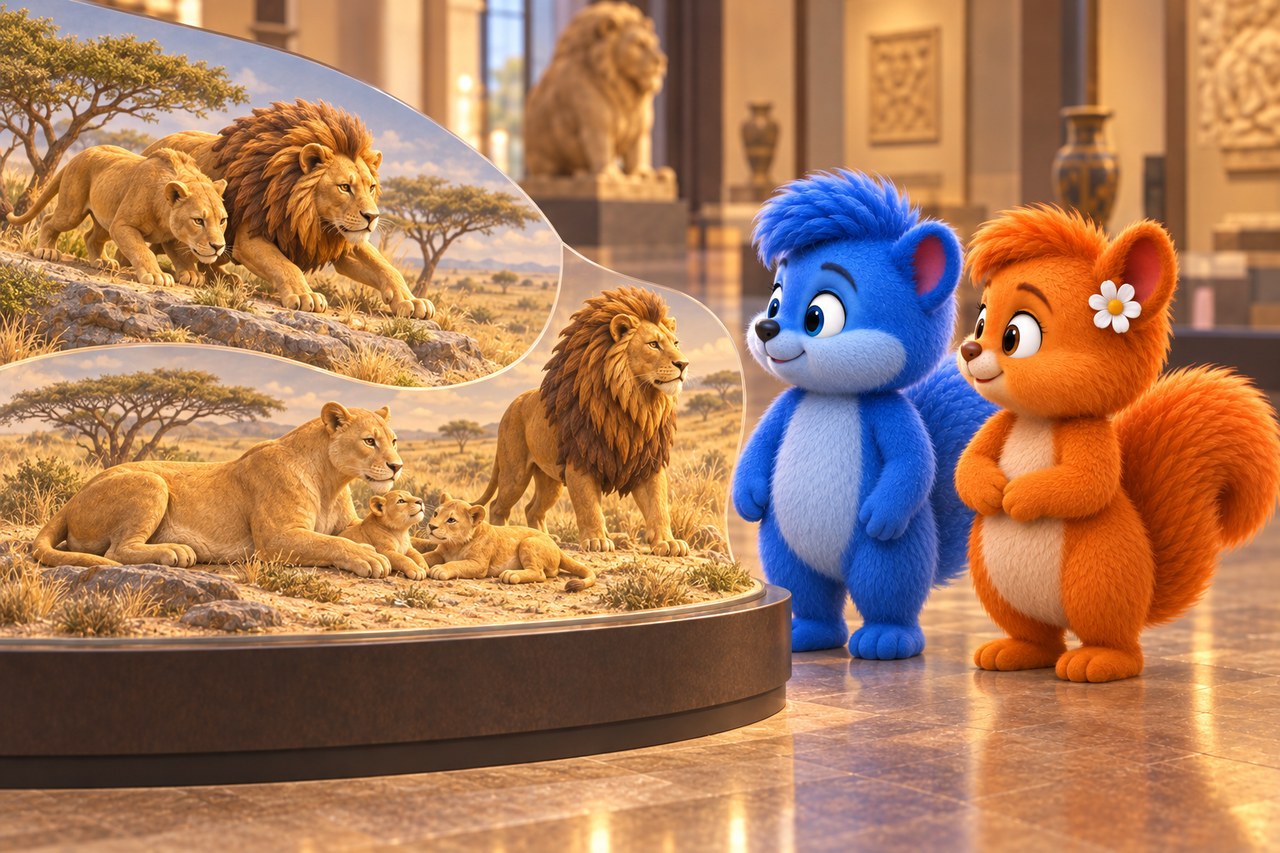

Puschel and Flauschi in the museum. Lion pride museum model with adults, cubs and different activities. An example group, not a fixed composition for every pride. AI-created illustration, not a photograph of nature.
Explained in three pictures
1 An example pride
Lionesses, cubs and adult males can form a pride.
2 Together and apart
Subgroups sometimes rest or hunt together. Males hunt too.
3 Cubs and protection
Group life includes caring for cubs and defending territory.
More about the picture
A lion pride often consists of related lionesses, their cubs and one or more adult males. Groups and subgroups vary. Males hunt too; our examples are not a fixed division of roles for every pride.
An imagined Wusel scene
Puschel and Flauschi investigate
In the museum model, Puschel first counts only males with manes. Flauschi points to females and cubs. They draw all members and check the label. His picture now shows a pride, not just its most conspicuous animals.
Look closely
Compare the museum model with the three picture steps. Subgroups sometimes rest or hunt together. Males hunt too.
An example to help you understand
On paper, draw a small imaginary pride with females, cubs and an adult male. With adult help cut out the figures, placing some together and others a little apart. This merely shows how subgroups might be represented; it is no plan for every real pride. Then compare the mane and dark tail tuft on a suitable photograph.
Try explaining it
What is a lion pride?
Choose a), b) or c), then explain your choice.
- a)A chance gathering of animals that do not live together.
- b)A single pair of parents whose young are not part of the group.
- c)A group often including related females and young.
Show the explanation
Correct: c): A group often including related females and young.
Lions often live in groups called prides. Related females and their young commonly form the core; adult males may join them. They share space and activities, but pride composition varies.
Explore in more detail
Here you will find longer explanations and further details. You can explore them together.
1. Not every lion has a mane
Lions belong to the cat family. Many adult males have a mane around their neck and head. Its colour and development vary; males without a conspicuous mane also occur. Females normally have no mane. This visible feature helps when comparing pictures, but cannot replace detailed knowledge of an individual animal.
Checked against: [1]
2. A pride has no fixed seating plan
Many lions live in prides. These often include related females, cubs and adult males. Members may spend time in smaller subgroups. Some lions also live without a settled pride. Numbers and membership are therefore not the same everywhere. Lions communicate through sounds and scents, among other means.
3. Males can hunt too
Lions eat other animals. Females may cooperate in hunting, but males hunt too. “Only lionesses hunt” would be incorrect. A pride needs suitable prey and space. Between active periods lions spend much time resting. A quietly resting lion is therefore no invitation to approach.
4. Protection includes coexistence with people
Most wild lions live in Africa; a smaller population lives in India. A population here means animals of the same species living in a particular area. Grasslands, open woodland and other habitats can be suitable. Habitat loss and fragmentation make their lives harder. Specialists also work with local communities to protect livestock better and reduce conflict.
An optional question for further exploration
You can use the longer explanation above. This is extra, not needed for the first quiz.
An extra question
Is it true that only lionesses hunt?
Discover the answer
No. Lionesses may hunt together, but male lions hunt too. How animals live together and find food depends on their group and circumstances.
Pictures and sources for adults
Sources for further reading
Facts checked against the specialist sources below on 12 October 2026. The Wusel scene is fictional; comparisons and simplified models are explicitly explained. Sources are in English.