Who lived and worked in a real castle?
A castle was a protected residence and a sign of power. Its kitchen mattered as much as its gate.
The short answer
Many people lived and worked in a castle: the ruling household, guards, craftspeople and workers supplying food and services. Walls offered defence, while rooms also had to support everyday life.
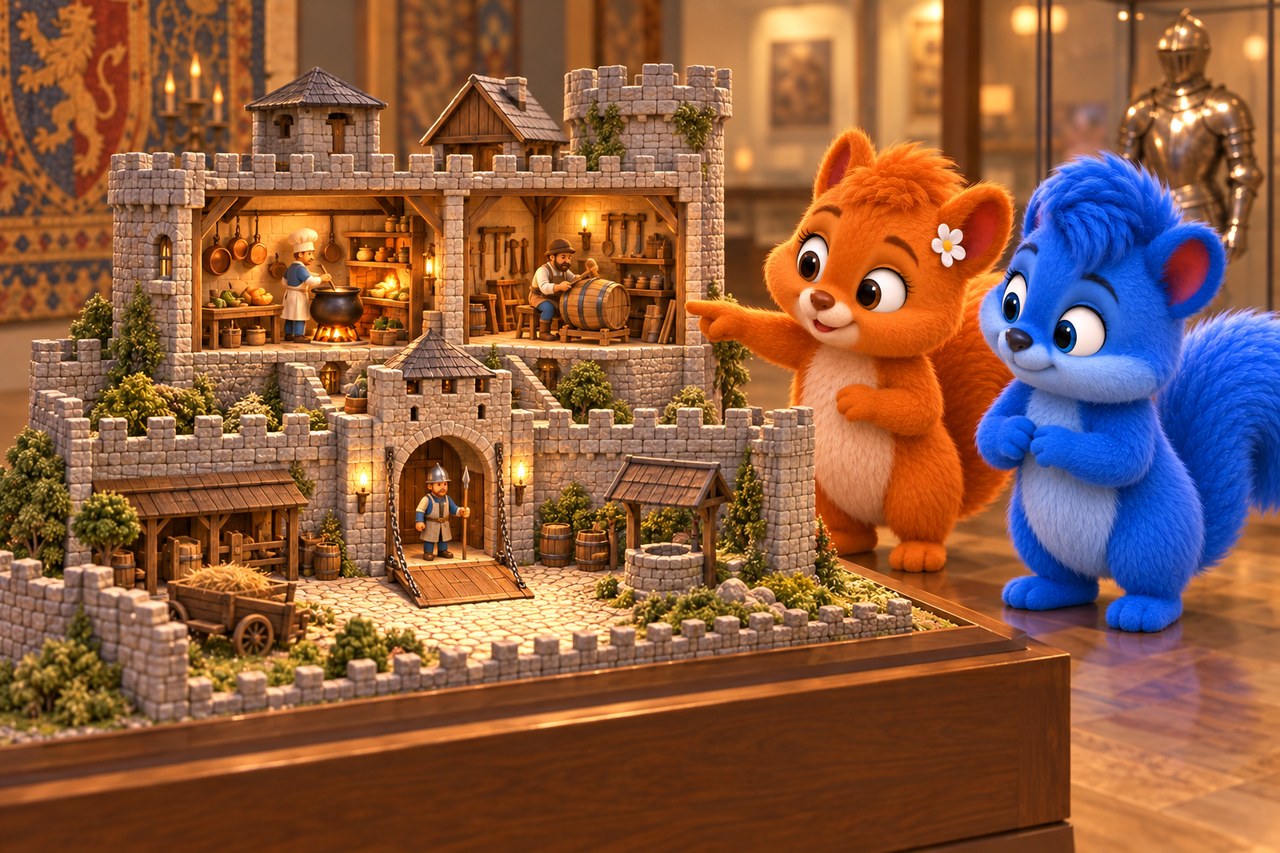
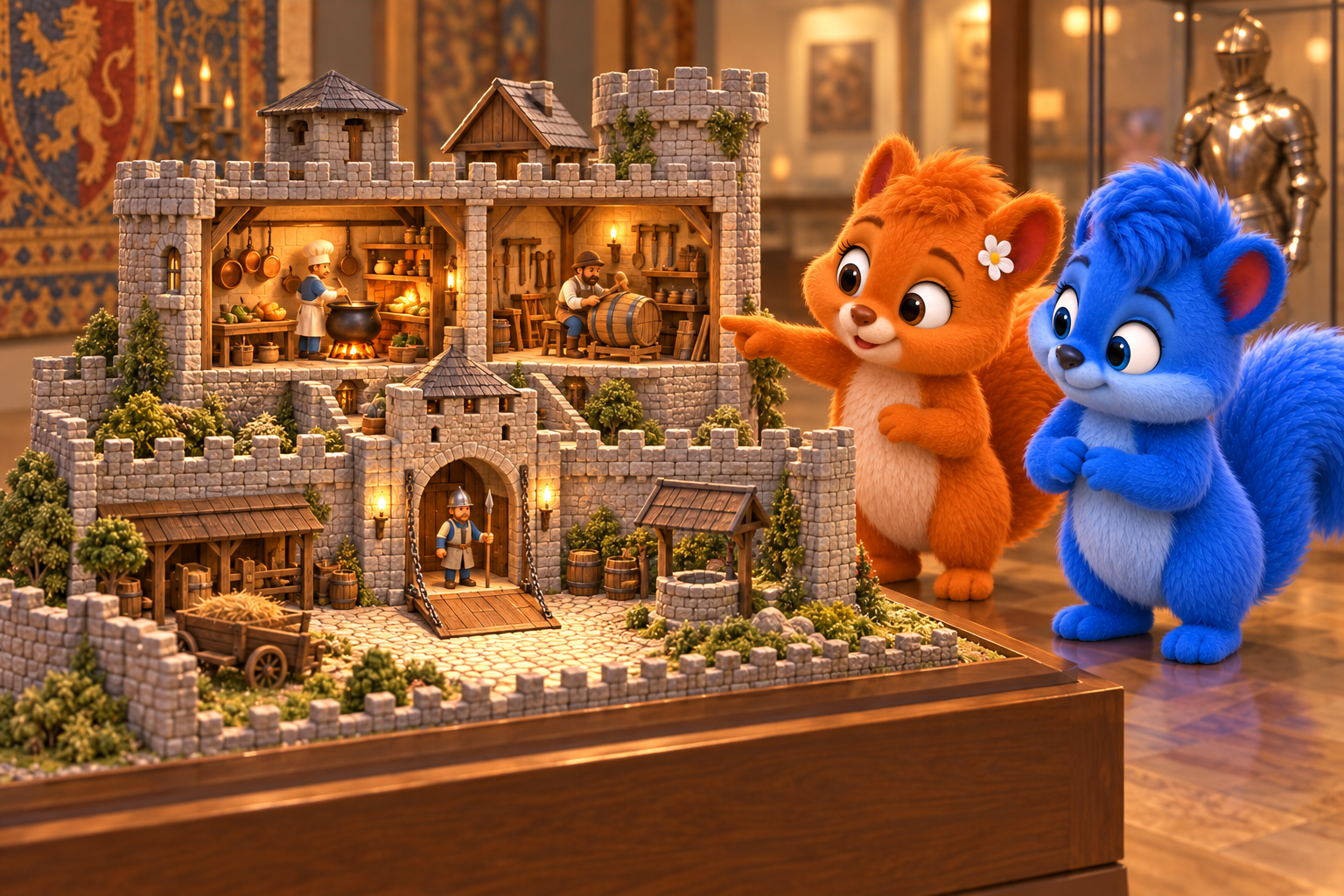
Puschel and Flauschi in the museum. Castle model with cooking, craftwork and a gate guard. An invented overview; real castles varied with place and period. AI-created illustration, not a photograph of nature.
Explained in three pictures
1 Kitchen and stores
Cooks and other workers prepared food.
2 Hall and household
Household members lived there and managed supplies and tasks.
3 Gate and defence
Guards protected entrances. Craftspeople maintained things.
More about the picture
Many people lived and worked in a real castle: household members, cooks, guards and craftspeople, for example. Residents and jobs varied with the castle and period. The pictures show examples, not a complete castle plan.
An imagined Wusel scene
Puschel and Flauschi investigate
At the castle model, Puschel counts suits of armour. Flauschi points to the kitchen, well and workshop. They trace a loaf's route to the table. He adds the people whose work he had missed on his first look.
Look closely
Compare the museum model with the three picture steps. Household members lived there and managed supplies and tasks.
An example to help you understand
Draw a simple castle plan with gate, living room and kitchen. Place cards for guarding the entrance, preparing food and providing a place to sleep in appropriate areas. Remove the kitchen card. Explain the problem residents would need to solve. This explores everyday cooperation, not how to build defences. One drawn tower does not reveal a population. For a visited castle, read that particular site’s explanation.
Try explaining it
Who belonged to castle life besides knights?
Choose a), b) or c), then explain your choice.
- a)People who received all food ready-made from outside and stored none.
- b)People who only fought and handled supplies without other work.
- c)People working in kitchens, supplies and crafts too.
Show the explanation
Correct: c): People working in kitchens, supplies and crafts too.
Many people lived and worked in a castle: the ruling household, guards, craftspeople and workers supplying food and services. Walls offered defence, while rooms also had to support everyday life.
Explore in more detail
Here you will find longer explanations and further details. You can explore them together.
1. Residence and defence
A medieval castle combined living rooms with fortifications: structures intended to protect a place against attack, such as a wall and controlled gate. Castles also displayed owners’ power. Parts varied with location and construction date.
Checked against: [1]
2. Everyday life needs many jobs
Different people lived and worked in castles. Soldiers could guard a gate, cooks prepare meals and servants maintain the household. Work and living conditions were unequal. Not everyone was a knight or owner. A strong wall alone cannot cook lunch. Goodrich Castle in England gives a striking example of the scale. When Countess Joan de Valence arrived in 1296, her following included 194 people and more than 50 horses. They all needed supplies and space. This recorded visit illustrates this castle, not the usual population of every castle.
Checked against: [2]
3. Knights belonged to real history
Knights belonged to medieval warfare. Horses and armour were expensive. Armour is protective equipment worn on the body, and it changed over time. Mail consists of joined metal rings; later plate armour uses solid metal pieces. The background suit is a museum model, not evidence for every period of knighthood.
Checked against: [3]
4. Buildings change
Some early English castles had earth banks and wooden defences. At certain sites, stone later replaced parts. Other castles had large stone towers from the beginning. There was no single sequence for every castle. Ask where a real building stands, when each part appeared and what changed.
Checked against: [3]
An optional question for further exploration
You can use the longer explanation above. This is extra, not needed for the first quiz.
An extra question
Why can knights and tall walls alone not explain castle life?
Discover the answer
Other people prepared food, managed supplies and rooms, or guarded the gate. Castles needed living and working spaces; everyday life varied by site and period.
Pictures and sources for adults
Sources for further reading
Facts checked against the specialist sources below on 12 October 2026. The Wusel scene is fictional; comparisons and simplified models are explicitly explained. Sources are in English.