Inventions: an idea needs testing
What should our idea improve? Sketches, simple models and clear tests help us discover whether it fits the task.
The short answer
An invention often begins with a problem or wish. We plan a solution, build a model and test whether it does the job. Test failures help improve it. A new idea alone is not a proven solution.
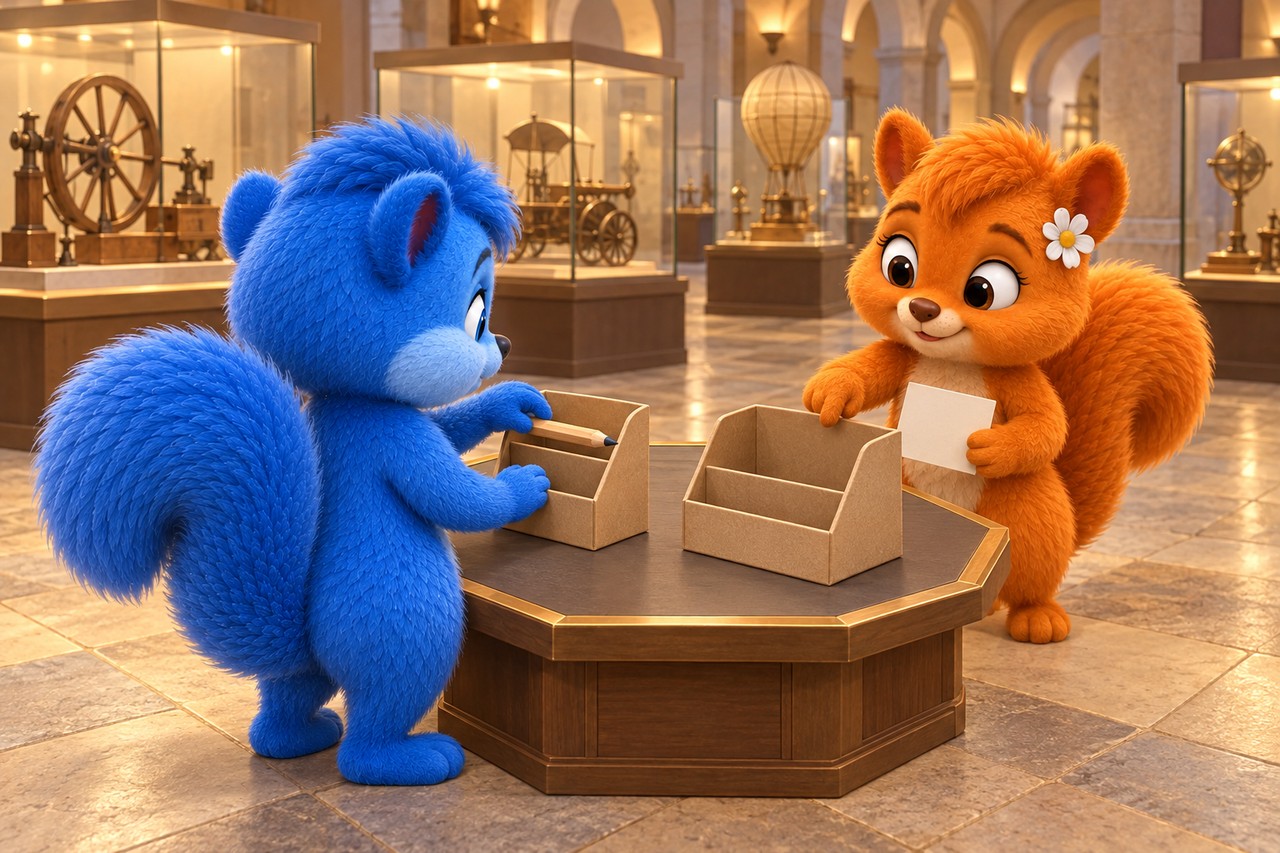
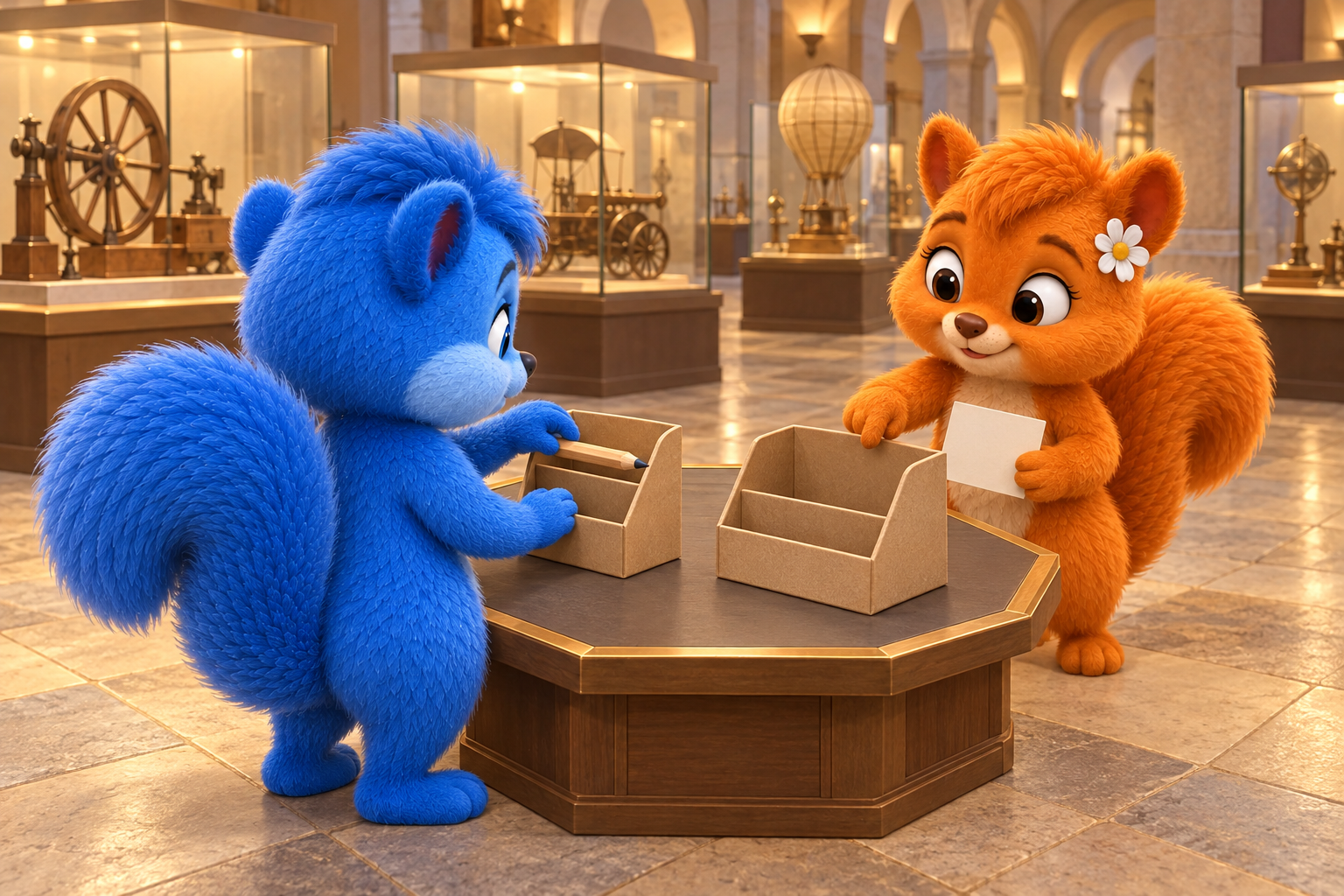
Puschel and Flauschi compare two cardboard holders at a museum invention station. Original learning scene with cardboard prototypes; no historical invention or proven new product. AI-created illustration, not a photograph of nature.
What the diagram shows
The diagram simplifies the process. First compare its shapes and arrows. You can read its labels in larger text below.
Read the picture labels
These are the words and sentences from the diagram above. The full explanation follows below.
- Two compartments, three questions for our test
- Does the pencil fit?
- Does the card fit?
- Does the holder stay upright?
- Specify task → build → test → revise
- Same objects, same surface.
- Investigate one change; record results.
- A problem in testing helps with the next design too.
- Original sketch and test questions; no measured results yet.
An imagined Wusel scene
Puschel and Flauschi investigate
Puschel's attractive bridge model does not carry the agreed light load. Flauschi records the result instead of hiding it. They change one support and repeat the same test. The failure helps them improve the idea deliberately.
Look closely
In the invention museum, Puschel and Flauschi compare two original cardboard models at a visitor station. Puschel places a drawing pencil against one compartment. Flauschi examines the other model and holds a small sketch card. Old mechanical models are protected behind glass.
An example to help you understand
Original task: a cardboard holder should keep a thick drawing pencil and a large paper card separate. Sketch two compartments and build a small prototype from prepared parts. On the same level surface, test with the same objects: do both fit, remain separate, and leave the holder standing when placed gently? Change just the base width, for example, and test again. One successful attempt does not prove a globally new invention.
Try explaining it
How do we test in practice whether an invention model does its job?
Choose a), b) or c), then explain your choice.
- a)Explain the planned procedure and leave out the trial.
- b)Try it at its task and improve it based on the result.
- c)Judge its function from its appearance without trying it.
Show the explanation
Correct: b): Try it at its task and improve it based on the result.
An invention often begins with a problem or wish. We plan a solution, build a model and test whether it does the job. Test failures help improve it. A new idea alone is not a proven solution.
Word help
- prototype
- An early model or device for testing an idea.
Explore in more detail
Here you will find longer explanations and further details. You can explore them together.
1. Begin with a task
An inventive idea may grow from an observed task. Explore existing solutions, sketch suggestions and discuss them. Invention is a process with several attempts and may involve collaboration. It does not always depend on one sudden inspiration.
Checked against: [1]
2. Describe success in advance
Requirements specify what a solution should do. Constraints may concern available materials, time or cost. For our paper station, first ask which objects should stay separate and how to tell whether the model fulfils its task. An attractive appearance alone does not answer these questions.
3. Build a prototype
A prototype is an early model or working version used to investigate an idea. It need not yet look like a finished product. Build something simple, test it and revise the design if needed. This repeated process is called iteration: revise and check again.
4. Make comparisons fair
Compare possible solutions against the same requirements. Keep test conditions appropriately consistent and change just one investigated aspect where possible. Record what fails too. This helps identify which change makes a difference and what still needs checking.
Checked against: [3]
An optional question for further exploration
You can use the longer explanation above. This is extra, not needed for the first quiz.
An extra question
Why decide what a prototype should do before building it?
Discover the answer
So testing can check specific requirements. Without a clear goal, we cannot tell whether the model fulfils its task. Consistent test conditions help us compare changes.
Pictures and sources for adults
Sources for further reading
Facts checked against the specialist sources below on 12 October 2026. The Wusel scene is fictional; comparisons and simplified models are explicitly explained. Sources are in English.