Who benefits from an insect hotel?
Tubes may help some solitary bees. Flowers and natural nesting places remain important.
The short answer
Suitable tubes and cavities can provide nesting space for some solitary bees and wasps. Not every insect uses these aids. Food plants and suitable habitats remain important.
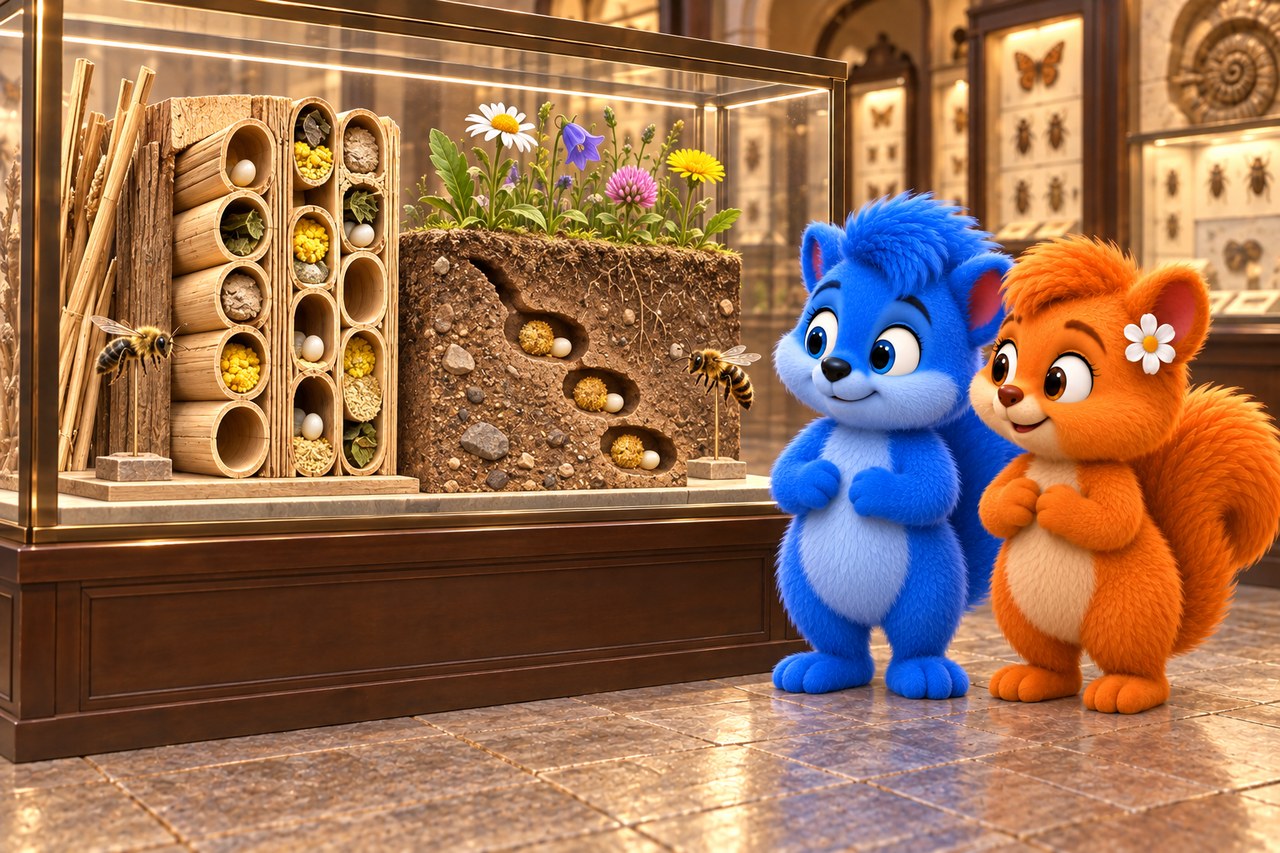
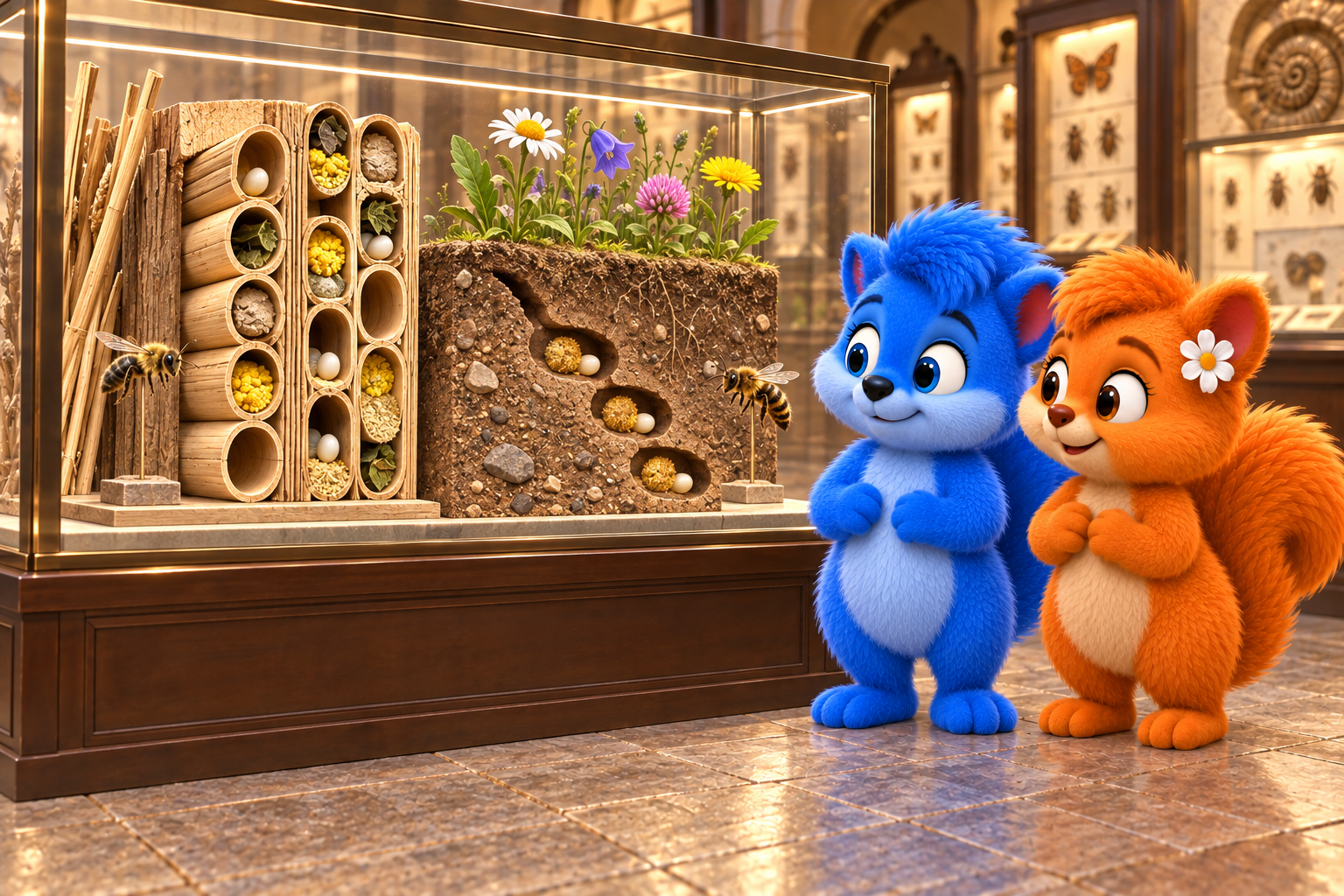
Puschel and Flauschi in the museum. Nesting models in tubes and soil; flowers provide food. Examples of different nesting habits; not all species use nesting aids. AI-created illustration, not a photograph of nature.
Explained in three pictures
1 Some wild bees
Certain solitary wild bees use suitable cavities for their young.
2 Solitary wasps too
Some solitary wasps also use such cavities.
3 Many need other places
Many wild bees nest in soil. All need suitable food.
More about the picture
An insect hotel helps certain solitary wild bees and wasps when materials and cavities suit them. It is not a home for all insects. Flowers and natural nesting sites matter too. The open nests are drawings only; real nests are left closed.
An imagined Wusel scene
Puschel and Flauschi investigate
Puschel wants to label his nesting-aid picture “For all insects.” Flauschi compares the tubes with their shown occupants. They read which animals use them. He adds plants and open habitat around the small aid.
Look closely
Compare the museum model with the three picture steps. Some solitary wasps also use such cavities.
An example to help you understand
On permitted paper draw three original symbols: a flower, a hollow passage and a bare ground patch. Match them with “food” or “possible nesting place”. A symbol cannot identify the exact plant or bee species involved. Then compare the empty tube and flower models in the museum without opening their cases.
Try explaining it
Why is a nesting aid alone not enough to protect insects?
Choose a), b) or c), then explain your choice.
- a)A nesting aid also supplies its inhabitants with enough flower food.
- b)Every insect species needs the same nesting tubes to live.
- c)Food plants and suitable habitats may still be missing.
Show the explanation
Correct: c): Food plants and suitable habitats may still be missing.
Suitable tubes and cavities can provide nesting space for some solitary bees and wasps. Not every insect uses these aids. Food plants and suitable habitats remain important.
Word help
- pollen
- Fine powder from flowers. Pollination carries it to a suitable flower’s receiving surface. It is not a plant seed.
- nectar
- A sugary liquid offered by many flowers and eaten by some animals.
Explore in more detail
Here you will find longer explanations and further details. You can explore them together.
1. A nesting place rather than a holiday hotel
Some solitary bees and wasps create brood chambers in suitable cavities. Solitary means a female builds her nest without a shared colony. Brood chambers are small separate spaces for offspring, where young animals develop from eggs. “Insect hotel” is an engaging name, no hotel for holiday visitors. From outside you may observe animals bringing in materials or closing entrances. Leave their nests undisturbed.
Checked against: [1]
2. Smooth suitable passages matter
Tubes and drilled passages must suit the animals concerned. Splinters and projecting fibres can injure delicate wings. Clear glass or plastic tubes are unsuitable nesting aids: moisture and mould may cause problems inside. Adults seek expert advice on materials, workmanship and placement. Our enlarged museum model is no building guide.
3. A tube wall does not help every species
Many solitary bee species nest in the ground. Others use various plant stems or cavities. Pith is the soft tissue inside some plant stems. Pithy stems are not offered in the same way as hollow tubes; suitable individual upright stems may matter. A decorative collection of random objects therefore does not automatically meet animals’ needs. Distinguish nesting habits rather than placing the same aid everywhere.
4. Food and habitat belong together
Bees need suitable flowers offering pollen and nectar. Pollen is the fine powder made by flowers; nectar is a sugary liquid many flowers provide. A varied supply during their active period helps more than a nesting place without nearby food. Wildlife-friendly gardens also offer different structures such as bare ground patches, dead wood and retained plant stems. Which help suits depends on the species present.
Checked against: [4]
An optional question for further exploration
You can use the longer explanation above. This is extra, not needed for the first quiz.
An extra question
Is an insect hotel enough to help every solitary bee species?
Discover the answer
No. Some species use suitable tubes; many others nest in the ground or elsewhere. They also need suitable food and habitats. A nesting aid can be an addition but cannot replace varied natural surroundings.
Pictures and sources for adults
Sources for further reading
Facts checked against the specialist sources below on 12 October 2026. The Wusel scene is fictional; comparisons and simplified models are explicitly explained. Sources are in German.