How do we invent a magic school?
A setting, original story rules and a small task: create an imaginary school on paper.
The short answer
Imagine a fictional school where children learn magic. One clear rule might be: a floating spell lasts only one minute. The characters must then find a solution in time. Such rules help a story make sense.
Real dangerous experiments are not part of it.
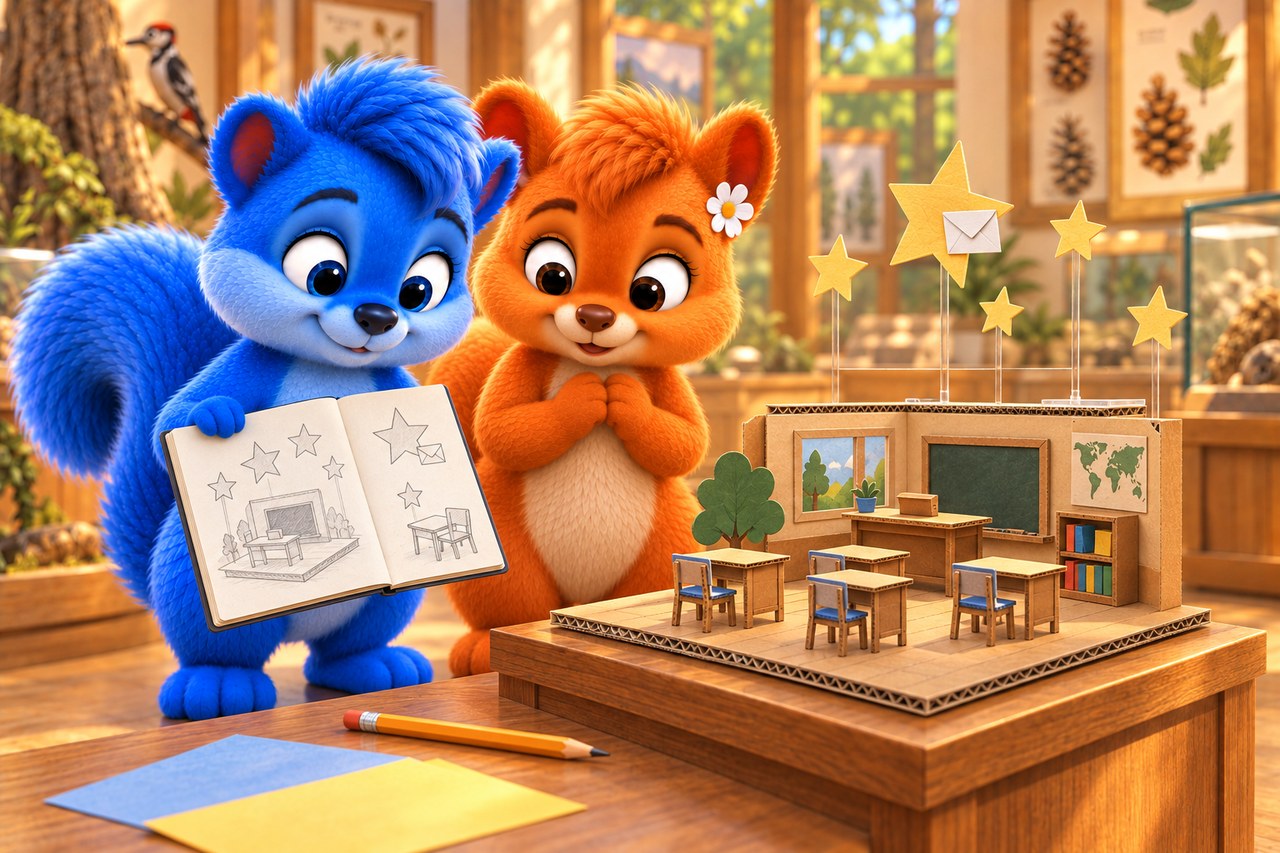
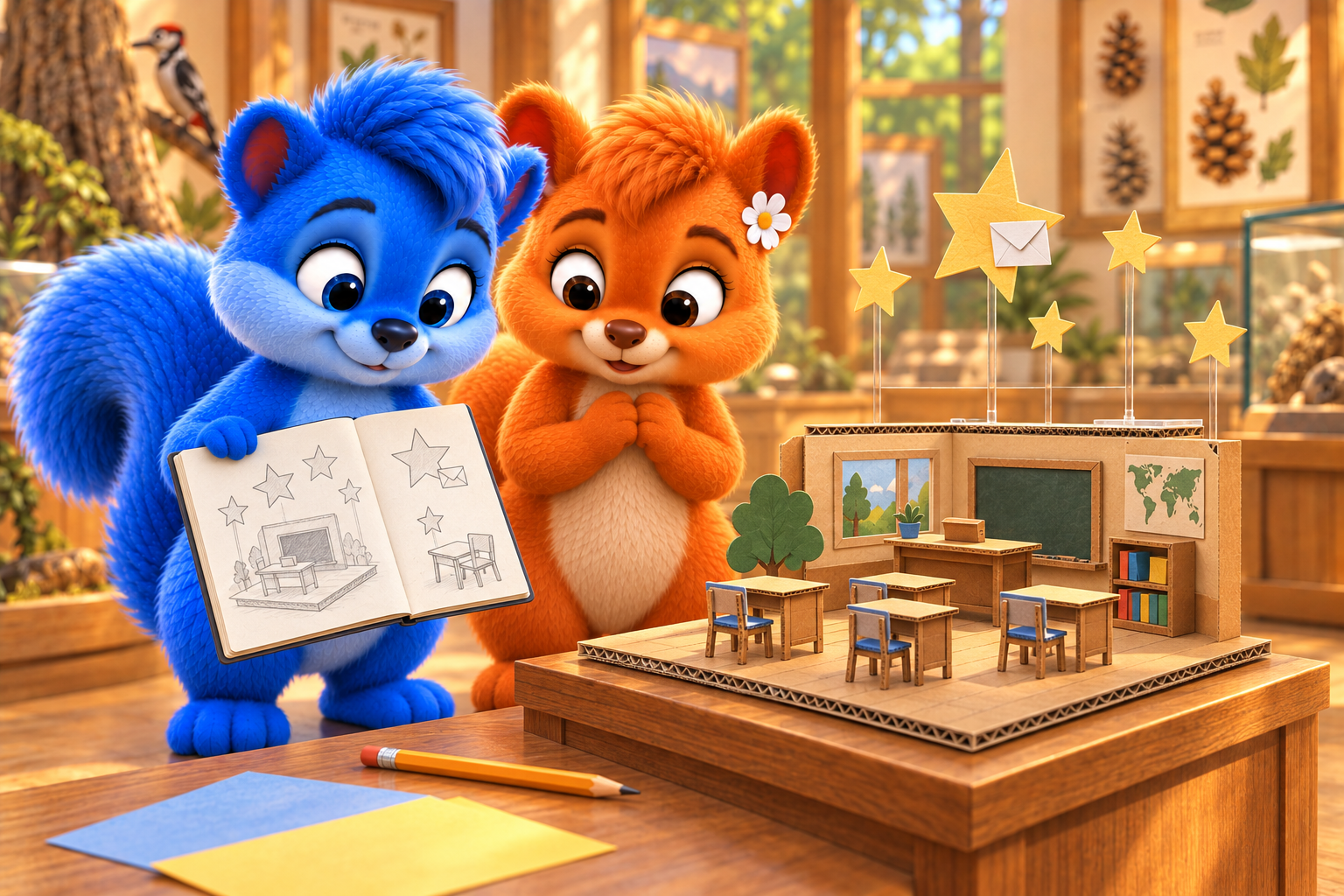
Puschel and Flauschi in the museum. Invented school model: paper stars carry messages; desks stay on the floor. The rule belongs to our invented story. AI-created illustration, not a photograph of nature.
Explained in three pictures
1 Invent a place
First we invent a place and a learning task.
2 Choose a clear rule
Our example rule: only paper stars can float.
3 Tell within the rule
A star carries a message; the desk stays on the floor.
More about the picture
A magical school grows from a place, a learning idea and story rules. A concrete example helps check whether the solution fits the invented rule. This paper-star rule applies only to this example, not permanently to the Wusel world.
An imagined Wusel scene
Puschel and Flauschi investigate
Puschel's invented school solves every problem with a spell. Soon there is no story left. Flauschi asks about a limit to the magic. They decide lost memories cannot be conjured back. Now their character needs a plan.
Look closely
Compare the museum model with the three picture steps. Our example rule: only paper stars can float.
An example to help you understand
Draw your own imaginary school and give it an original name. Put three cards beside it: “setting,” “learning idea” and “story rule.” Tell a small task and how a character solves it. If a detail does not fit your rule, change the detail or clearly explain the new rule. Label the drawing and story as invented. These are your original designs, no new permanent rules for Puschel and Flauschi.
Try explaining it
Why do clear rules help an invented magical school story?
Choose a), b) or c), then explain your choice.
- a)They let every character remove any difficulty without limits.
- b)They replace the plot because rules alone tell a story.
- c)They show characters' possibilities, limits and problems.
Show the explanation
Correct: c): They show characters' possibilities, limits and problems.
Imagine a fictional school where children learn magic. One clear rule might be: a floating spell lasts only one minute. The characters must then find a solution in time. Such rules help a story make sense.
Real dangerous experiments are not part of it.
Explore in more detail
Here you will find longer explanations and further details. You can explore them together.
1. A setting belongs to a story
Fantasy is a form of storytelling that may include impossible things and invented worlds. A setting is the place where something happens in a story. A magic school can be such an invented place. The British Library’s fantasy exhibition included drafts, maps and drawings of imagined worlds. A draft provides evidence of creative work, not real magic.
Checked against: [1]
2. One particular example is Roke
Ursula K. Le Guin’s Earthsea story world includes Roke, a place where wizards are trained. The Dragonfly excerpt published on the official author website mentions that training. Naming the author and story world makes clear that this is an example from a particular work, no actual school or rule for all fantasy stories.
Checked against: [2]
3. Our school gets its own rules
Choose three things for our design: a place, something to learn and a limit on the invented ability. For example, our original Paper Word School stands beside a drawn forest. Only in our story can words appear as paper shapes; they do not complete other people’s tasks. Such decisions help us continue the story clearly. In his writing advice, Don Long stresses the importance of characters and settings.
Checked against: [3]
4. A small task moves the action forward
Plan a short original story: a character wants to make a shared word picture. At first, some letters are missing. The character asks others which words matter to them and changes the design. Finally, the shared picture is ready. This sequence is our writing idea, no compulsory pattern for every story. Read it again to check whether place, actions and rules fit together; revision is part of writing too.
Checked against: [3]
An optional question for further exploration
You can use the longer explanation above. This is extra, not needed for the first quiz.
An extra question
Why write down a story rule for our imaginary school?
Discover the answer
It lets us explain what is possible in our invented story and what limits apply. That helps us continue and revise it. The rule belongs to our design; it provides no evidence of real magic.
Pictures and sources for adults
Sources for further reading
Facts checked against the specialist sources below on 12 October 2026. The Wusel scene is fictional; comparisons and simplified models are explicitly explained. Sources are in English.