Media & Invention
How does a message reach another phone?
The short answer
Your device turns an internet message into digital data. Small data packets travel through connected networks. Radio first connects the phone to a network access point; cables often carry the journey onward.
Devices, and often a service’s server, forward data until the destination can display the message.
See how it works
Arrows show a direction or change. Sizes and distances are simplified. Read in order; each explanation belongs to the picture above it.
1. Make data
Letters, pictures or sounds are represented as digital data. For transmission, data is divided into packets with extra information. This helps devices identify and forward them.
2. Join a network
A phone may use Wi-Fi to reach a router or a mobile connection to a radio station. Wi-Fi alone is not the whole internet: it first provides a nearby link.
3. Forward the data
Routers link networks and forward packets. Long routes often use cables, including undersea cables. Many messaging apps use a service’s server to receive and forward data.
4. Display at the destination
At the destination, transmitted data is put together and processed. The service organises delivery; missing data can be transmitted again. A phone that is off or disconnected cannot immediately receive a new message.
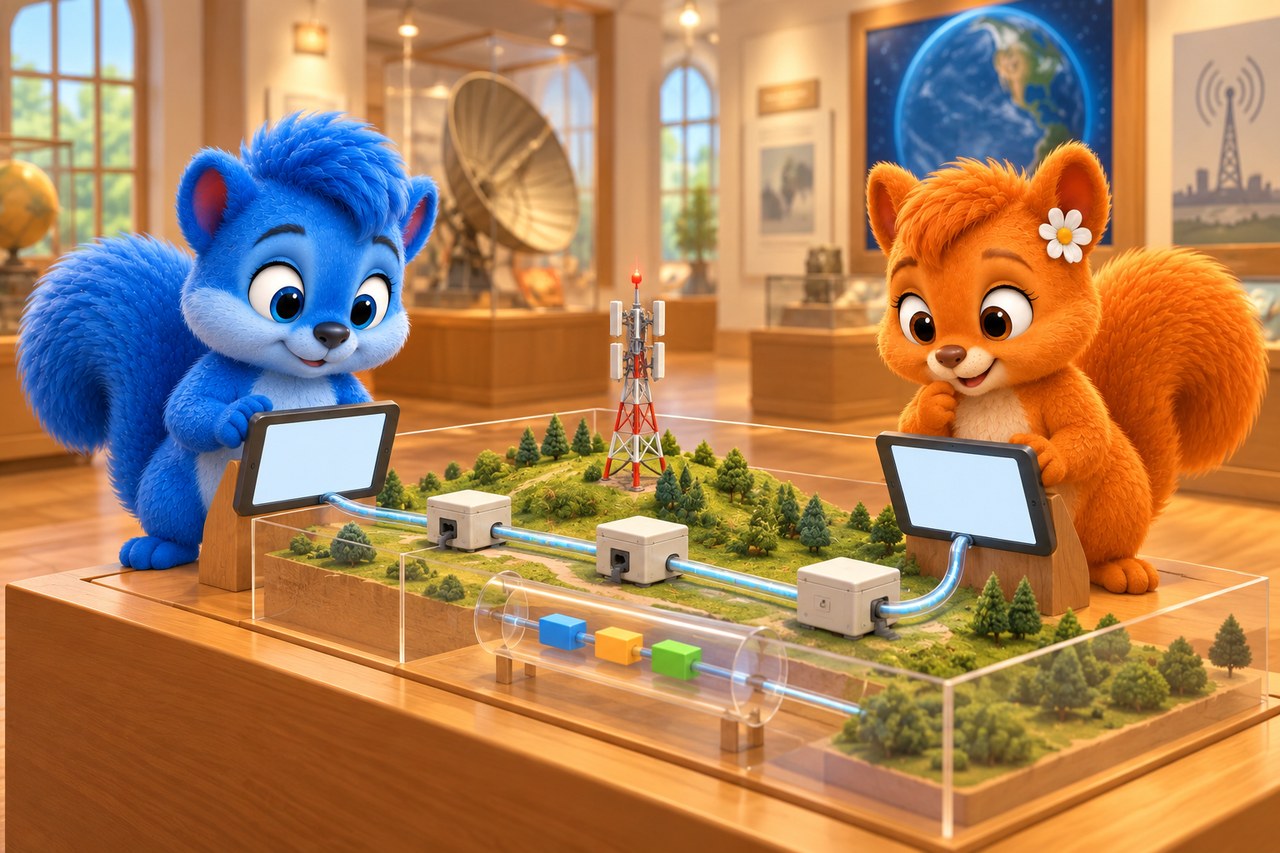
An imagined Wusel scene
Puschel and Flauschi investigate
At the museum, Puschel looks for one radio beam going straight between two phones. Flauschi follows the cables of the network model. They discover how many connections can carry one message.
Word help
- Router
- A device forwarding data between networks.
- Server
- A computer or system providing a service to other devices.
Your activity
Divide a made-up short message across three numbered paper cards. Pass them through two table stations and put them in order at the destination. Numbers are a learning aid; real network rules are more precise.
Quiz: understand the idea
Why does a phone’s radio symbol not explain the whole journey?
Choose a), b) or c), then explain your choice.
- a)Wi-Fi and the entire worldwide internet are the same device.
- b)Other networks and cables may follow the first radio link.
- c)A phone sends every internet message straight to the destination phone.
Show the explanation
Correct: b): Other networks and cables may follow the first radio link.
Radio can provide access; further networks are part of the transmission route too.
Try a new example
When can the destination phone display a newly arriving message?
Choose a), b) or c), then explain your choice.
- a)While switched off, if a server has stored the message.
- b)As soon as only the sender shows a radio symbol.
- c)When it is on, reachable and has received the needed data.
Show the explanation
Correct: c): When it is on, reachable and has received the needed data.
A sending connection alone does not display anything at the destination. That device must work and receive the data.
Explore in more detail
Here you will find longer explanations and further details. You can explore them together.
More to discover
Packets are not paper parcels
A packet is an organised group of digital information. Signals in cables or radio transmit it. Coloured blocks in the model are enlarged drawing aids. Packets do not all have to take exactly the same route.
Pictures and sources for adults
Sources
Museum scene: AI-generated illustration, checked separately from the factual diagram. The diagrams simplify the process. Editorial source check: 19 October 2026.