How do gears work together?
Teeth pass a turn onward. Wheels of different sizes can change the motion.
The short answer
When two external gears mesh, each pushes the other in the opposite direction. A small wheel must turn more times than a large one to pass the same number of teeth. Size therefore changes turning speed.
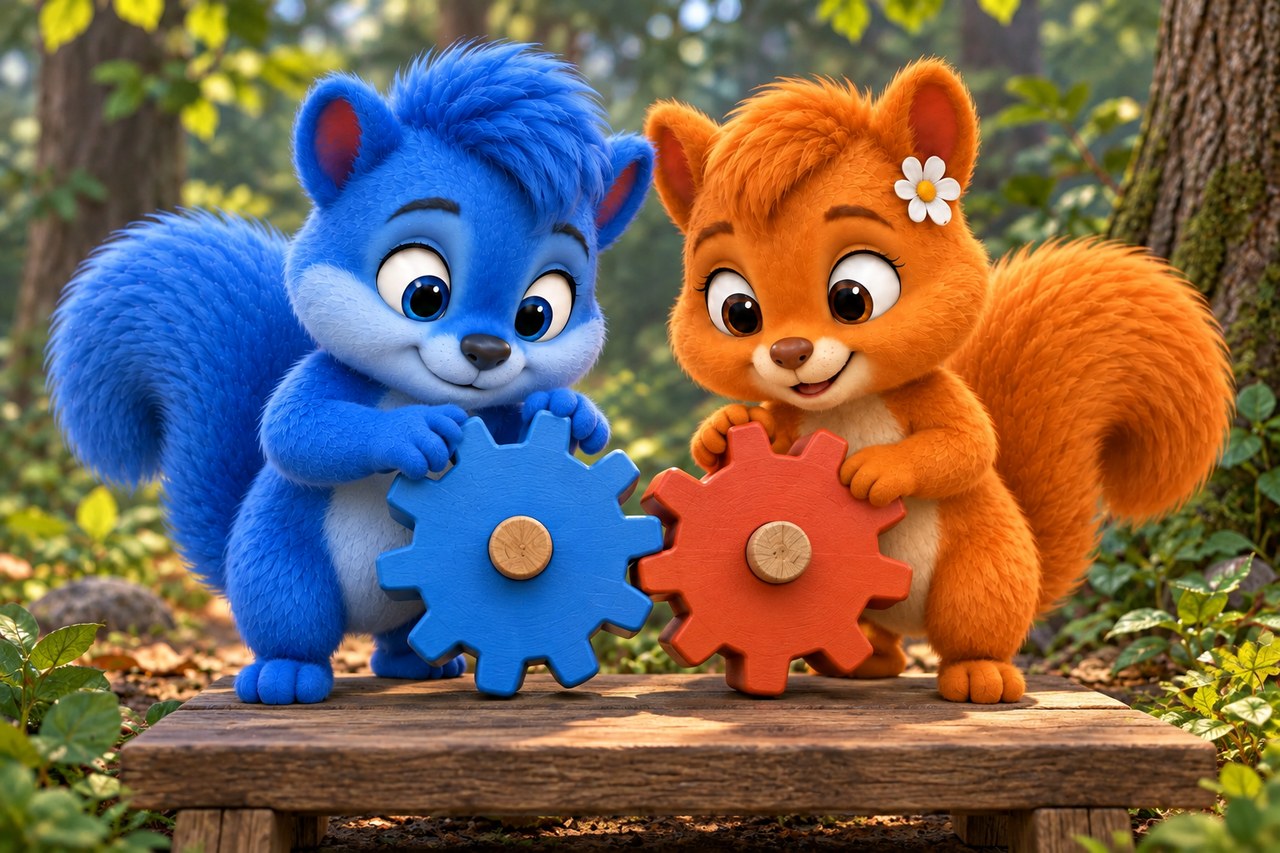
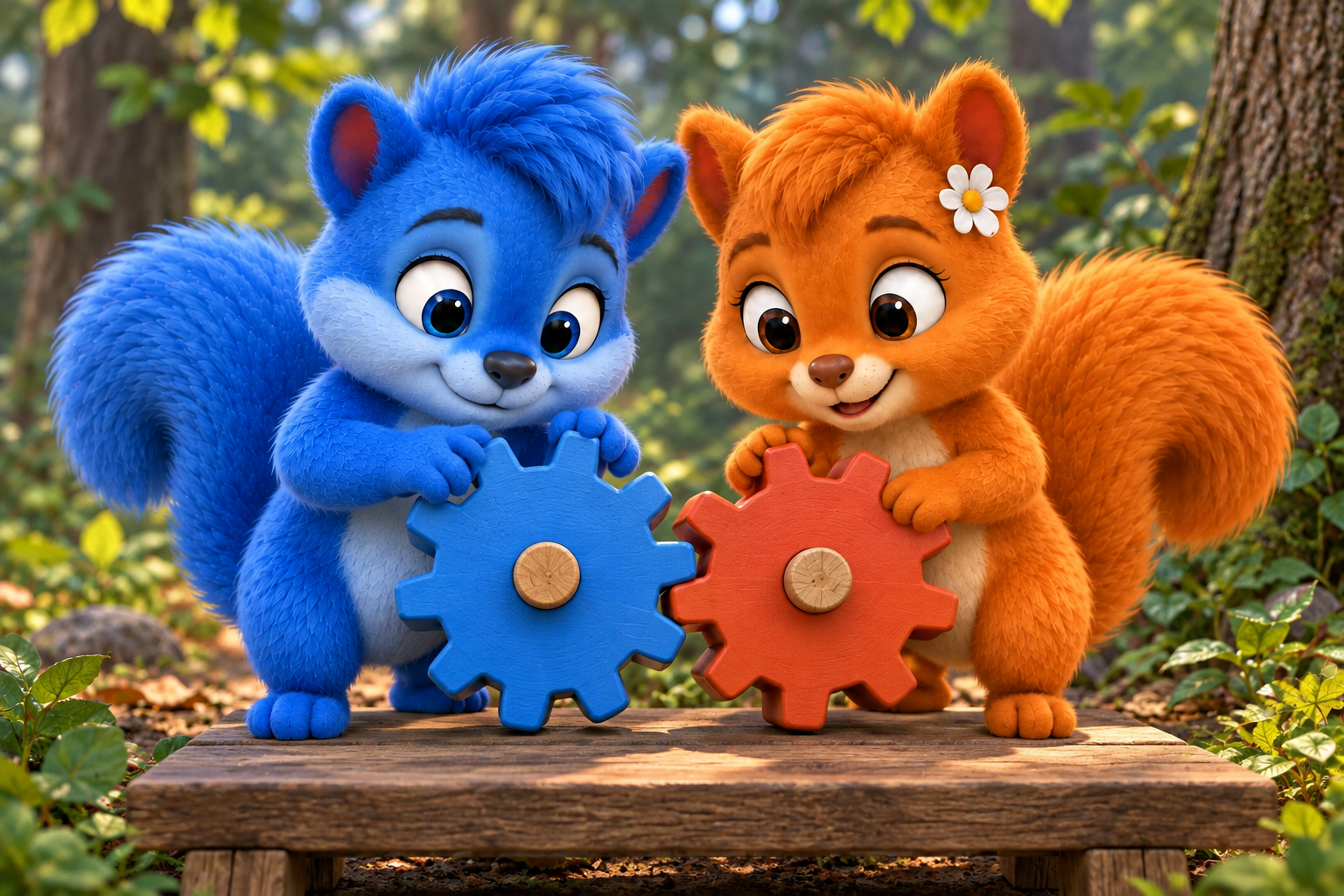
Equal-sized adult Wusels stand on a display table behind two large colorful gears in a stationary model. Invented museum illustration. The separate diagram has exactly ten and twenty simplified teeth; tooth shapes and supports are not a technical construction drawing. AI-created illustration, not a photograph of nature.
What the diagram shows
The diagram simplifies the process. First compare its shapes and arrows. You can read its labels in larger text below.
Read the picture labels
These are the words and sentences from the diagram above. The full explanation follows below.
- Count teeth and compare full turns
- 10 teeth
- 20 teeth
- 2 full turns
- 1 full turn
- At the contact: both wheels move the same number of teeth onward.
- Small: 10 + 10 = 20 teeth → two full turns Large: 20 teeth → one full turn
- Arrows show opposite turning directions in this external gear pair. Exact tooth counts; simplified tooth shapes. Not a technical construction drawing.
An imagined Wusel scene
Puschel and Flauschi investigate
Flauschi marks one tooth on the small model gear. Puschel counts its passes while the large wheel completes a turn. It takes more than one small-wheel turn. They then check their opposite direction arrows.
Look closely
Puschel and Flauschi stand on the display table and examine a stationary model. Its artistically drawn wheels are not our exact ten-to-twenty example. Use the separate diagram below for counting.
An example to help you understand
Draw two separate counting circles on paper: ten evenly spaced dots on a small circle and twenty on a large one. Mark a starting dot on each. Count ten dots forward around the large circle: you are only halfway round. Count another ten: its turn is complete. The small circle needed two turns for that. Dots explain the comparison; the paper circles are not working gears. The diagram’s tooth shapes are simplified, not building instructions.
Try explaining it
How do two directly meshing external gears turn?
Choose a), b) or c), then explain your choice.
- a)The larger wheel goes forward and the smaller alternates forward and back.
- b)In opposite directions.
- c)In the same direction because both sets of teeth push forward.
Show the explanation
Correct: b): In opposite directions.
When two external gears mesh, each pushes the other in the opposite direction. A small wheel must turn more times than a large one to pass the same number of teeth. Size therefore changes turning speed.
Word help
- friction
- An effect between touching surfaces that resists sliding between them.
Explore in more detail
Here you will find longer explanations and further details. You can explore them together.
1. First the model needs support
Imagine a construction set: a firm frame holds two rods in place. Gears sit on these rods. A rod that transfers turning motion is called a shaft. A bearing supports it while allowing it to rotate. The wheel centers must not simply move apart during turning. Building therefore involves more than attractive wheels: the supports must fit too. A toy model stands on a firm, level surface.
2. Teeth push other teeth
A gear has regularly spaced teeth around its edge. One wheel’s teeth fit into gaps on the other. When the first wheel turns, its teeth press against the neighboring teeth and turn the second wheel. In our two side-by-side wheels with teeth outside, their turning directions are opposite. If the left one turns like clock hands, the right one turns the other way. This applies to this arrangement, not every possible gear mechanism.
3. Ten teeth meet twenty
Our diagram shows a small wheel with ten teeth and a large one with twenty. After one full turn of the small wheel, ten teeth have passed the contact. On the large wheel that is only half a turn. The small one needs two turns for the large one to make one. A full turn means a marked point returns to its starting place. This assumes the teeth mesh properly and do not skip gaps.
4. Slower turning can mean more turning effect
If the small wheel drives the large one, the large one turns more slowly. However, greater torque can act at its shaft. Torque describes how strongly something is made to turn. Think of a tight screw-top lid: opening it needs a turning effect. Gears do not create extra energy. They trade turning speed for torque; friction takes up some usable energy. If the large wheel drives the small one instead, the small one turns faster but its available torque is lower.
An optional question for further exploration
You can use the longer explanation above. This is extra, not needed for the first quiz.
An extra question
Our small ten-tooth wheel makes four full turns. How many does the matching twenty-tooth wheel make?
Discover the answer
Two. Four times ten gives forty teeth passing the contact. The large wheel has twenty per turn: forty divided by twenty is two turns. In our external gear pair, it turns opposite to the small wheel.
Pictures and sources for adults
Sources for further reading
Facts checked against the specialist sources below on 12 October 2026. The Wusel scene is fictional; comparisons and simplified models are explicitly explained. Sources are in English.