Haudenosaunee: a longhouse tells history
A house made of wood and bark helps us understand past shared living. These people and their communities also exist today.
The short answer
Haudenosaunee roughly means People of the Longhouse. Longhouses show shared living and also represent the union of their nations. These communities continue today; they are not only a topic of the past.
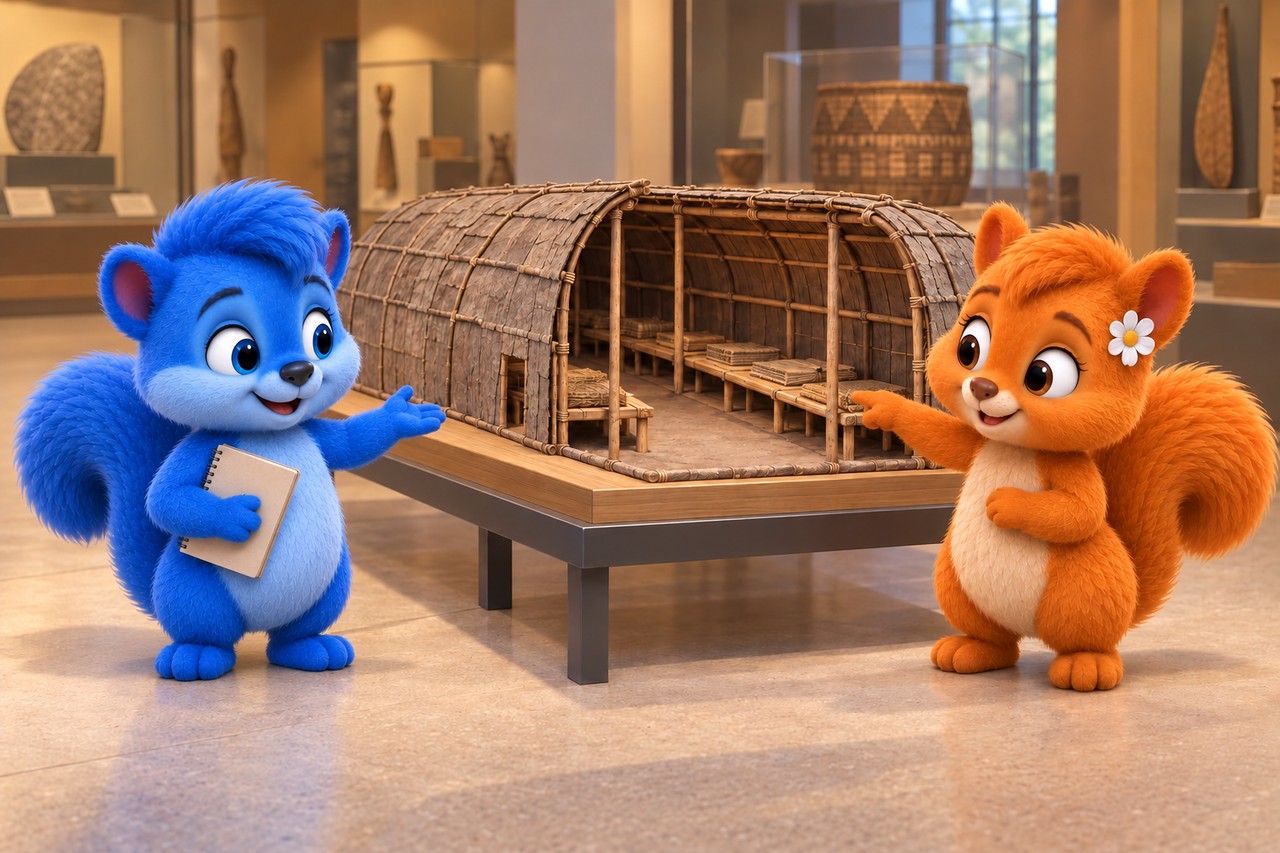
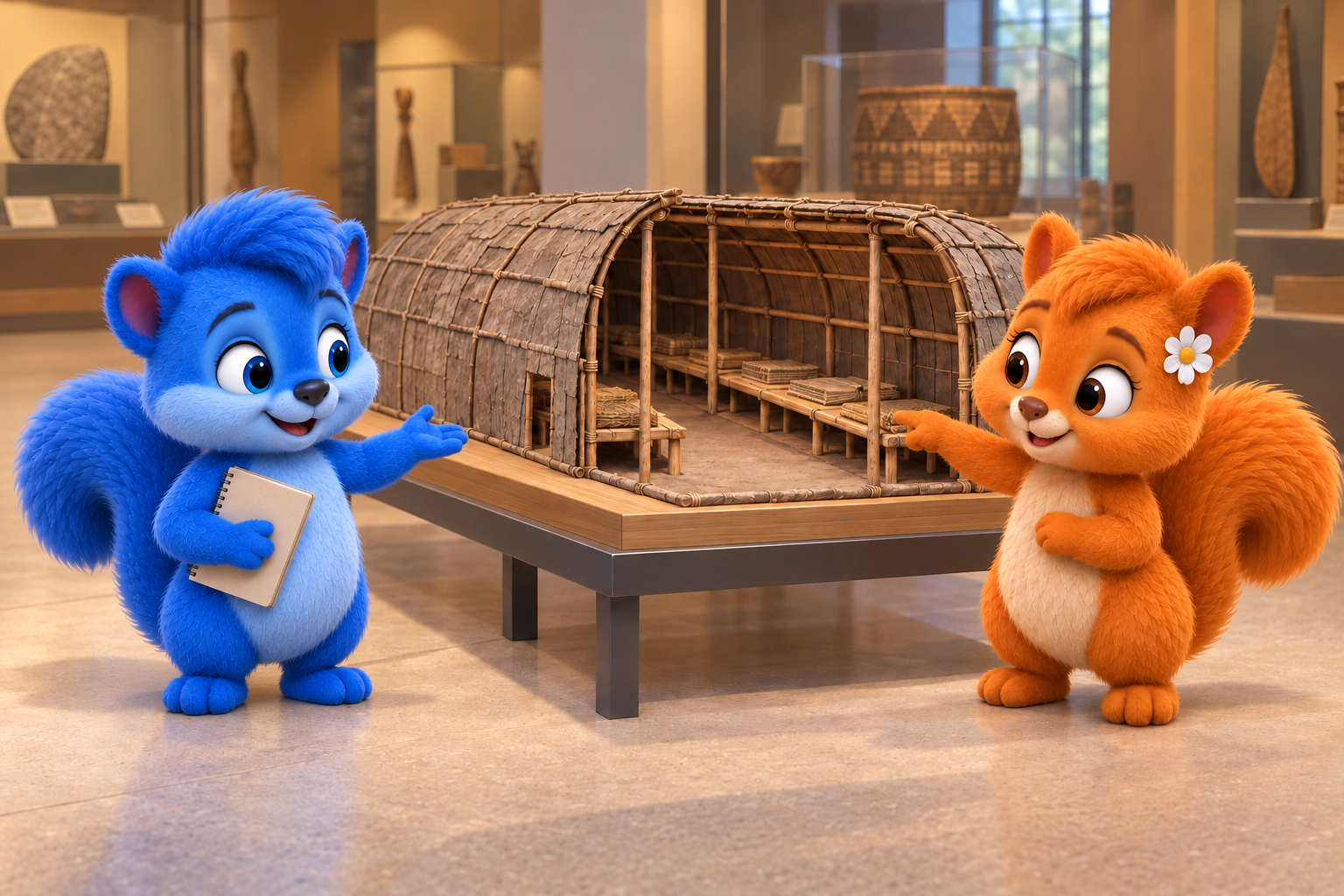
Equal-sized adult Wusels examine the bark covering and interior of a simplified longhouse museum model. Artistic cutaway, not a reconstruction of a particular house. Past housing and present-day lives are different questions. AI-created illustration, not a photograph of nature.
What the diagram shows
The diagram simplifies the process. First compare its shapes and arrows. You can read its labels in larger text below.
Read the picture labels
These are the words and sentences from the diagram above. The full explanation follows below.
- Covered outside, open in a cutaway
- Bark covering
- Wooden frame
- Sleeping/storage
- Raised platform
- Interior
- Cutaway: the drawing omits a wall so you can see inside. Simplified past housing, not present-day homes or a building plan. Not to scale; shared hearths and other details omitted.
An imagined Wusel scene
Puschel and Flauschi investigate
Puschel files the longhouse picture only under “long ago.” Flauschi finds present-day communities on the label too. They add a place for the present. Their history display no longer suggests a vanished people.
Look closely
Puschel examines the bark covering. Flauschi points to a raised surface inside the opened model. Part of the wall is omitted for visitors to see inside.
An example to help you understand
Compare an old house picture with a modern house photograph. What do materials and shapes reveal? What remains unknown? A wall cannot tell you what residents enjoy reading. Draw your own cutaway house: leave one wall out of the drawing so its rooms become visible. Label it your invention. This drawing method helps us look inside; it is not a historical building or a picture of all Haudenosaunee.
Try explaining it
Are the Haudenosaunee only a subject of the past?
Choose a), b) or c), then explain your choice.
- a)Yes, because people with a long history have no communities today.
- b)No, their communities exist today.
- c)Yes, because a model of earlier homes replaces present communities.
Show the explanation
Correct: b): No, their communities exist today.
Haudenosaunee roughly means People of the Longhouse. Longhouses show shared living and also represent the union of their nations. These communities continue today; they are not only a topic of the past.
Explore in more detail
Here you will find longer explanations and further details. You can explore them together.
1. A name for several nations
Haudenosaunee roughly means People of the Longhouse. Six nations belong to the confederacy today: Mohawk, Oneida, Onondaga, Cayuga, Seneca and Tuscarora. Here a nation is a distinct community with its own history and culture. The Onondaga describe their alliance themselves. Indigenous communities have long-standing roots in a territory, predating European settlement. Not all Indigenous communities belong to the Haudenosaunee.
Checked against: [2]
2. Wood supports; bark covers
Earlier longhouses had wooden frames covered with large pieces of bark held by additional poles. The frame supports the shape; bark forms the outer covering. Our model removes part of that covering so we can look inside. A lived-in house did not simply have this large display opening.
Checked against: [1]
3. Related families shared space
Raised sleeping and storage places ran along the sides, with shared hearths inside. Several related families lived together. Related means belonging to a family, such as children, parents, aunts and grandparents. The picture is a small simplified view without fire, not a complete construction plan. The Onondaga Nation also explains that after marriage a husband traditionally moved into the longhouse of his wife’s clan family. A clan is an extended kinship group. Living arrangements therefore connected with family organisation. This is an Onondaga example, not a housing rule for every Indigenous community.
Checked against: [1]
4. Communities continue today
Onondaga people today live in different kinds of homes and work, for example, as teachers or nurses. Their language and culture remain living and also change. Longhouses still matter for meetings and ceremonies: special community practices. A historical dwelling model therefore does not show how everyone lives today.
An optional question for further exploration
You can use the longer explanation above. This is extra, not needed for the first quiz.
An extra question
Does this model prove all Onondaga people today live in bark houses like this?
Discover the answer
No. It illustrates a historical dwelling. The Onondaga Nation explains that people now live in different homes; longhouses still matter for community gatherings.
Pictures and sources for adults
Sources for further reading
Facts checked against the specialist sources below on 12 October 2026. The Wusel scene is fictional; comparisons and simplified models are explicitly explained. Sources are in English.