Greek god stories: what does the owl tell us?
Old stories, images and beliefs have a history. We look for clues and distinguish them from explanations of nature.
The short answer
Greek traditions connect the owl with Athena. Such symbols help identify figures in stories and art. A myth is a tradition, not scientific evidence that an event happened.
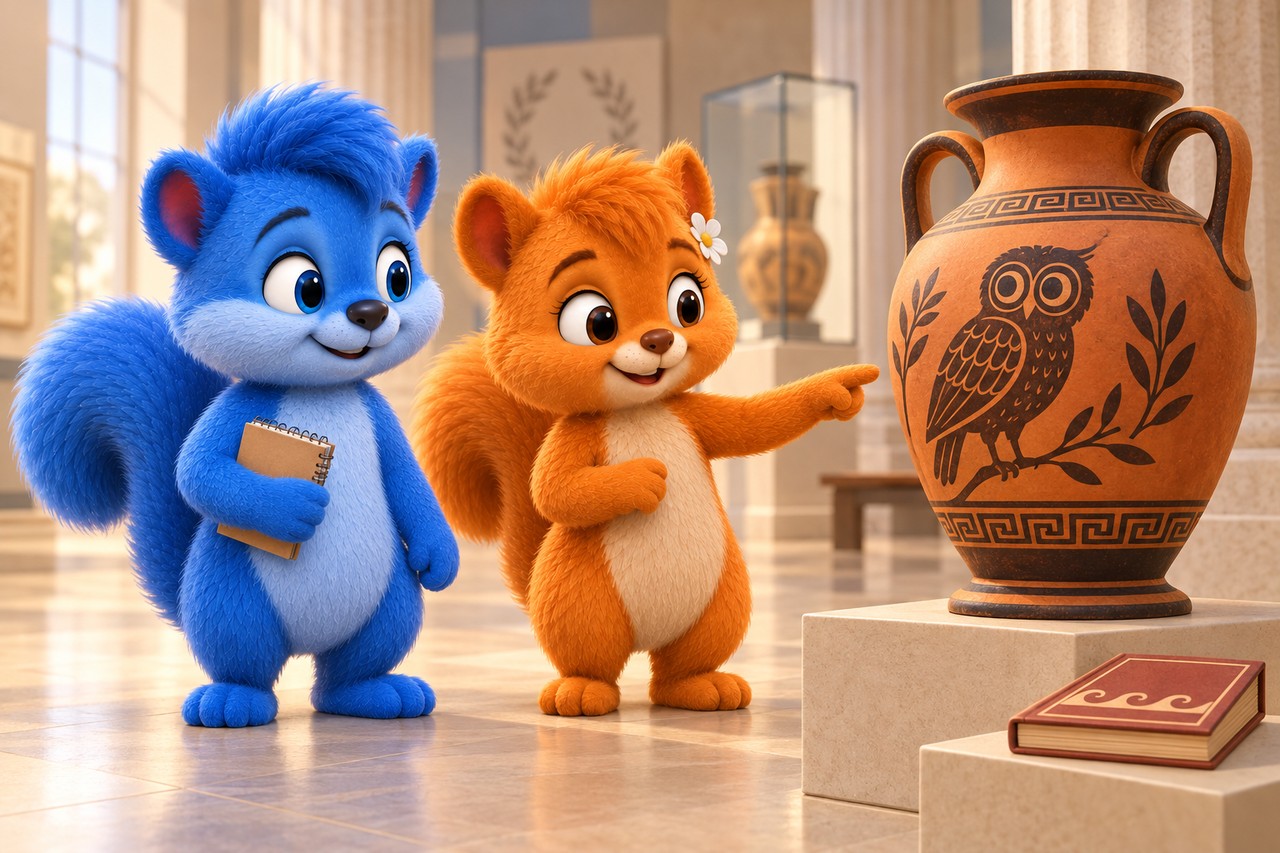
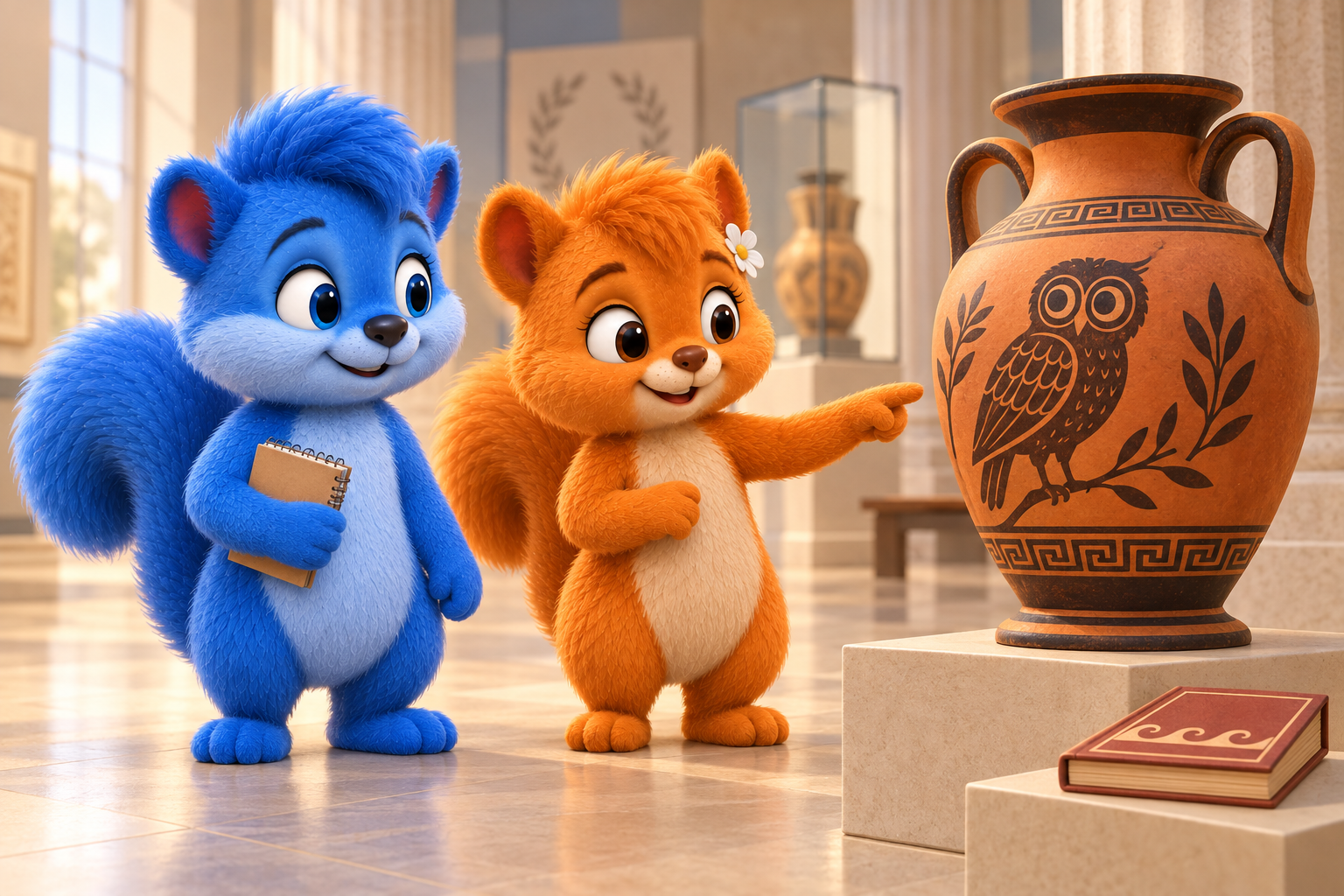
Equal-sized adult Wusels examine an invented Greek-inspired vase with a painted owl in a museum. Artistic vase and book, not original finds. The owl is a clue in this example; god stories do not explain thunderstorm physics. AI-created illustration, not a photograph of nature.
What the diagram shows
The diagram simplifies the process. First compare its shapes and arrows. You can read its labels in larger text below.
Read the picture labels
These are the words and sentences from the diagram above. The full explanation follows below.
- Matching helps us remember.
- Zeus
- Sky
- Poseidon
- Sea
- Athena
- Owl as a clue
- Our memory cards, not complete depictions of the gods. A clue needs context; an owl does not always mean Athena. Stories and beliefs, not explanations of natural processes.
An imagined Wusel scene
Puschel and Flauschi investigate
Puschel first treats an owl depiction as an animal-identification picture. Flauschi shows the associated Athena image. They find the symbol in the story. He labels it an artistic clue rather than proof of a real encounter.
Look closely
Flauschi points to the owl painted on the vase; Puschel studies the same picture. The vase and small book are invented museum props, not copies of the linked bronze figure.
An example to help you understand
Draw three clue cards of your own: a cloud for the sky, a wave for the sea and an owl for Athena in our god story. Match them to Zeus, Poseidon and Athena. This memory game does not reproduce an ancient artwork. Cover the owl card: what information is missing? You might guess from this game. For a genuinely unknown find, guessing is not enough. Researchers examine further clues and explain remaining uncertainty.
Try explaining it
What is an owl beside Athena in art?
Choose a), b) or c), then explain your choice.
- a)A symbol from a tradition.
- b)Evidence that every pictured animal was a real companion of the goddess.
- c)Instructions for identifying every owl as the same bird species.
Show the explanation
Correct: a): A symbol from a tradition.
Greek traditions connect the owl with Athena. Such symbols help identify figures in stories and art. A myth is a tradition, not scientific evidence that an event happened.
Explore in more detail
Here you will find longer explanations and further details. You can explore them together.
1. People told stories about many gods
Ancient Greek stories described many gods and goddesses. Such a traditional story is called a myth. Traditional means passed on through telling or writing. These stories were also connected with religious beliefs. Versions differed; people did not all tell every story in exactly the same way.
Checked against: [1]
2. Characters had different roles
In the stories Zeus was associated with the sky, Poseidon with the sea, and Athena with wisdom and crafts, among other things. Wisdom here means thoughtful, sensible judgment. These associations explain story characters, not the scientific causes of thunderstorms or moving seawater.
Checked against: [1]
3. An image can contain a clue
The owl was a symbol associated with Athena. A symbol can suggest a figure or idea, as an envelope can represent a message. Our invented vase therefore shows an owl. That does not mean every owl drawing depicts Athena. Understanding an old artwork also requires its context.
Checked against: [1]
4. A find can remain ambiguous
The Met displays a real small bronze figure that could represent Zeus or Poseidon. An object once held in its hand is missing; that object could have helped identify the figure. Missing evidence can leave a question open. An honest explanation says so instead of inventing certainty. A thunderbolt would have fitted Zeus; a trident would have fitted Poseidon. A trident has three points. Such recurring identifying features are called attributes. Without the crucial attribute, posture and beard alone cannot reliably distinguish the two figures.
Checked against: [2]
An optional question for further exploration
You can use the longer explanation above. This is extra, not needed for the first quiz.
An extra question
Why does the museum call its bronze figure Zeus or Poseidon rather than giving one certain name?
Discover the answer
An important object from its hand is missing. It could have helped identify the figure. The surviving evidence leaves the question open, and the museum explains that.
Pictures and sources for adults
Sources for further reading
Facts checked against the specialist sources below on 12 October 2026. The Wusel scene is fictional; comparisons and simplified models are explicitly explained. Sources are in English.