How do goods travel on giant ships?
Container ships carry many large transport boxes. Their journey often continues by train or truck after the port.
The short answer
Large cargo ships often carry goods in standardised containers: strong boxes with matching dimensions. Cranes transfer them between ship, rail and lorries. Loading order and weight distribution need planning.
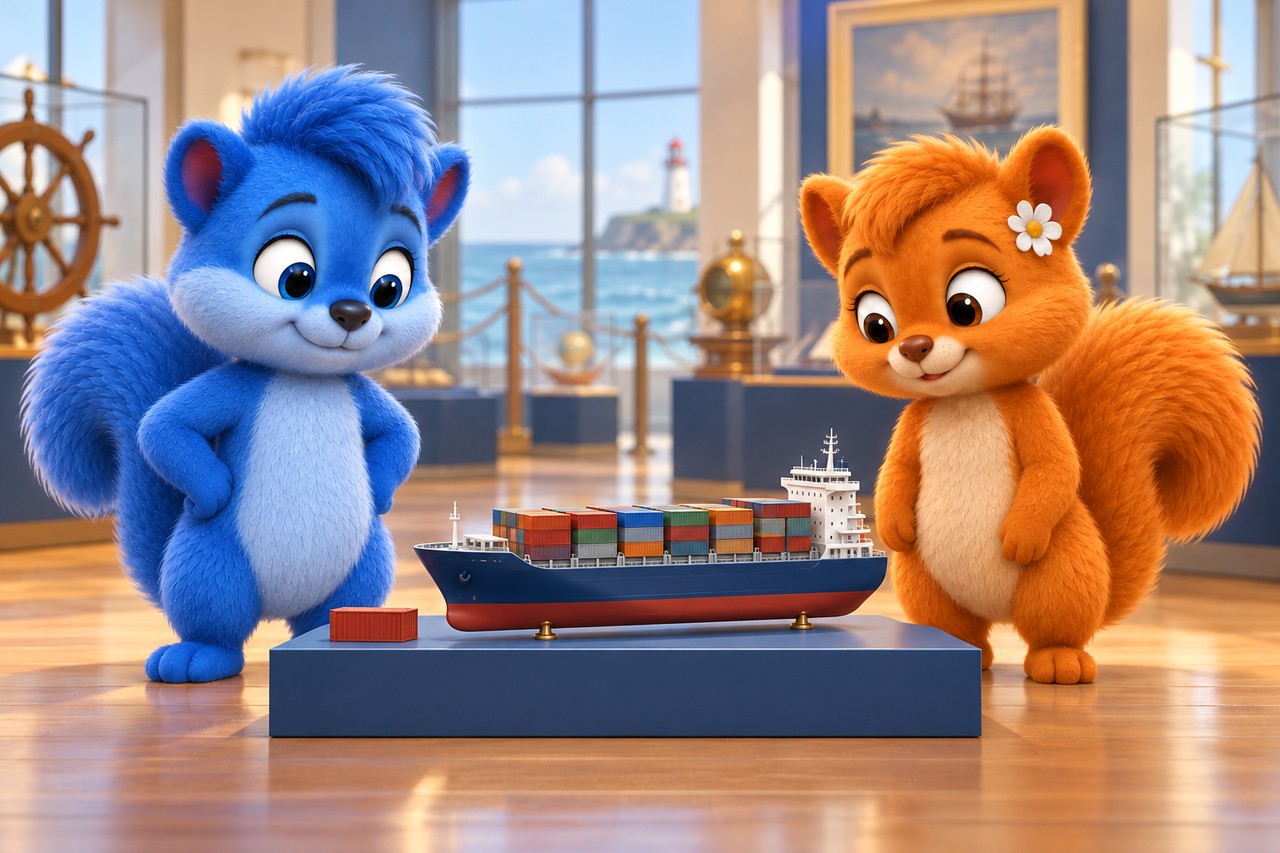
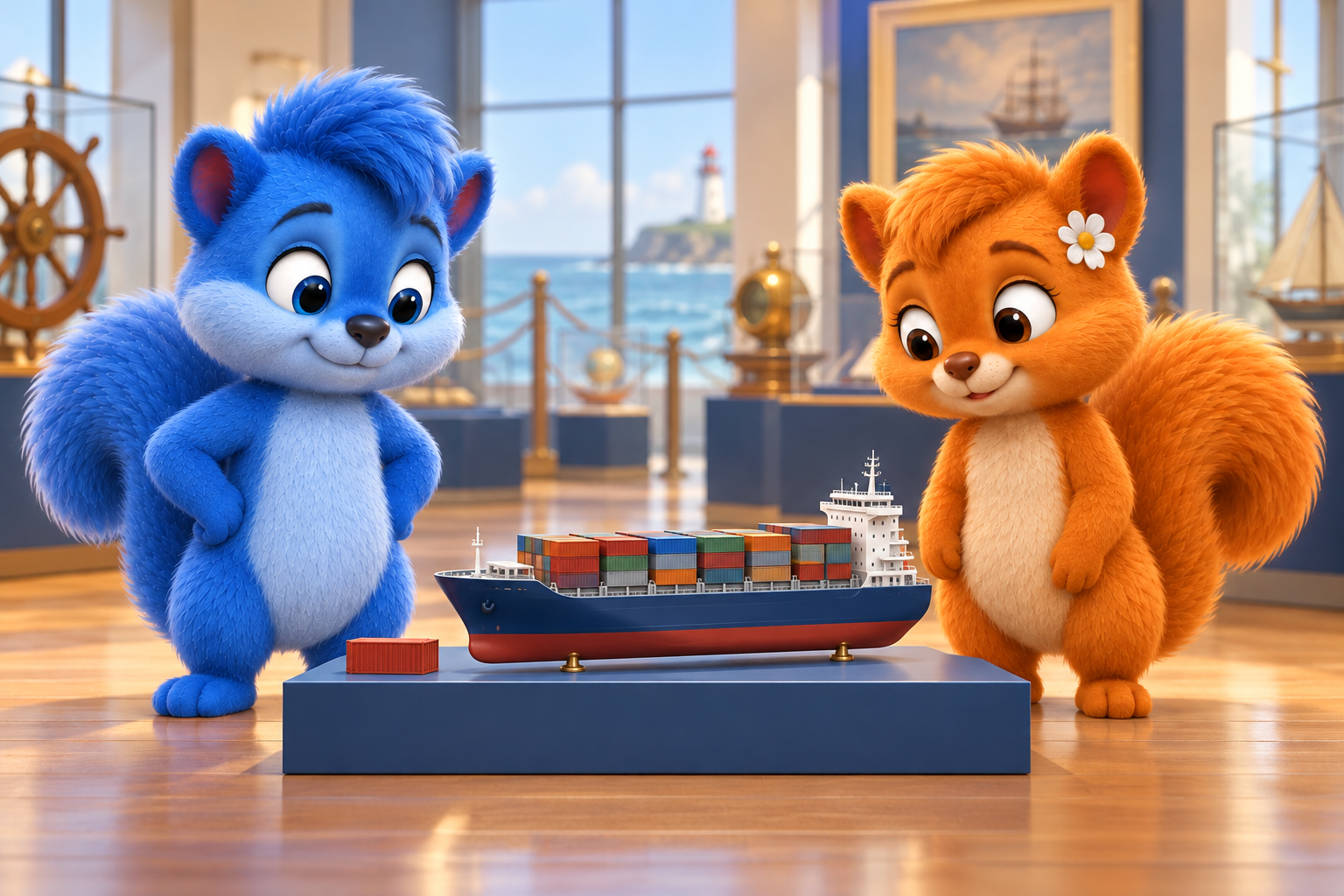
Equal-sized adult Wusels examine a container-ship model and a separate transport box in a museum. Invented model, not to scale. Supports hold the ship on a solid display base. The learning diagram compares different loads on the same ship in a simplified way. AI-created illustration, not a photograph of nature.
What the diagram shows
The diagram simplifies the process. First compare its shapes and arrows. You can read its labels in larger text below.
Read the picture labels
These are the words and sentences from the diagram above. The full explanation follows below.
- The same ship sits lower with more cargo
- Less cargo
- Draft
- Same water depth
- More cargo
- Draft
- Same water depth
- Waterline blue; draft brown; waterway bed below. Greater draft leaves less space beneath the same ship.
- Ship
- Port crane
- Train or truck
- The same closed box travels onward. Simplified drawing, not to scale.
An imagined Wusel scene
Puschel and Flauschi investigate
Puschel places the first-needed model container at the bottom. Flauschi tries to remove it without moving the others. She cannot. They replan the order and also check how the weight is distributed.
Look closely
Compare the colorful boxes on the museum ship with the separate box beside it. Find the white structure at the rear used for directing the ship. Small supports hold the model on its blue base; the base is not a water tank.
An example to help you understand
Draw the same water surface twice as a horizontal line, going across the paper. Add a lightly loaded floating ship to the first drawing. In the second, give that same ship more cargo and draw it sitting lower. Its hull does not grow bigger: its position relative to the waterline changes. Mark draft with a vertical line from the surface to the hull bottom. Draw the waterway bed farther down. Greater draft leaves less space beneath the ship at the same water depth. This comparison does not calculate an approved cargo load.
Try explaining it
Why do containers fit different kinds of transport?
Choose a), b) or c), then explain your choice.
- a)The boxes must be emptied and repacked for every transfer.
- b)Their sizes are standardised.
- c)Each form of transport reshapes containers during loading.
Show the explanation
Correct: b): Their sizes are standardised.
Large cargo ships often carry goods in standardised containers: strong boxes with matching dimensions. Cranes transfer them between ship, rail and lorries. Loading order and weight distribution need planning.
Word help
- buoyancy
- The upward force a fluid such as water exerts on an immersed object.
Explore in more detail
Here you will find longer explanations and further details. You can explore them together.
1. Goods fit inside transport boxes
A container is a large sturdy transport box. Many have standardized sizes, so suitable vehicles and cranes can move them. Packaged goods can travel inside. Before departure, professionals inspect the box and load the goods. A full container is not necessarily one giant item: it can contain many smaller things.
2. A crane moves the whole box
At a port, a container crane loads boxes onto a ship or unloads them. Its lifting attachment picks up the container. Workers do not have to remove every item from the box at this stage. The same container can continue on a suitable rail wagon or truck. Waterways, railways and roads handle different sections of a journey.
3. A heavy ship displaces water
The hull is the ship’s large main body. It displaces water, occupying space where water would otherwise be. Water exerts an upward force: buoyancy. Earth pulls the ship and its cargo down; this force is weight. For a ship floating still, these forces balance. A heavy steel ship can therefore float when its shape and loading are suitable. It cannot carry unlimited cargo.
Checked against: [3]
4. More cargo means more hull underwater
Additional cargo makes the same ship heavier. It sits lower and displaces more water until the forces balance again. Draft is the vertical distance from the water surface to the bottom of the hull. Vertical here means straight downward. Water depth instead reaches from the surface to the bed of the waterway. A safe gap must remain beneath the ship. Professionals also check water levels, weather and currents.
An optional question for further exploration
You can use the longer explanation above. This is extra, not needed for the first quiz.
An extra question
Why must the crew consider water depth when adding cargo?
Discover the answer
A more heavily loaded ship sits lower; its draft increases. At the same water depth, less space remains beneath the hull. Loading and the route must be planned so the ship does not touch the bottom.
Pictures and sources for adults
Sources for further reading
Facts checked against the specialist sources below on 12 October 2026. The Wusel scene is fictional; comparisons and simplified models are explicitly explained. Sources are in German and English.