How might vehicles travel in the future?
Power, control and sharing a ride are different questions. Research models help test ideas.
The short answer
New vehicles develop through ideas, models and many tests. A power system alone does not solve everything: energy use, safety, space and accessibility matter too. Tests must show which ideas work well.
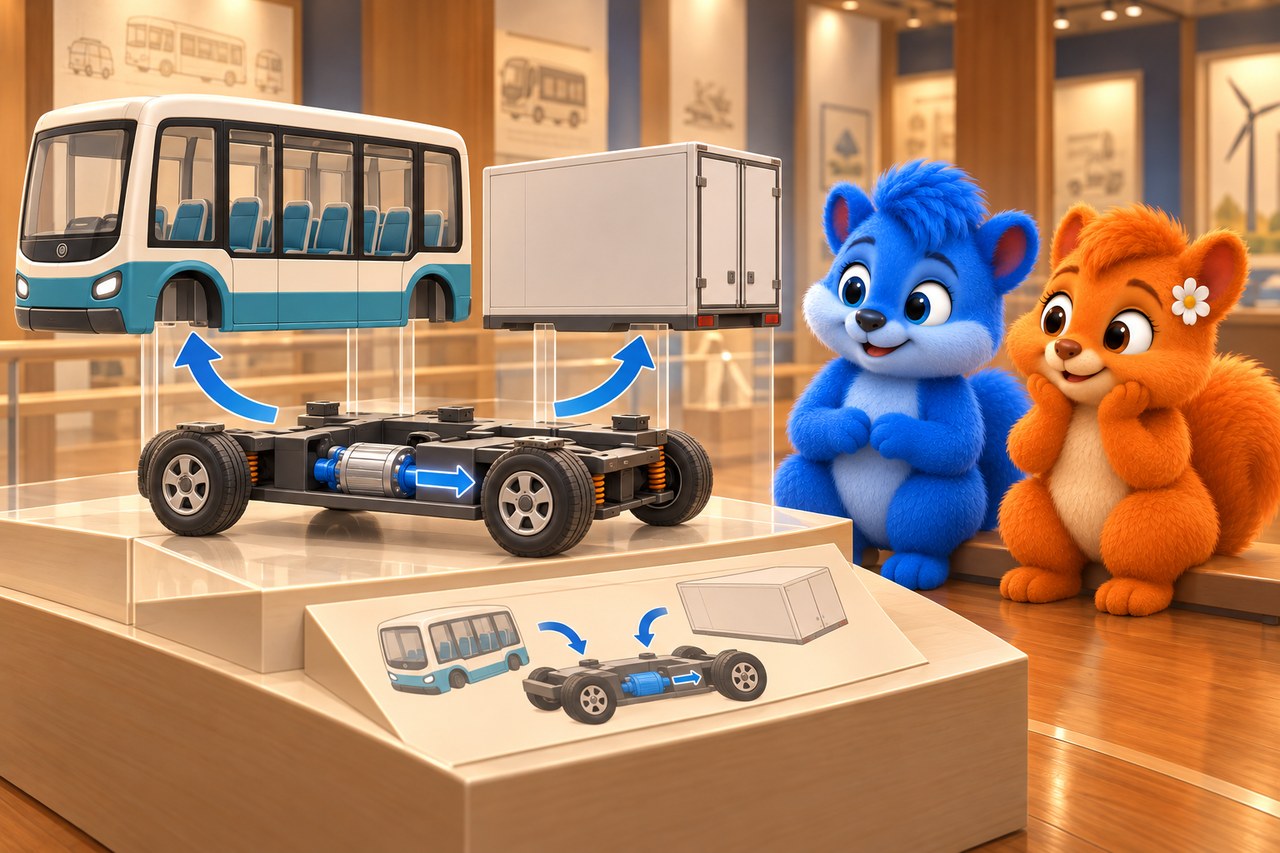
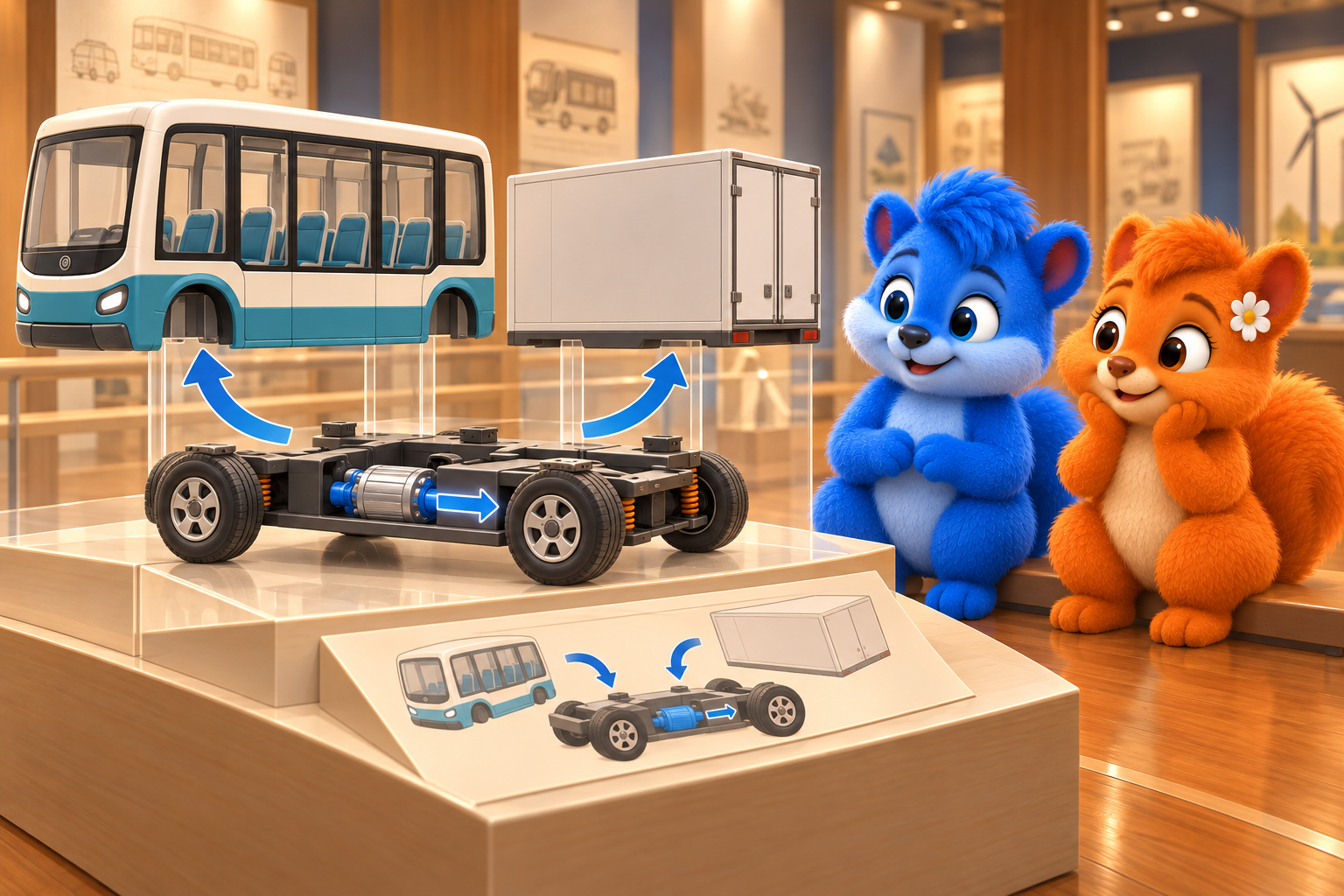
Puschel and Flauschi in the museum. Vehicle design with a shared chassis and interchangeable bodies. One possible design idea, not a certain prediction. AI-created illustration, not a photograph of nature.
Explained in three pictures
1 One drive module
Motor, wheels and controls form the base module.
2 A passenger body
A passenger body can fit on top.
3 A cargo body
Or a cargo body: the same drive, a different purpose.
More about the picture
One concrete approach is a vehicle with interchangeable bodies, as in DLR’s U-Shift concept. Propulsion and body serve different purposes. This is a simplified concept drawing, not a prediction: safety and everyday usefulness must be tested.
An imagined Wusel scene
Puschel and Flauschi investigate
At the vehicle model, Puschel first plans only a powerful motor. Flauschi asks where its energy comes from and how everyone gets in. They add cards for energy, access and brakes. Their design now has several jobs to test separately.
Look closely
Compare the museum model with the three picture steps. A passenger body can fit on top.
An example to help you understand
Draw two stops and six paper passengers. Add a small bus with six available places and three cars with two available places each. Either arrangement can carry all six people. Compare the number of vehicles. The paper shows only seating arrangements; it does not calculate actual energy use. That would also require distances, vehicle design and how full the vehicles really are.
Try explaining it
What must a new vehicle idea consider besides power?
Choose a), b) or c), then explain your choice.
- a)Infer safety from the power of the motor.
- b)For example safety, energy use and access.
- c)Consider energy needs only after the finished vehicle is built.
Show the explanation
Correct: b): For example safety, energy use and access.
New vehicles develop through ideas, models and many tests. A power system alone does not solve everything: energy use, safety, space and accessibility matter too. Tests must show which ideas work well.
Word help
- sensor
- A device part that measures something, such as light or distance.
- prototype
- An early model or device for testing an idea.
Explore in more detail
Here you will find longer explanations and further details. You can explore them together.
1. An idea is tested first
Researchers build new vehicle concepts and test them. A prototype is a model or early vehicle used to try out an idea. The German Aerospace Center researches electric vehicles and small shared passenger transporters, for example. A prototype does not prove that everyone will travel that way later. One specific DLR concept is U-Shift. An electric driving unit is designed to carry different modules, such as a passenger cabin or goods container. Its interesting feature is separating the tasks: one driving unit could serve different transport needs. Practical performance still needs testing.
2. What moves the wheels?
In a battery-electric vehicle, a rechargeable battery stores energy. It supplies electrical energy to a motor that powers movement. The vehicle does not need to burn fuel in its motor. Electric describes its power system: how movement is produced. A person may still drive an electric vehicle.
3. Who chooses the path?
Automated driving functions use sensors to measure the surroundings. A sensor is a measuring device: for example, it measures distances to obstacles. Computer programs process measurements and control certain driving actions. Available functions depend on the technology and conditions. Rain, unusual situations or unclear measurements can be challenging. Systems therefore need careful testing. Automated and electric are different things.
4. More than the vehicle matters
A shared small bus can carry several people. Whether transport saves resources also depends on passenger numbers, routes and how vehicles are made. Resources include raw materials and energy. Batteries and electricity supplies affect the environment too. No exhaust from burning fuel does not mean no environmental impact.
An optional question for further exploration
You can use the longer explanation above. This is extra, not needed for the first quiz.
An extra question
Does electric automatically mean that no person controls the vehicle?
Discover the answer
No. Electric describes the power system. Automated driving functions concern control. They may occur together but do not have to.
Pictures and sources for adults
Sources for further reading
Facts checked against the specialist sources below on 12 October 2026. The Wusel scene is fictional; comparisons and simplified models are explicitly explained. Sources are in German.