What can a fingerprint reveal?
Fine skin ridges leave a pattern. Clear details matter more than a quick glance.
The short answer
Fine ridges on fingertips can leave a print when touching something. Specialists compare their paths and small details. A blurry print is not certain proof. Fingerprints are personal data.
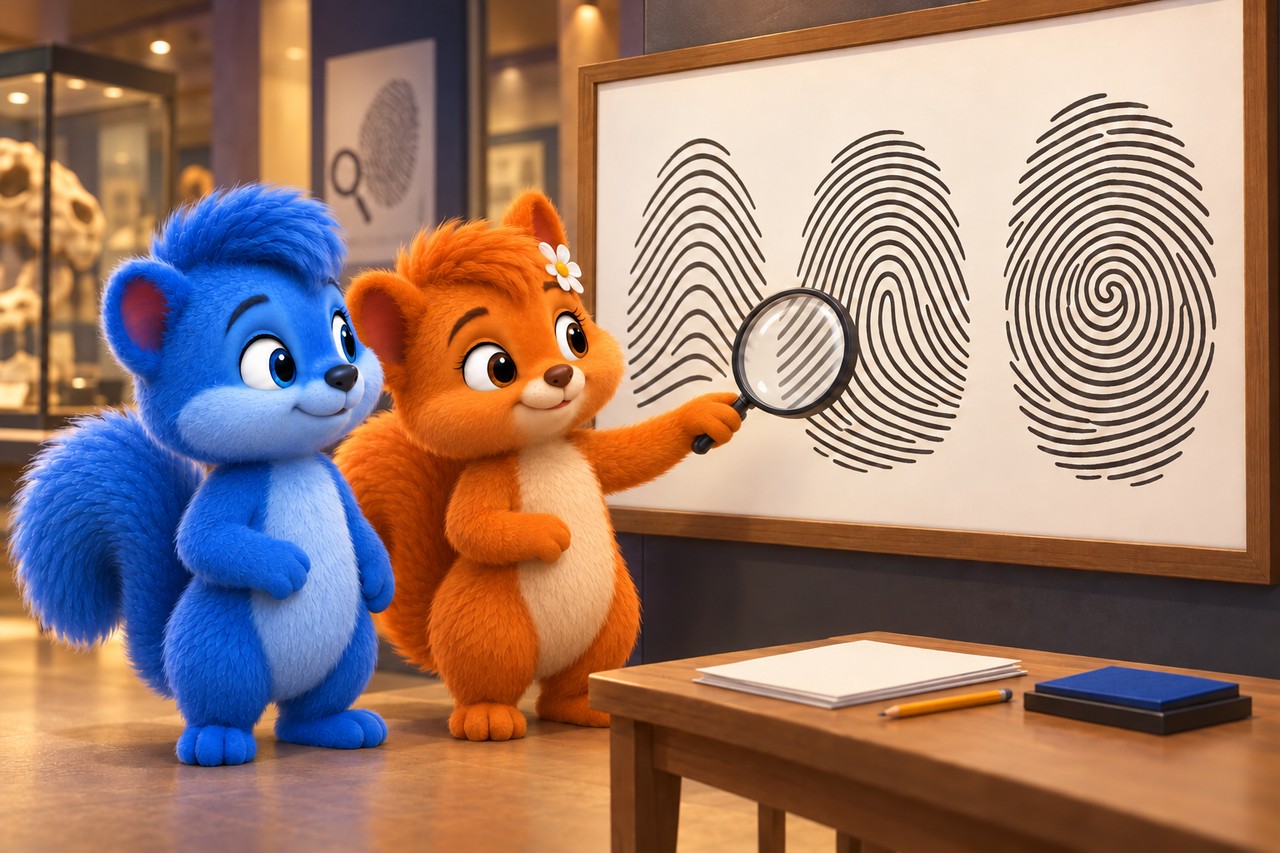
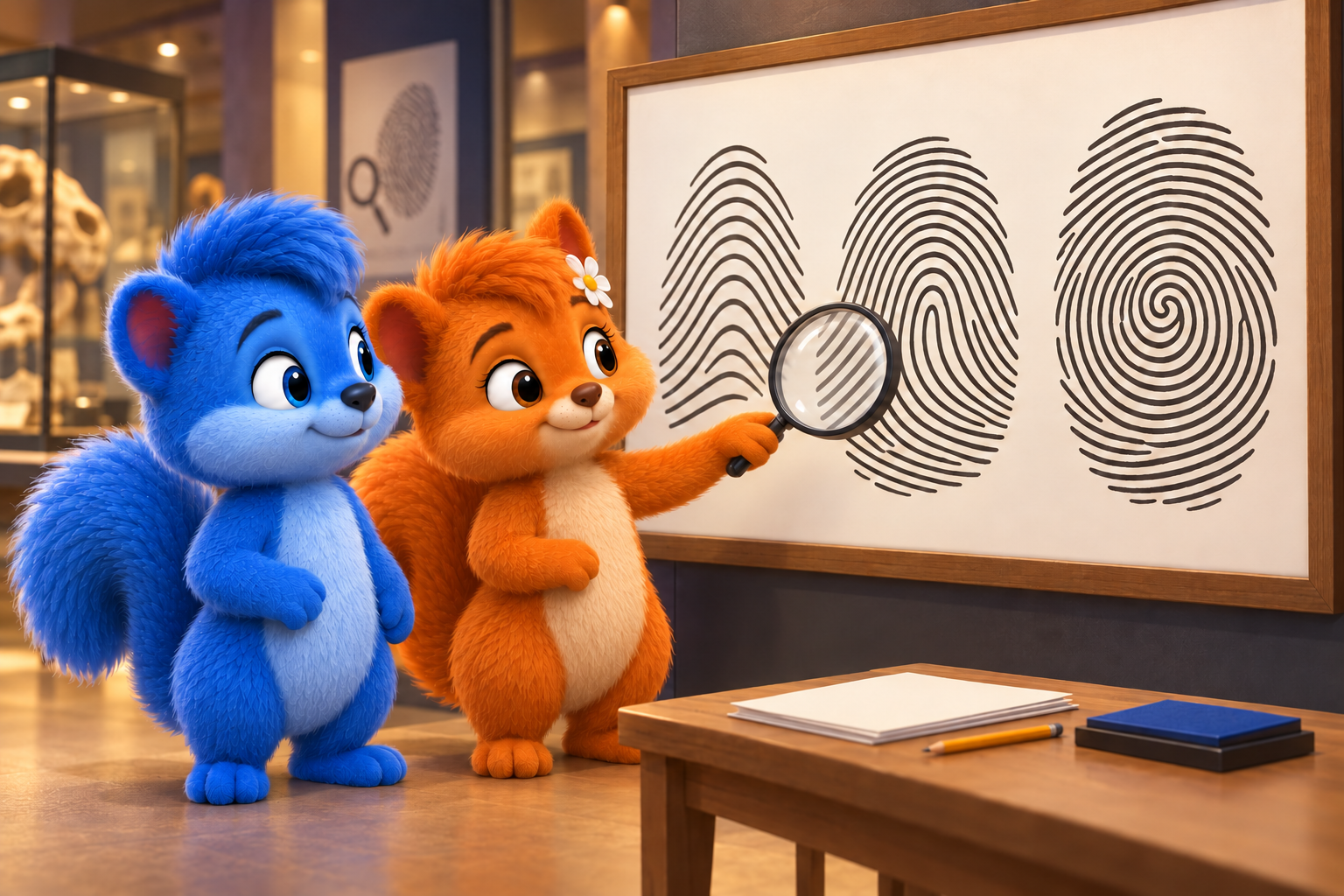
Equal-sized Wusels study three drawn ridge patterns; Flauschi holds the magnifying glass. Schematic teaching drawings, not actual biometric data. Enlarged patterns, not evidence photographs. AI-created illustration, not a photograph of nature.
What the diagram shows
The diagram simplifies the process. First compare its shapes and arrows. You can read its labels in larger text below.
Read the picture labels
These are the words and sentences from the diagram above. The full explanation follows below.
- Distinguish pattern groups from details
- Fork higher
- Fork lower
- Similar shape does not mean the same arrangement.
- Invented line cards: not fingerprints or an identification.
An imagined Wusel scene
Puschel and Flauschi investigate
Puschel spots a loop in the practice picture and wants to call two prints a match. Flauschi points to a smudged area. They mark what is visible and what is missing. A similar-looking patch is not yet certain proof.
Look closely
Flauschi holds a magnifying glass over drawn ridges. The three large patterns are teaching drawings, not collected personal fingerprints. The Wusels study human patterns; the picture makes no claim about Wusel paws.
An example to help you understand
Draw two line-pattern cards. Include a forked line on each but put the forks in different places. Compare: the same kind of feature has a different arrangement. Cover part of each card with paper. Is enough visible for your description? You are not identifying the source of an actual fingerprint; you are practising observation and noticing missing information.
Try explaining it
Why is a smudged print not always enough for certainty?
Choose a), b) or c), then explain your choice.
- a)Important details may be missing.
- b)The size of the mark is enough even if lines are missing.
- c)One similar curved ridge is enough for a certain match.
Show the explanation
Correct: a): Important details may be missing.
Fine ridges on fingertips can leave a print when touching something. Specialists compare their paths and small details. A blurry print is not certain proof. Fingerprints are personal data.
Word help
- whorl
- Several leaves or leaf-like parts arranged in a ring at one level around a stem.
Explore in more detail
Here you will find longer explanations and further details. You can explore them together.
1. Ridges on a fingertip
Human fingertips have fine raised skin ridges, with grooves between them. Touching a suitable surface can leave a pattern. A print on paper records the surface, not the whole finger. Pressure, movement and the recording surface affect its appearance.
2. Arches, loops and whorls
Broad groups include arches, loops and whorls. Arch ridges rise across the pattern; loop ridges bend back; whorl ridges circle around a centre. These groups help organise patterns. Two prints in the same group need not come from the same person.
Checked against: [3]
3. Examine small details
Specialists also compare where ridges end or split. The arrangement of these features matters. One similar arch is not enough. First they check whether a trace contains enough clear detail. A smudged or tiny trace may not permit a useful comparison.
Checked against: [1]
4. A clue is not a whole story
Even specialists can make mistakes, so comparisons need careful checking. A matching trace alone does not say when or why someone touched a surface. Explaining events requires other information. Comparing our drawn lines is not a forensic examination.
Checked against: [1]
An optional question for further exploration
You can use the longer explanation above. This is extra, not needed for the first quiz.
An extra question
Does sharing a pattern group prove that two prints come from the same person?
Discover the answer
No. Many people have loop patterns, for example. A specialist comparison requires clear corresponding details and their arrangement, with allowance for errors and insufficient traces.
Pictures and sources for adults
Sources for further reading
Facts checked against the specialist sources below on 12 October 2026. The Wusel scene is fictional; comparisons and simplified models are explicitly explained. Sources are in English.