What does a car need to go fast?
A powerful motor alone is not enough: tires, airflow and brakes matter too.
The short answer
An engine supplies motion, but tyres must transmit force to the road. Air resists more strongly at higher speeds. Shape, weight, brakes and safe control therefore matter alongside the engine.
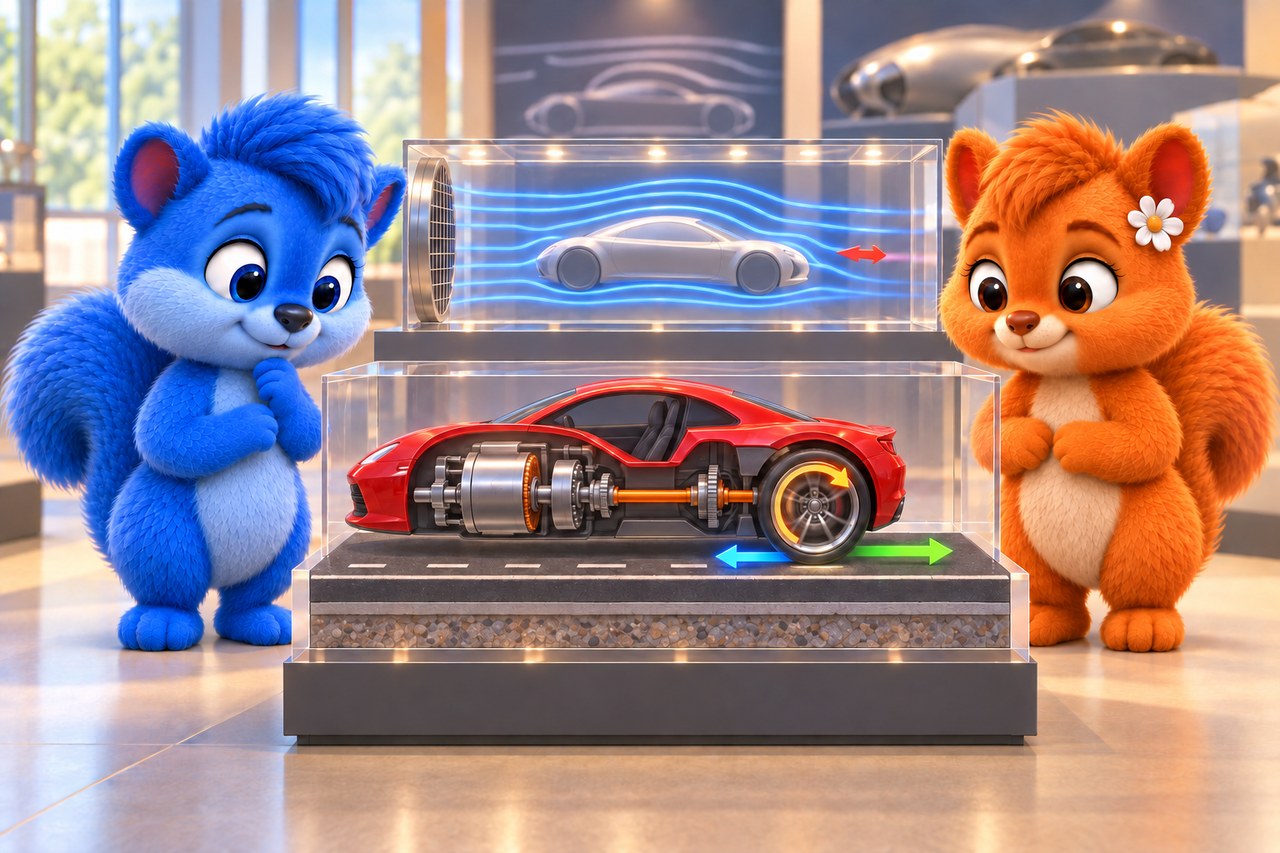
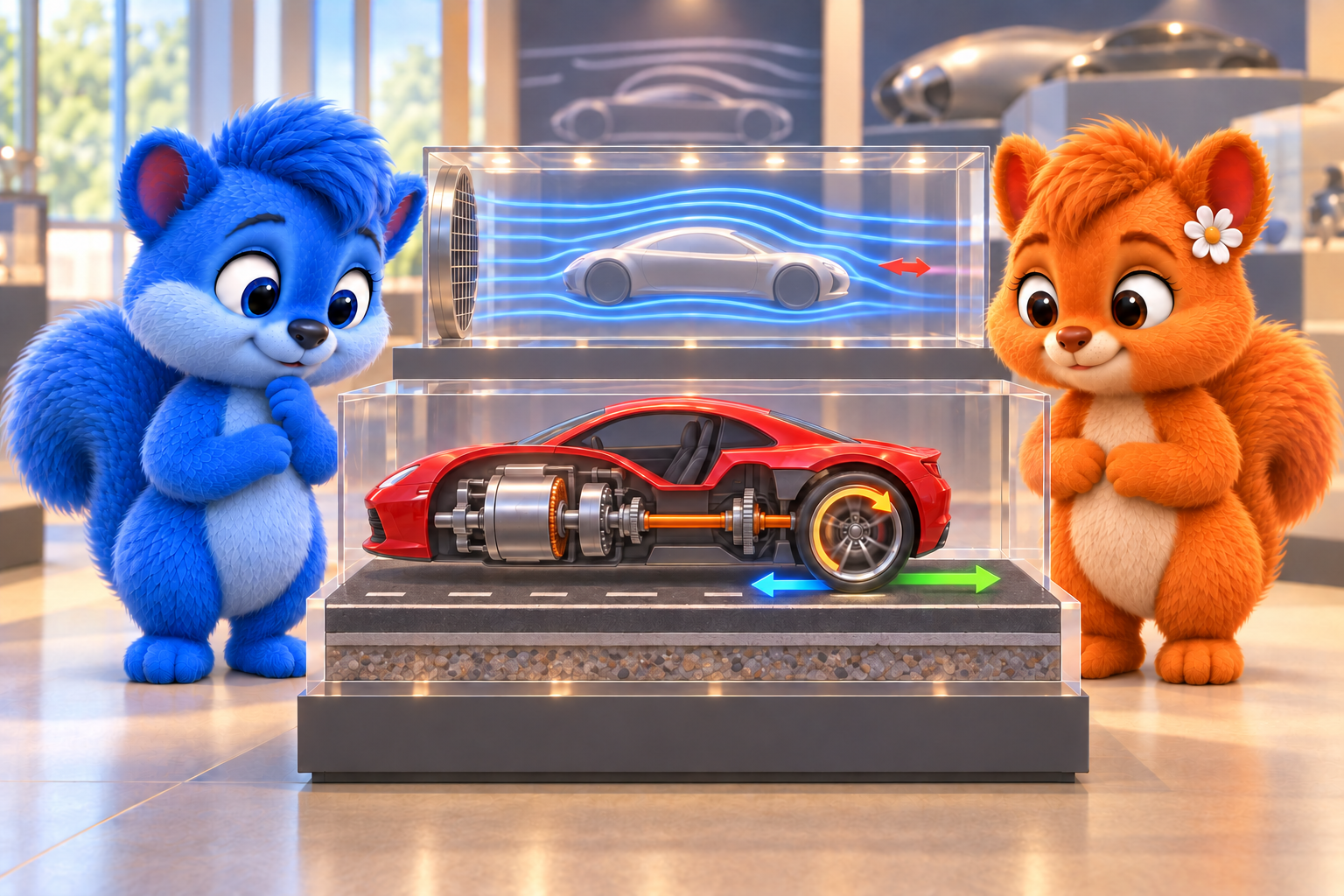
Puschel and Flauschi in the museum. Car model with drive to a wheel, ground contact and airflow around its body. Simplified inanimate museum model; arrows and colours help explain it. AI-created illustration, not a photograph of nature.
Explained in three pictures
1 Energy to the motor
Fuel or a battery supplies energy for propulsion.
2 Wheels provide drive
Wheels push backwards against the ground; the ground pushes forwards.
3 Air resists
With the same conditions: twice the speed, about four times the air drag.
More about the picture
Driving fast requires energy, suitable propulsion and tyre grip. Air drag grows strongly with speed. The comparison on the right applies only with the same shape, air and drag coefficient; it does not show braking distance.
An imagined Wusel scene
Puschel and Flauschi investigate
Puschel chooses only the biggest engine for his paper car. Flauschi adds pictures of tyres and brakes. They trace force to the ground and consider how the car stops again. His design now includes a safe stopping idea.
Look closely
Compare the museum model with the three picture steps. Wheels push backwards against the ground; the ground pushes forwards.
An example to help you understand
Draw the same car twice. In the first picture it moves through still air at an imagined speed; in the second, twice as fast. Assume unchanged shape, air conditions and drag coefficient. Represent air resistance with one box, then four equal boxes beside it. These compare forces, not travel distance or braking distance. Real measurements consider more detail. Professionals also test models in wind tunnels: air flows around a model held in place.
Try explaining it
Why is a powerful engine alone not enough for a good fast car?
Choose a), b) or c), then explain your choice.
- a)Tyres, drag, brakes and control matter too.
- b)A powerful engine makes up for poor tyre grip when braking.
- c)More engine power automatically reduces air resistance.
Show the explanation
Correct: a): Tyres, drag, brakes and control matter too.
An engine supplies motion, but tyres must transmit force to the road. Air resists more strongly at higher speeds. Shape, weight, brakes and safe control therefore matter alongside the engine.
Explore in more detail
Here you will find longer explanations and further details. You can explore them together.
1. From motor to wheels
A motor changes energy into motion. In an electric car a rechargeable battery provides electrical energy; the electric motor drives wheels through suitable components. A transmission transfers the turning motion. A real vehicle also needs cooling and controls. Cooling helps keep components within a suitable temperature range. Our picture shows an invented car model, not its motor inside.
Checked against: [1]
2. The road acts on the tires
During acceleration, driven tires push backward against the road at their contact. The road exerts a forward force on them. This force can speed the vehicle up. A force is a push or pull. Tires need enough grip: they must not simply slip uncontrollably at the contact. On a slippery surface or with spinning wheels, motor power cannot turn into unlimited acceleration.
Checked against: [2]
3. Air can resist and push downward
Air resistance is a force opposing motion through air. Size, shape and speed affect it. With otherwise unchanged conditions and the same drag coefficient, doubling speed makes it four times as large. A drag coefficient is a number describing effects of shape and flow. Racing cars also use downforce: airflow produces an extra downward force. Wings and the floor can contribute. More downforce can load tires more strongly and improve grip, but often also brings more air resistance.
4. Going fast does not mean stopping instantly
A car travels some distance before stopping. First its driver must notice danger and react, while the vehicle keeps moving. Braking distance follows. Together these make overall stopping distance. Speed, road surface and vehicle condition affect it. Wet conditions can require more space. A technical maximum speed therefore does not tell you what speed is safe on a road.
Checked against: [5]
An optional question for further exploration
You can use the longer explanation above. This is extra, not needed for the first quiz.
An extra question
Does twice the speed mean only twice the air resistance in our comparison?
Discover the answer
No. Under the specified unchanged conditions, air resistance becomes four times as large. This is our described model with an unchanged drag coefficient. The boxes do not calculate stopping distance.
Pictures and sources for adults
Sources for further reading
Facts checked against the specialist sources below on 12 October 2026. The Wusel scene is fictional; comparisons and simplified models are explicitly explained. Sources are in English.