What do we tell about fairies and kobolds?
Compare names, story versions and image evidence: imaginary characters have no single compulsory form across every story.
The short answer
A fairy helps in one story; a goblin hides shoes in another. These beings are imaginary. Storytellers decide what they can do and how they act. The same kind of fantasy creature can therefore be very different in different stories.
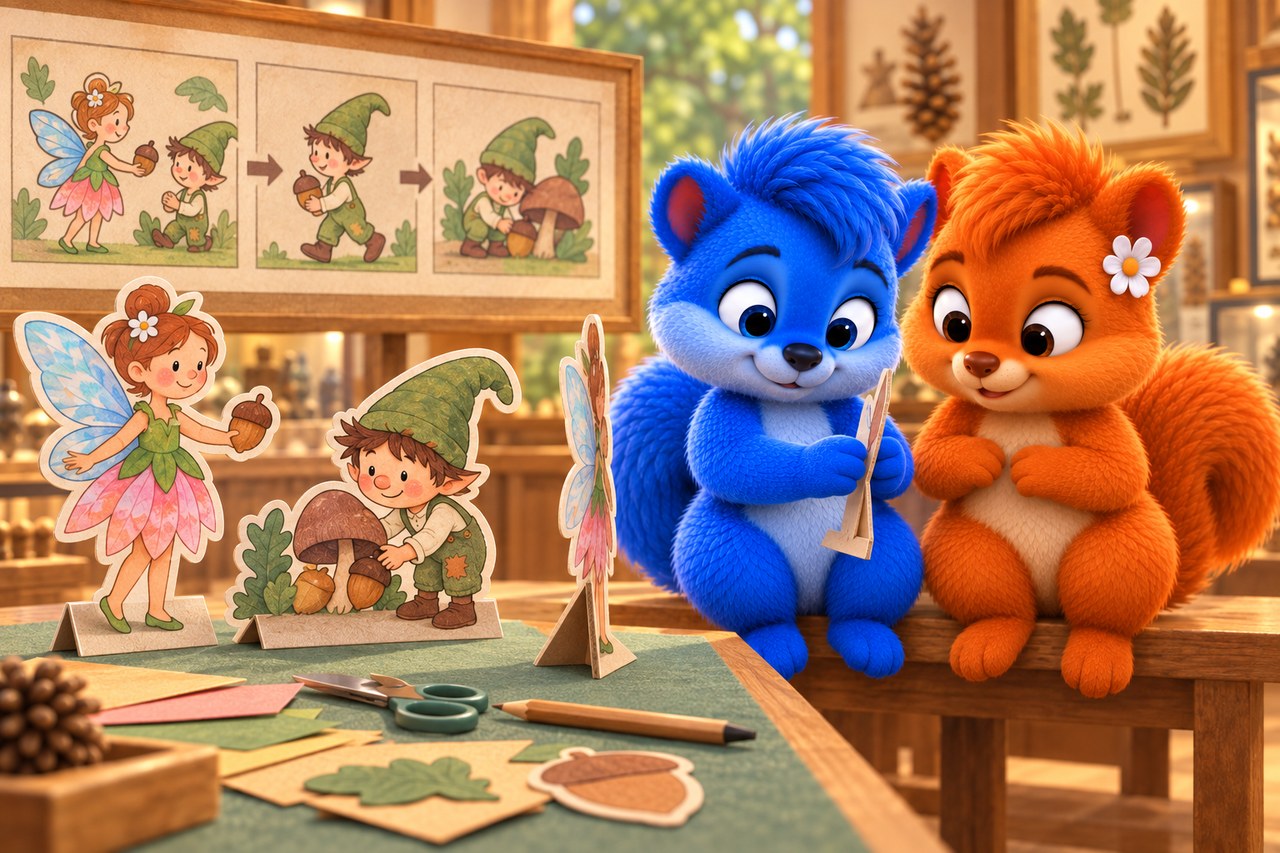
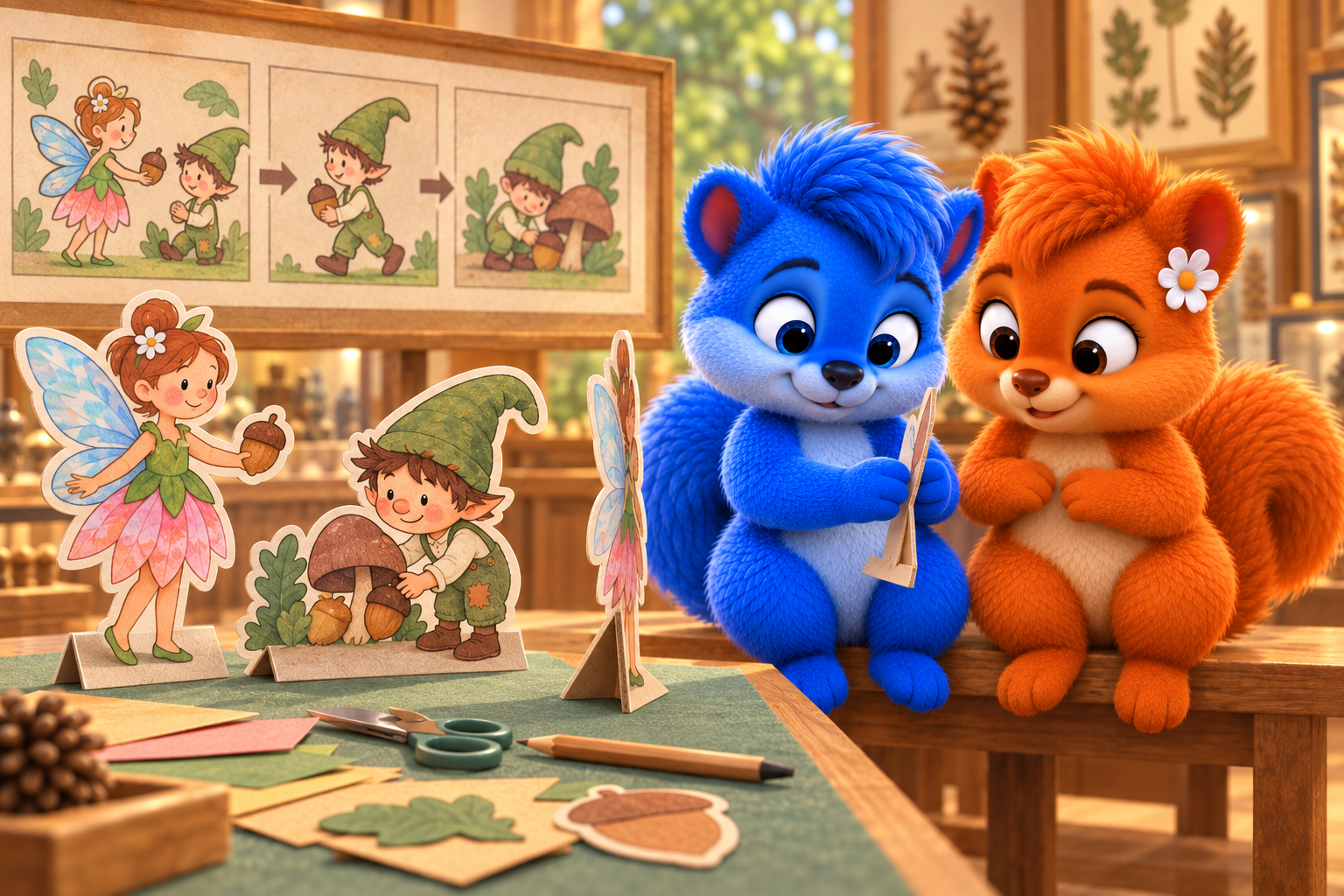
Puschel and Flauschi in the museum. Fairy and sprite paper figures with visible supports and a thin side edge. Clearly identified paper art, not evidence for magical creatures. AI-created illustration, not a photograph of nature.
Explained in three pictures
1 Our own fairy figure
Our invented fairy figure helps in the story.
2 Our own sprite figure
Our invented sprite hides an acorn.
3 Paper seen from the side
Both figures are paper art. They do not prove magical creatures exist.
More about the picture
Fairy and sprite stories give characters different roles and traits. Our roles are our own imaginary examples, not a rule for all traditions. Paper art can show stories; it does not prove that magical beings exist.
An imagined Wusel scene
Puschel and Flauschi investigate
Puschel draws his fairy exactly as in the first book. Flauschi shows a differently depicted figure in another. They look at each character's role. He realises a familiar depiction is not a requirement for every story.
Look closely
Compare the museum model with the three picture steps. Our invented sprite hides an acorn.
An example to help you understand
Draw two friendly original characters on paper. Give each an invented name and describe what they do in your story. With adults, add “our invented characters.” Compare a standing paper figure from the front and side: its flat paper form is easier to recognise from the side. Do not deceive other people; openly explain how your depiction was made.
Try explaining it
Must fairies look and act alike in every story?
Choose a), b) or c), then explain your choice.
- a)Yes, the oldest drawing determines every later story.
- b)No, their roles depend on the story.
- c)Yes, the same name fixes their traits in every story.
Show the explanation
Correct: b): No, their roles depend on the story.
A fairy helps in one story; a goblin hides shoes in another. These beings are imaginary. Storytellers decide what they can do and how they act. The same kind of fantasy creature can therefore be very different in different stories.
Explore in more detail
Here you will find longer explanations and further details. You can explore them together.
1. A fairy belongs to a fairy-tale idea
The German word Fee describes a fairy-tale being with magic powers. Stories may give fairies different actions. The word’s definition describes a linguistic idea; it provides no scientific evidence for such a being. For a particular book, ask about its character, features and actions.
Checked against: [1]
2. A kobold belongs to a traditional idea
In German usage, Kobold can describe a small household spirit in traditional belief. Traditional belief here means inherited ideas and narratives. The name identifies no scientifically studied animal species. Our paper character is a new design; we may decide its looks and behaviour without assigning those features to every tradition.
Checked against: [2]
3. Fairy tales are told and reshaped
Fairy tales reach audiences through telling, writing, collecting and new versions. The British Library introduces fairy-tale author Madame d’Aulnoy, for example. The Brothers Grimm also used written sources and contributions from storytellers they knew. A new version may emphasise details differently. It helps to name the title and version rather than claim a single correct form.
Checked against: [3]
4. An image must support the particular claim
The Cottingley fairy photographs became famous as supposed images of real fairies. Later, the participants explained how paper figures had been used in the photographs. Leeds University Library documents the history and differing later accounts. It shows why a photograph and claims about it need separate examination. Our image of paper figures likewise shows a craft idea, not discovered fairies or kobolds.
Checked against: [4]
An optional question for further exploration
You can use the longer explanation above. This is extra, not needed for the first quiz.
An extra question
Does a photograph of a paper fairy prove that a living imaginary being stood there?
Discover the answer
No. It may show a paper figure. Examine how the image was made and which claim it supports. Original fairy and kobold stories may contain imagination; we openly label our paper art as invented.
Pictures and sources for adults
Sources for further reading
Facts checked against the specialist sources below on 12 October 2026. The Wusel scene is fictional; comparisons and simplified models are explicitly explained. Sources are in English.