What moves an excavator arm?
An excavator has no muscles. Pressurized oil helps move its heavy parts.
The short answer
In a digger, a pump pushes oil through hoses into strong tubes called cylinders. Inside, the oil moves a sliding part called a piston. It pushes or pulls on the digger arm, moving the bucket. Transferring force with liquid is called hydraulics.

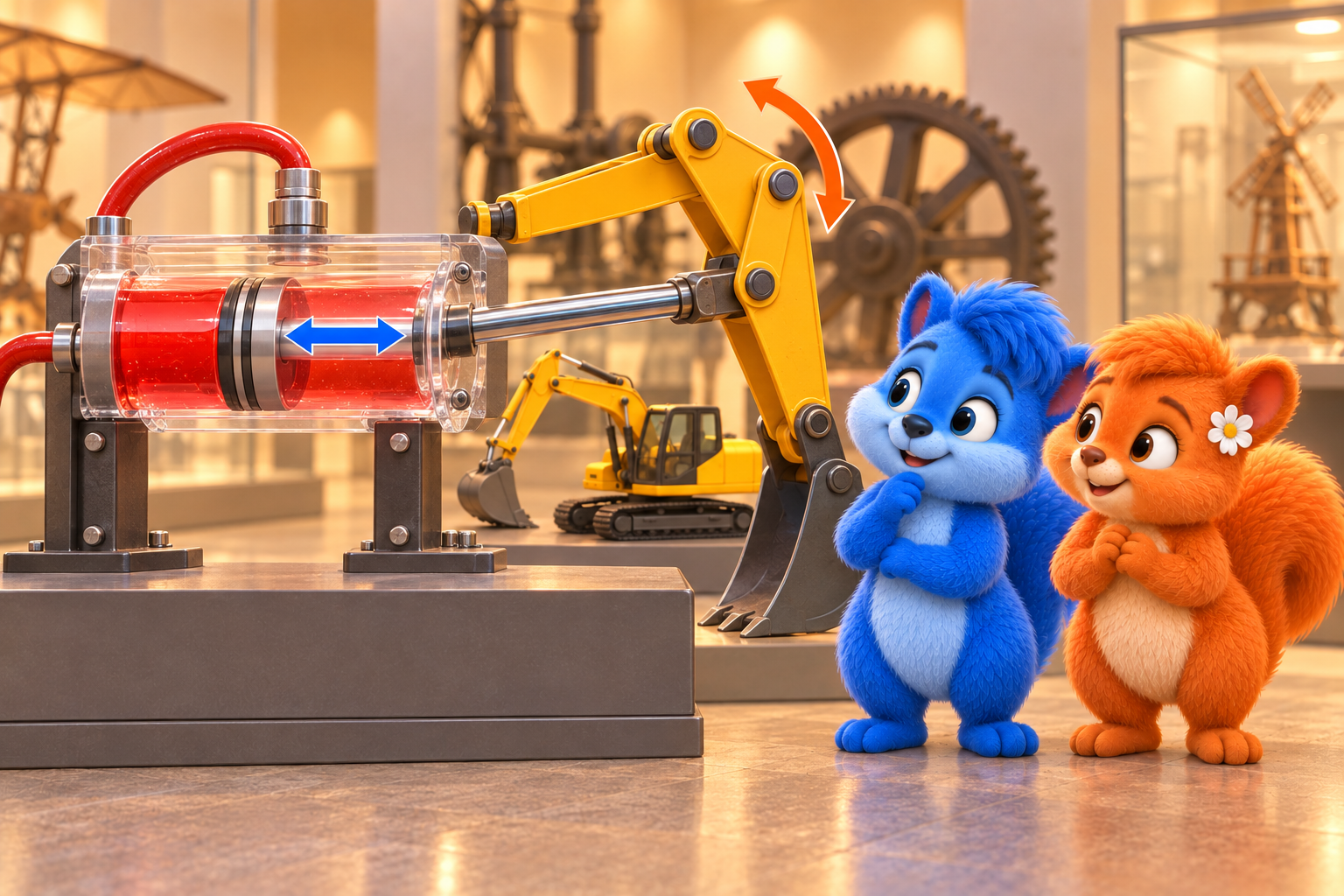
Puschel and Flauschi in the museum. Transparent hydraulic cylinder: piston and rod slide and move a joint. Simplified inanimate museum model; arrows and colours help explain it. AI-created illustration, not a photograph of nature.
Explained in three pictures
1 Oil under pressure
A pump pushes oil onto one side of the piston.
2 Piston and rod
The piston moves the rod. It does not grow.
3 Arm turns at a joint
The connection turns the arm around a joint.
More about the picture
Pressurised oil moves a piston. Its rod is connected to the arm and can turn it around a joint. The drawings show the principle, not a hydraulic circuit or load capacity. Oil flow is also controlled appropriately for the return movement.
An imagined Wusel scene
Puschel and Flauschi investigate
Puschel follows the arm in the cutaway and loses sight of the pipe. Flauschi starts again with him at the pump. They trace fluid to the piston and then the arm. Now each movement arrow follows from the previous one.
Look closely
Compare the museum model with the three picture steps. The piston moves the rod. It does not grow.
An example to help you understand
Slowly bend and straighten your own arm at the elbow. Your elbow is a joint; muscles move your arm. Excavator cylinders perform part of a similar movement task, but they are not living muscles. Now compare the two piston rods in the diagram. Which extends farther from the housing? The piston has moved; the whole rod has not simply grown longer. The drawing only explains this movement. It cannot tell you how much weight a particular excavator may lift.
Try explaining it
What transmits force to an excavator's moving arm?
Choose a), b) or c), then explain your choice.
- a)Electric wires pulling directly on the digger arm.
- b)Fluid in pipes and cylinders.
- c)Air flowing through the same hydraulic pipes without liquid.
Show the explanation
Correct: b): Fluid in pipes and cylinders.
In a digger, a pump pushes oil through hoses into strong tubes called cylinders. Inside, the oil moves a sliding part called a piston. It pushes or pulls on the digger arm, moving the bucket. Transferring force with liquid is called hydraulics.
Liquid pushes against the moving piston in a cylinder. An electric wire does not pull directly on the arm.
Word help
- joint
- A connection between bones. Many joints allow movement.
- hydraulics
- Fluid in pipes transmits force, for example to an excavator piston.
- piston
- A moving part inside a matching cylinder that can push or be pushed.
Explore in more detail
Here you will find longer explanations and further details. You can explore them together.
1. The arm has movable connections
Our excavator has two large arm sections and a bucket at the front. The first section is the boom; the next is the stick. Parts turn relative to each other at joints: movable connections. Digging and emptying require different bucket positions. Simply pushing the entire arm straight up would not provide all these movements.
2. Oil pushes on a piston
Hydraulics here means using a liquid to transfer forces and help move things. An excavator uses special oil. A motor drives a pump, a machine that moves oil through pipes. The pump supplies the energy that allows pressurized oil to move parts. Pressure describes how strongly something pushes on a surface. A hydraulic cylinder has a strong housing containing a movable piston, which separates two internal spaces. Pressure differences between its sides can move it. The closed housing hides the piston from view.
3. The rod pushes and pulls
A piston rod is attached to the piston. As the piston moves, the rod extends or retracts. The cylinder can therefore push or pull a connected part. Movable connections attach the cylinder and rod at suitable points on the excavator arm. Changing their combined length turns an arm section at its joint. Our cutaway omits seals and many pipes; it is not repair instructions.
4. Several movements work together
Separate cylinders move the boom, stick and bucket. Together they bring the bucket toward the ground, collect material and lift it again. The driver controls these movements. A cylinder moves along a straight direction, while the attached arm can turn at a joint. Straight rod movement and turning arm movement therefore fit together.
An optional question for further exploration
You can use the longer explanation above. This is extra, not needed for the first quiz.
An extra question
Does the piston rod itself grow longer as it extends from the cylinder?
Discover the answer
No. It shifts together with the piston. More of it then projects from the housing. Movable connections allow this shift to turn the excavator arm.
Pictures and sources for adults
Sources for further reading
Facts checked against the specialist sources below on 12 October 2026. The Wusel scene is fictional; comparisons and simplified models are explicitly explained. Sources are in English.