Why do dolphins surface to breathe?
Using the common bottlenose dolphin as an example, explore air breathing, sound and changing groups.
The short answer
Dolphins are mammals with lungs. They need air and cannot take oxygen from water through gills as fish do. They bring their blowhole to the surface to breathe.
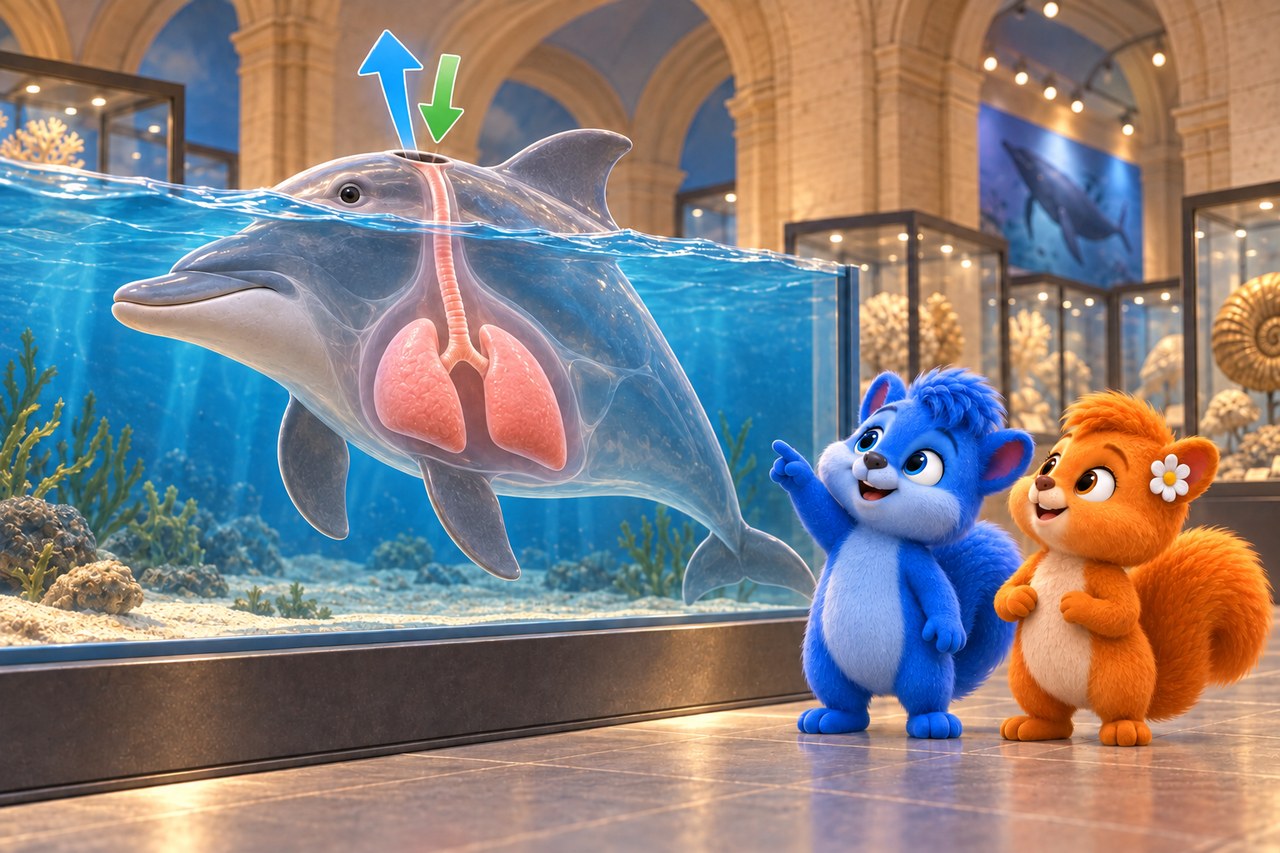
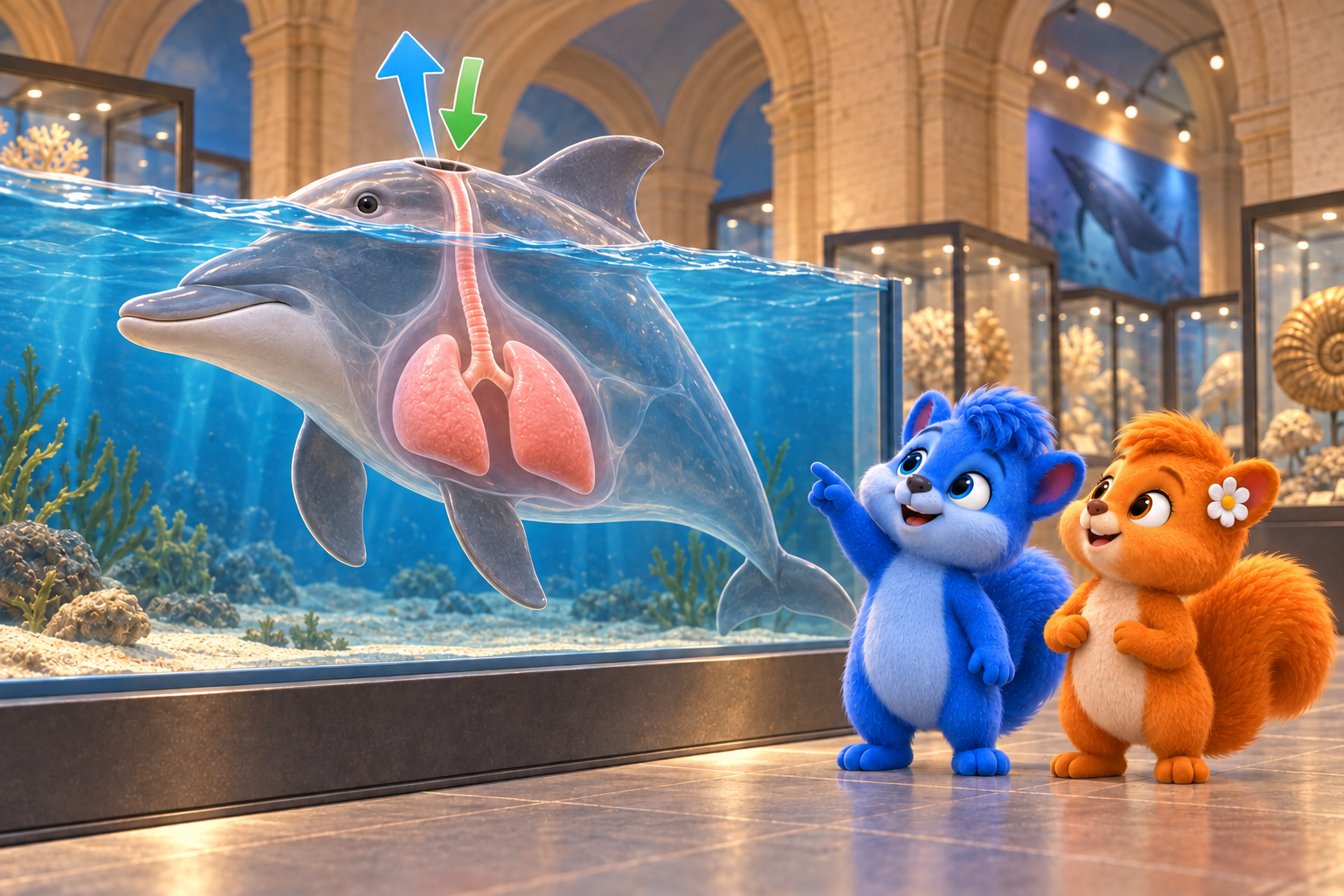
Puschel and Flauschi in the museum. Dolphin cutaway at the water surface: its blowhole leads air to symbolic lungs. Inanimate model; the air route is simplified and water does not enter the lungs. AI-created illustration, not a photograph of nature.
Explained in three pictures
1 Under water
During dives, the blowhole stays closed.
2 Surface to breathe
At the surface, it opens: air is breathed out and in.
3 Air reaches the lungs
The air reaches the lungs. Dolphins do not have gills.
More about the picture
Dolphins are mammals and obtain oxygen from air using their lungs. They must therefore reach the surface. The blowhole on top of the head connects to the airways and stays closed during dives. Echolocation is a different process.
An imagined Wusel scene
Puschel and Flauschi investigate
Puschel draws fish-like gills on the dolphin model. Flauschi points to the blowhole on its head. They trace air to the lungs in the cutaway. He corrects his drawing and marks the surface as its breathing place.
Look closely
Compare the museum model with the three picture steps. At the surface, it opens: air is breathed out and in.
An example to help you understand
Draw a dolphin under water and the same dolphin at the surface. Mark the blowhole on top of its head: closed under water, open when breathing. In the second sketch, draw the air route to a symbolic lung. Your drawing explains air breathing, not echolocation or exact anatomy. Look for the blowhole on the museum model without touching it.
Try explaining it
Why must a dolphin surface to breathe?
Choose a), b) or c), then explain your choice.
- a)It takes oxygen from water through gills.
- b)It fills its lungs with oxygen-rich water underwater.
- c)It needs air for its lungs.
Show the explanation
Correct: c): It needs air for its lungs.
Dolphins are mammals with lungs. They need air and cannot take oxygen from water through gills as fish do. They bring their blowhole to the surface to breathe.
Word help
- oxygen
- A gas that people and many other living things need. Oxygen occurs in air and can also dissolve in water.
Explore in more detail
Here you will find longer explanations and further details. You can explore them together.
1. A mammal in the water
Dolphins are mammals. Common bottlenose dolphins breathe air with lungs through a blowhole on top of the head. They surface to breathe; the opening stays closed during dives. Their young drink milk. Having fins therefore does not make a dolphin a fish.
Checked against: [1]
2. Sound can help with searching
Bottlenose dolphins use sound for communication and finding food. For echolocation they emit clicks and receive returning echoes. Researchers investigate these sounds with underwater microphones. An echo is reflected sound. Our drawn arrows show a simplified idea, no visible rays in the water.
3. Groups do not always stay the same
Common bottlenose dolphins may travel alone or in groups. Groups split and come together again. They live in coastal waters and farther out at sea. Their prey includes fish, squid and crustaceans. Not every dolphin species lives or hunts in the same way.
Checked against: [3]
4. Distance protects the animals
Feeding changes wild dolphins’ behaviour. They may associate people and boats with food, bringing them dangerously close to vessels or fishing gear. Following and crowding also disturb them. Admire them from a distance and follow the rules applying at that location.
Checked against: [4]
An optional question for further exploration
You can use the longer explanation above. This is extra, not needed for the first quiz.
An extra question
Does a common bottlenose dolphin breathe underwater with gills?
Discover the answer
No. It is a mammal and breathes air with lungs. It surfaces and opens its blowhole to breathe. The blowhole stays closed during dives.
Pictures and sources for adults
Sources for further reading
Facts checked against the specialist sources below on 12 October 2026. The Wusel scene is fictional; comparisons and simplified models are explicitly explained. Sources are in English.