What can a dog’s body language show us?
Consider posture, sounds and situation together; respect space rather than translating single signals like words.
The short answer
A dog's posture, face, tail, sounds and situation all matter together. A wagging tail does not always mean friendly. Keep space, ask the responsible person and leave a dog alone when it needs that.
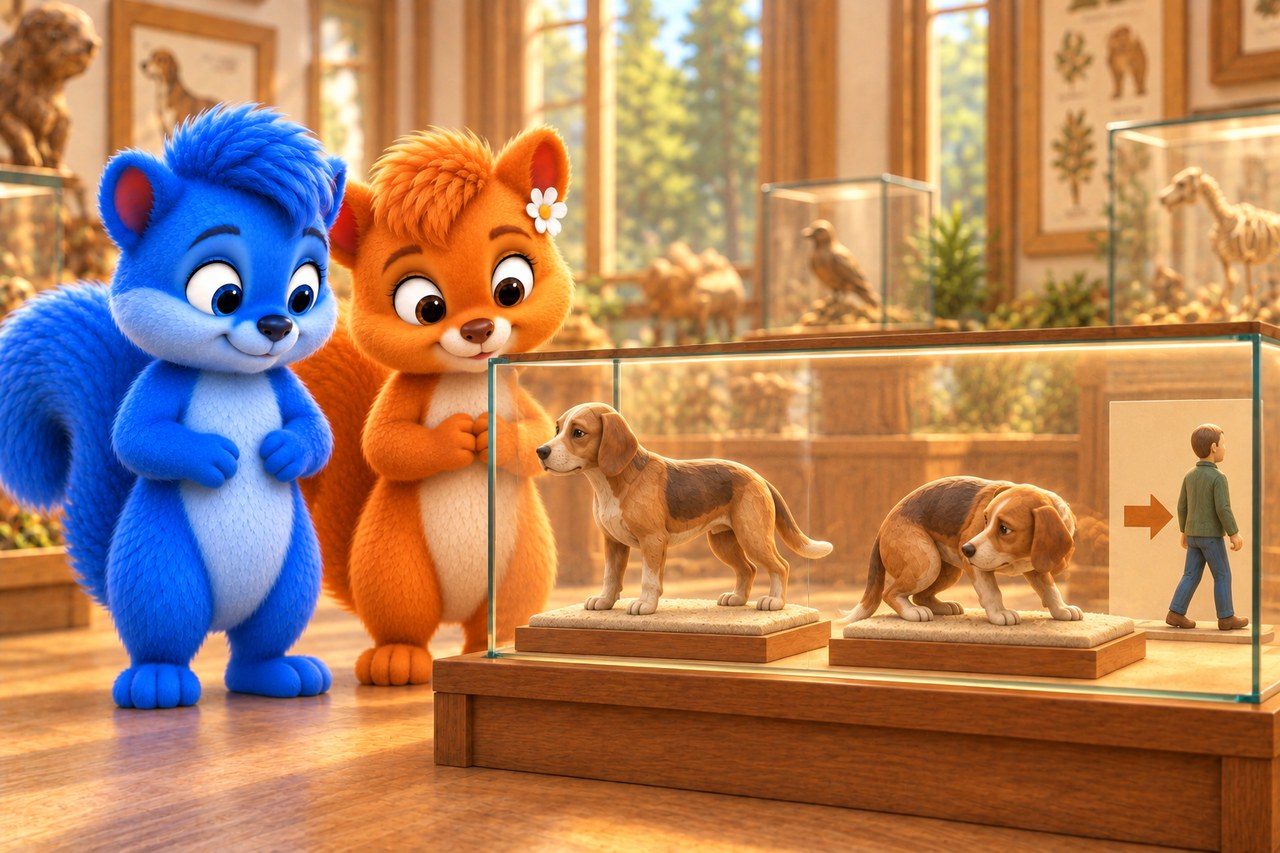
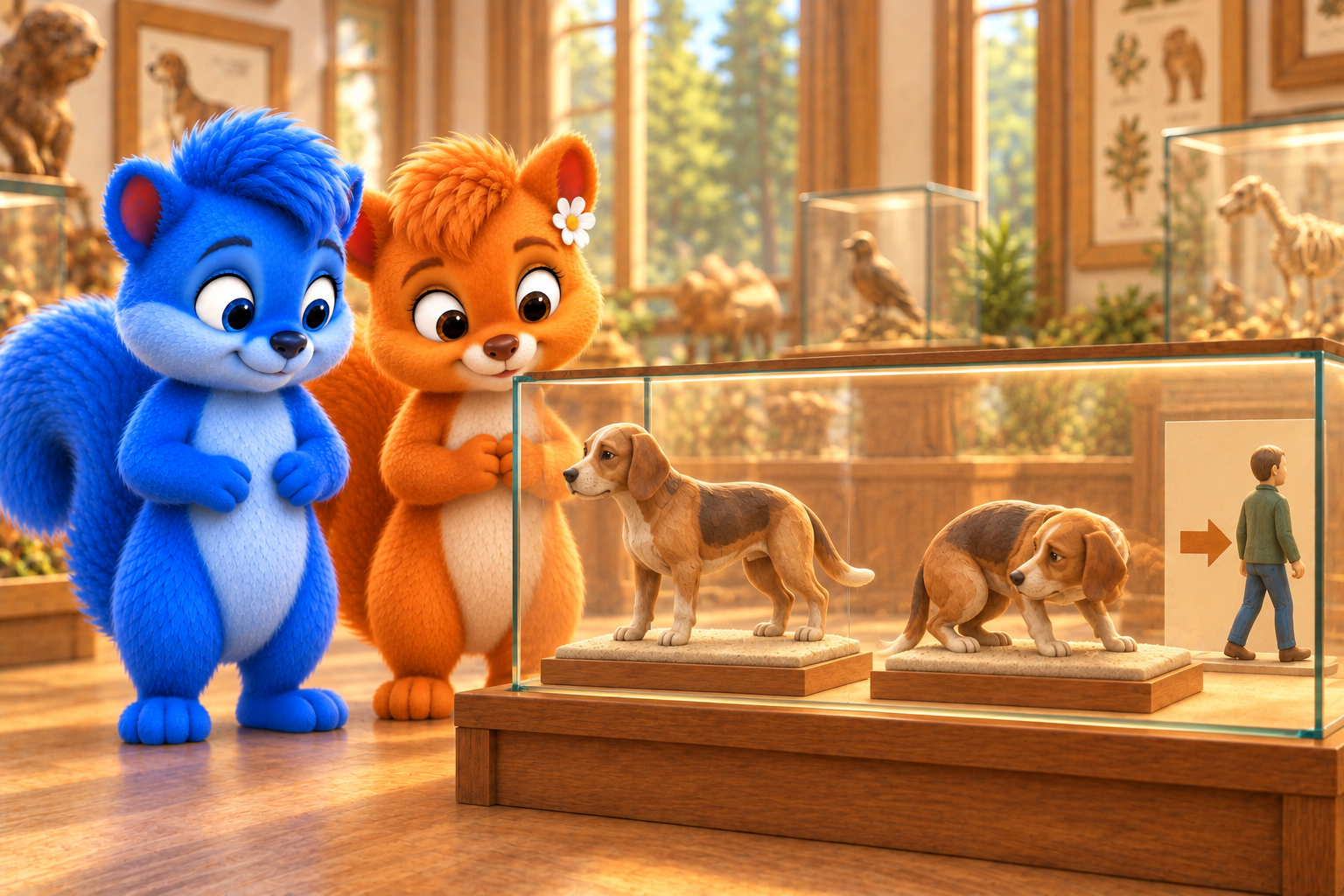
Puschel and Flauschi in the museum. Dog models in loose and crouching postures; a figure gives them space. One sign cannot reveal a feeling with certainty; body and situation matter. AI-created illustration, not a photograph of nature.
Explained in three pictures
1 A loose-looking posture
A loose posture may look relaxed. The situation matters.
2 Turning away and lowering
Turning away and crouching may suggest a need for more space.
3 A considerate response
Give space and ask an adult. One sign cannot reveal a feeling with certainty.
More about the picture
Consider ears, head, body and tail together. One sign, including wagging, does not reveal a feeling with certainty. These drawings are examples, not a diagnosis. If a dog moves away or seems uneasy, leave it undisturbed and ask an adult.
An imagined Wusel scene
Puschel and Flauschi investigate
In the museum picture, Puschel sees a wagging tail and wants to label it friendly. Flauschi reveals the rest. They consider body posture and context too. He drops his quick verdict: one sign is not enough.
Look closely
Compare the museum model with the three picture steps. Turning away and crouching may suggest a need for more space.
An example to help you understand
With adults, examine two suitable dog pictures. First describe only what is visible: head position, ears, body posture and tail. Then collect missing information, such as movement or situation. For a picture showing turning away, choose “give space” as a kind response. Never test your guess on a dog. A model, photograph or video replaces no attentive supervision during an actual encounter.
Try explaining it
Is tail-wagging alone permission to touch a dog?
Choose a), b) or c), then explain your choice.
- a)No, consider the whole situation and ask the responsible person.
- b)Yes, a wagging tail is enough without looking at the rest of the body.
- c)Yes, if the dog stands still, even without asking.
Show the explanation
Correct: a): No, consider the whole situation and ask the responsible person.
A dog's posture, face, tail, sounds and situation all matter together. A wagging tail does not always mean friendly. Keep space, ask the responsible person and leave a dog alone when it needs that.
Explore in more detail
Here you will find longer explanations and further details. You can explore them together.
1. Dogs communicate in several ways
Dogs communicate through scent information, sounds and body postures, among other means. Communication here means signals may convey information to others. Barking, whining or growling are no human words with a single fixed translation. Face, ears, tail and movement also belong to the overall picture. One sound alone is therefore insufficient to understand a dog better.
Checked against: [1]
2. The whole body offers clues
A loose posture, naturally positioned ears and relaxed mouth may together fit a relaxed dog. Low posture, ears back, turning away or lip-licking may indicate discomfort. RSPCA shows such examples. These are clues, no reliable diagnosis from a photograph. Consider the individual dog, movement and surrounding events.
3. Wagging is no reliable invitation
Dogs with a low wagging tail and ears back may also be uncertain. A signal can occur in different situations; not every dog shows the same combination. “Tail wagging, so I may stroke” therefore does not follow. If a dog moves away, turns its head away or seems tense, give it space and ask adults to supervise the situation.
4. Space gives the dog a choice
A dog should be able to retreat. Leave it undisturbed when eating, sleeping, resting or enjoying a toy. Adults stay attentive and end an encounter early if it becomes uncomfortable. There is no need to wait for an obvious threat. Familiar dogs need this consideration too. Learning body language does not make children solely responsible for safety.
Checked against: [4]
An optional question for further exploration
You can use the longer explanation above. This is extra, not needed for the first quiz.
An extra question
May I touch a dog just because its tail is wagging?
Discover the answer
No. Wagging may occur in different situations. The whole body, individual dog and situation matter. If unsure, give space and get adults; the dog may leave and stays undisturbed when resting or eating.
Pictures and sources for adults
Sources for further reading
Facts checked against the specialist sources below on 12 October 2026. The Wusel scene is fictional; comparisons and simplified models are explicitly explained. Sources are in English.