Woodland plants · Corylus avellana
Discover hazel
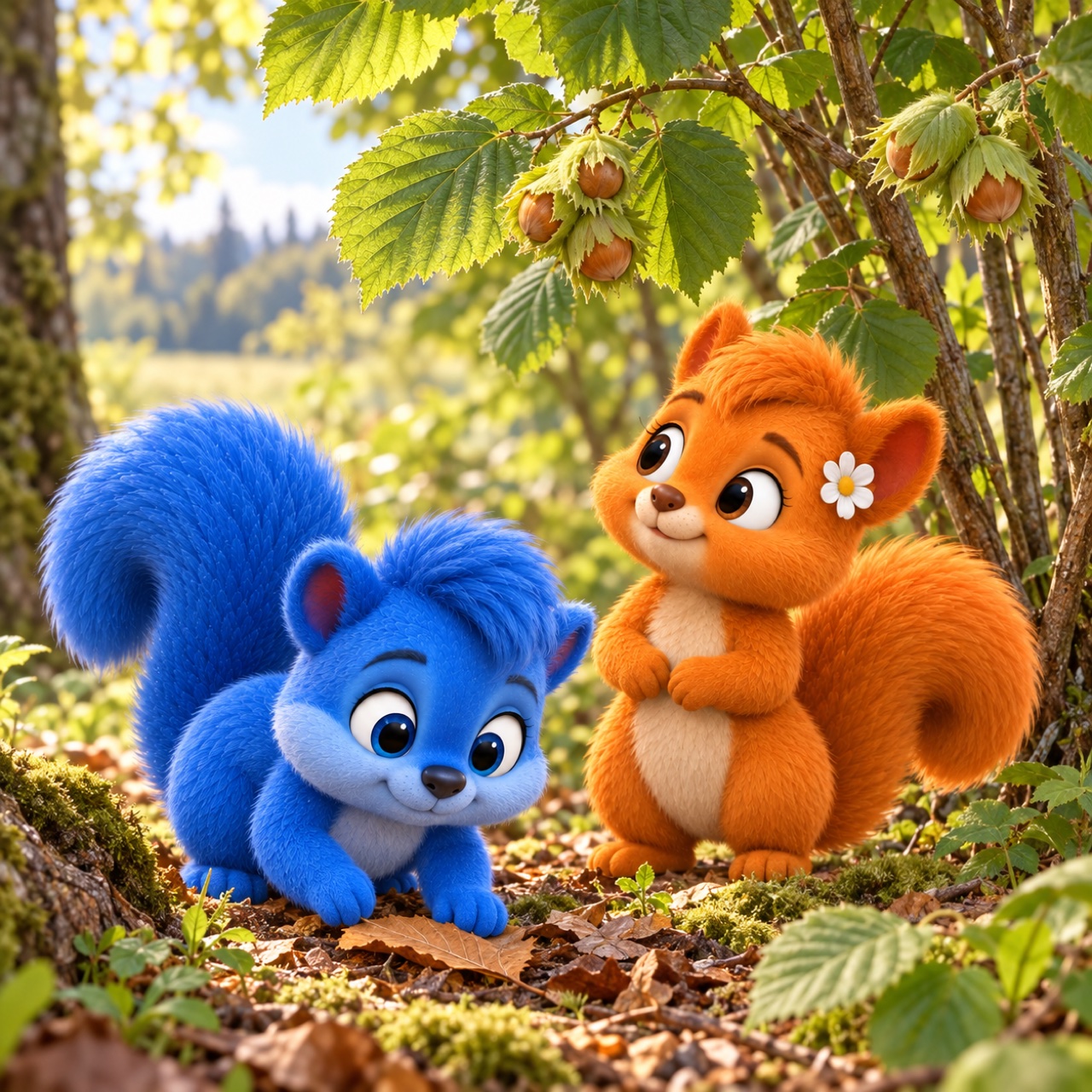
Nuts in green husks! Puschel notices the leafy hazel shrub. Flauschi remembers its catkins in early spring.
The short answer
Hazel leaves are broad with heart-shaped bases. Long hanging flower clusters called catkins often appear before leaves. Nuts are another clue; identification compares the whole plant.
An imagined Wusel scene
Puschel and Flauschi investigate
Puschel looks at the hazelnuts in their green husks. Flauschi points out the broad, toothed leaves beside them. Puschel“Today the shrub has nuts and leaves,” says Puschel.
Flauschi“It looked different early in the year,” Flauschi recalls. Flauschi“The long male catkins usually flowered before the leaves appeared.” Puschel smiles at their German name: Puschel“Little cats without paws!” They only look at the nuts and leave them on the shrub.
Plant clues
Three things to notice
Rounded leaves
The broad leaves have a heart-shaped base and a toothed edge.
Spring catkins
The long yellowish male catkins usually flower early in the year, before the leaves appear.
Hazelnuts
Nuts sit inside a leafy husk.
Mini quiz
What do you remember?
1. Which leaf shape matches hazel?
Choose one answer: a), b) or c).
- a)Long, narrow leaves
- b)Pinnate leaves
- c)Rounded leaves
Show answer
Correct answer: c): Rounded leaves Rounded leaves
2. Flauschi remembers the flowering hazel catkins early in the year. What were they?
Choose one answer: a), b) or c).
- a)Unripe nuts
- b)Leaf buds
- c)Groups of flowers
Show answer
Correct answer: c): Groups of flowers Groups of flowers
Word help
- cell
- A tiny living unit. Living things are made of cells.
- flower cluster
- Several flowers growing together in a particular arrangement.
- pollen
- Fine powder from flowers. Pollination carries it to a suitable flower’s receiving surface. It is not a plant seed.
- pollination
- Pollen reaches a flower’s receiving surface, the stigma. Further processes can then lead to seeds.
- stigma
- The part of a flower where pollen can land.
- fertilisation
- A male reproductive cell joins an egg cell. This is a different step from moving pollen.
Explore in more detail
Here you will find longer explanations and further details. You can explore them together.
Why does hazel flower without showy petals?
The long catkins contain many small male flowers. They release pollen, which wind can carry to the tiny female flowers. Often, only the fine red stigmas are obvious. Here a stigma is the part of a flower where pollen can land, not a wound. Pollination transfers pollen to a flower’s stigma. Fertilisation joins a male reproductive cell with an egg cell. Reproductive cells are special cells involved in producing offspring.
Compare and understand
This often happens before the leaves open. Wind pollination does not require bright petals to attract insects. After pollination and fertilisation, a female flower can develop into a hazelnut. The nut is the fruit; the seed lies inside its hard shell.