Everyday Life & Technology
Why does a towel soak up water?
A wet edge travels a little way through the cloth.
The short answer
Tiny spaces lie between a towel's fibres. Water clings to suitable fibres and spreads through these spaces. This lets the towel absorb water. Fibres are the fabric's fine threads.
An imagined Wusel scene
Puschel and Flauschi investigate
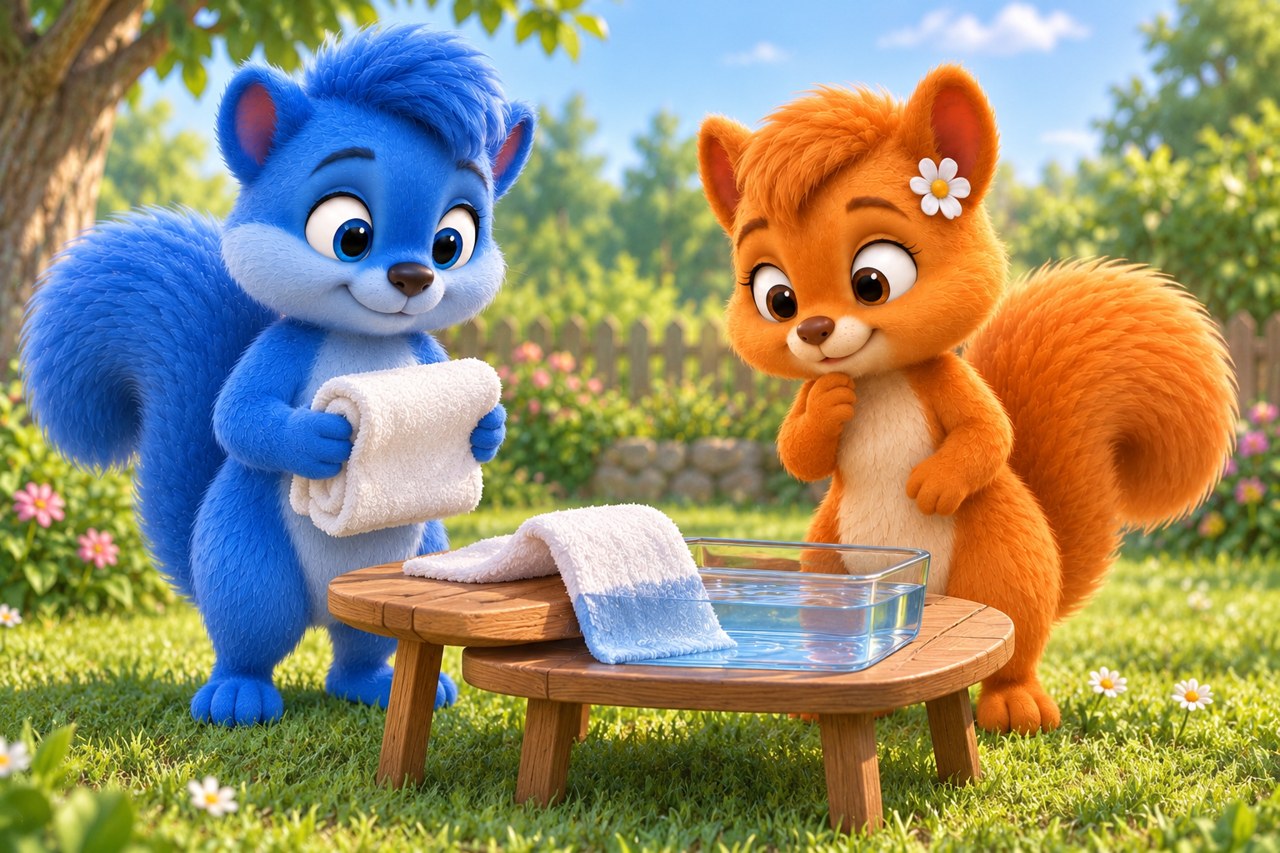
An edge of the clean towel touches water in a shallow tray. Puschel“The wetness is crawling!”
Flauschi looks closely. Flauschi“Water spreads between the fibres. The tiny spaces help it.”
Puschel holds a second towel dry beside the tray. Puschel“These feel different, although neither has feet.”
Flauschi“We do not need to walk with them. We are observing how the wet area changes.”
They dry the table. Puschel“Our towel has taken up lots of water. It can still have help with tidying.”
Little Wusel quiz
What are fibres?
Choose one answer: a), b).
- a)Thin threads in fabric.
- b)The spaces between the threads.
Show answer
Correct answer: a): Thin threads in fabric. Fibres are thin threads that make up fabric.
Do all fabrics absorb equal amounts of water?
Choose one answer: a), b).
- a)Yes.
- b)No.
Show answer
Correct answer: b): No. No. Material, weave and existing wetness matter.
Word help
- evaporation
- Liquid becomes gas at its surface, even without boiling.
Explore in more detail
Here you will find longer explanations and further details. You can explore them together.
Understand step by step
How it works – simply explained
There is space between fibres
A towel has many thin fibres with small gaps. It is not a sealed smooth water container.
Water wets and enters
Water can cling to suitable fibres and be drawn into narrow gaps. This is capillary action, spreading water through the fabric.
Absorption has limits
A wet towel already holds much water in fibres and gaps, so takes up less extra. Drying releases water back as vapour.
Why a dry towel often absorbs more
A dry towel has space for water around fibres and in gaps. Much of that space is already occupied in a very wet towel, so less extra water can be taken up. Evaporation removes water again. The towel is not an inflatable tank; water enters and leaves numerous small routes.
References for this explanation: [1]
The key points again
Discovery 1
Many small spaces lie between a towel’s fibres. Fibres are the thin threads that make up the fabric.
Source: [1]
Discovery 2
Water can cling to suitable fibres and spread through narrow spaces. This is called capillary action. It can also carry water a little way upwards.
Source: [1]
Discovery 3
Not all fabrics absorb equal amounts of water. Material, weave and existing wetness matter. An already wet towel can take up less additional water.
Source: [1]