Animals · Eurasian red squirrel
Discover a real red squirrel
Someone up there scampers like us! Puschel spots a real squirrel. Flauschi explains its home, food stores and winter habits.
The short answer
A real squirrel has a bushy tail that helps it balance. It stores food and builds rounded twig nests called dreys. It wakes to find food during winter too.
Listen to the animal
Real sounds from nature
A real red squirrel calling
Listen closely: the squirrel makes short calls. This longer field recording also contains woodland sounds.
Recording: Karl-Heinz Frommolt / Tierstimmenarchiv, Museum für Naturkunde Berlin · Original title: Gemeines Eichhörnchen (Sciurus vulgaris) – Rufe eines Eichhörnchens · CC BY-SA 3.0An imagined Wusel scene
Puschel and Flauschi investigate
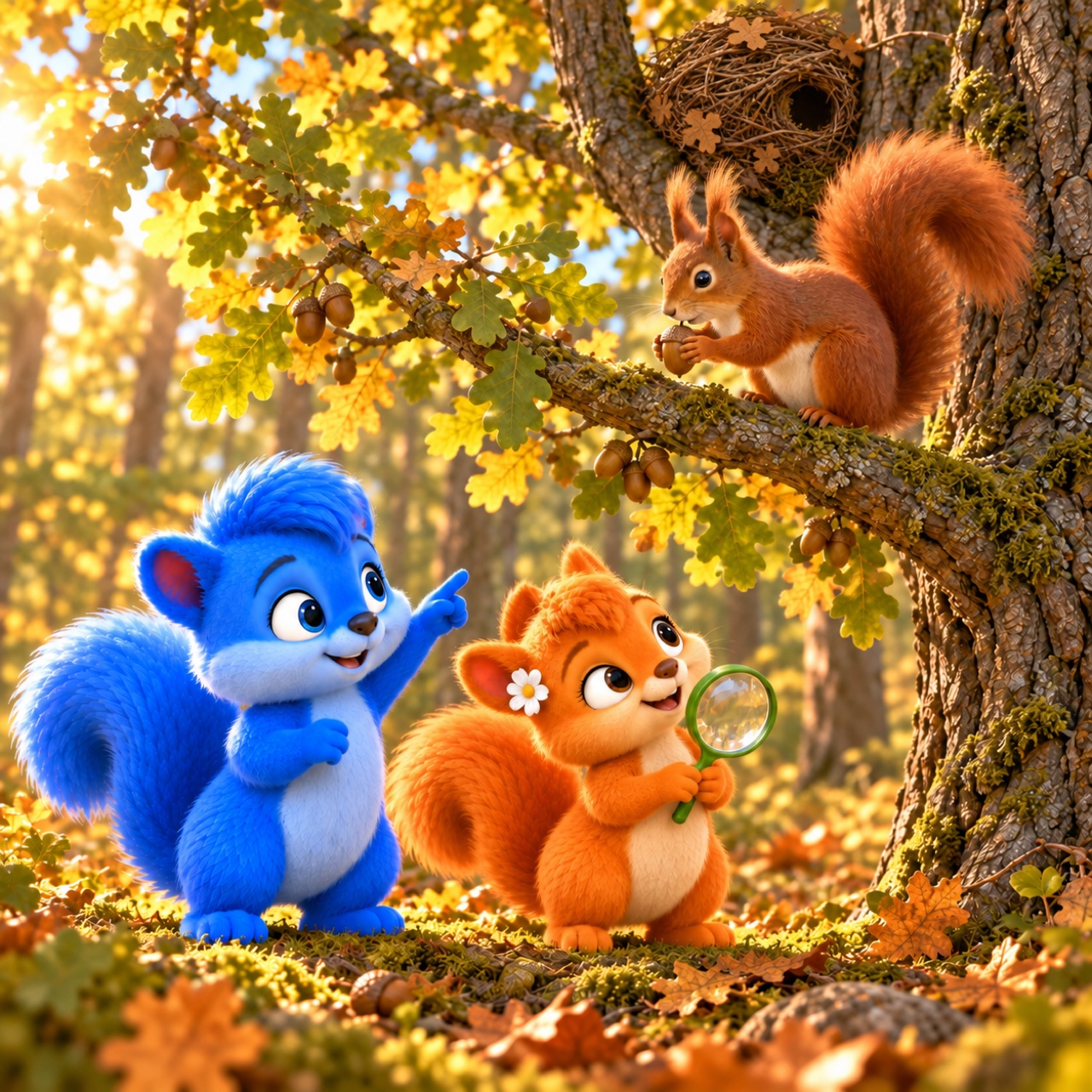
Puschel spots a red tail among the oak leaves. ‘Flauschi, someone up there is bustling about like us!’ Flauschi lowers her green magnifier. The squirrel on the branch is easy to see without it and holds an acorn.
They stand quietly on the ground. The animal runs along the trunk. High in the fork of the tree is its round nest. ‘Our Wusel home looks different,’ Puschel whispers. Flauschi smiles. ‘Yes. We tell stories – and this squirrel really lives here in the woods.’
Real animal facts
Four things to know
Many coat colours
Wild Eurasian red squirrels here can have pale red, reddish-brown or dark brown fur, sometimes almost black. Their belly is usually light. Their long bushy tail helps them balance and keeps them warm when resting.
A home in a tree
The round nest made from twigs and leaves is called a drey, or Kobel in German. It is usually high in a tree.
Hidden food
Squirrels eat seeds, nuts and tree fruit, among other things. They hide food in different places. Some forgotten seeds can sprout.
Awake in winter
Squirrels do not hibernate. In cold weather they rest a lot in their nest, but still go out to find food.
Mini quiz
What do you remember?
1. What is a squirrel’s nest called?
Choose one answer: a), b) or c).
- a)A drey
- b)Eyrie
- c)Tree cavity
Show answer
Correct answer: a): A drey A drey
2. What does a squirrel do with some of its food?
Choose one answer: a), b) or c).
- a)It stores everything in its nest
- b)It always eats everything at once
- c)It hides food for later
Show answer
Correct answer: c): It hides food for later It hides food for later
3. Does it hibernate?
Choose one answer: a), b) or c).
- a)No, it rests a lot but also goes out to find food
- b)Yes, it hibernates
- c)Only when it snows
Show answer
Correct answer: a): No, it rests a lot but also goes out to find food No, it rests a lot but also goes out to find food
Explore in more detail
Here you will find longer explanations and further details. You can explore them together.
Understand step by step
How it works – simply explained
A tail helps movement
The long tail aids balance while climbing and jumping and can protect from cold during rest. It is no wing.
Food is stored
Squirrels hide supplies in different places. Some forgotten suitable seeds may grow into plants.
A nest provides rest
A drey is a rounded nest of twigs and soft material. Squirrels rest there but do not hibernate; they forage during winter too.
References for this explanation: [1]