Trees and leaves · Oak Tree
Recognising an Oak Tree
A little cap for every acorn! Puschel marvels at these woodland treasures. Join Flauschi to spot the oak’s lobed leaves and cracked bark.
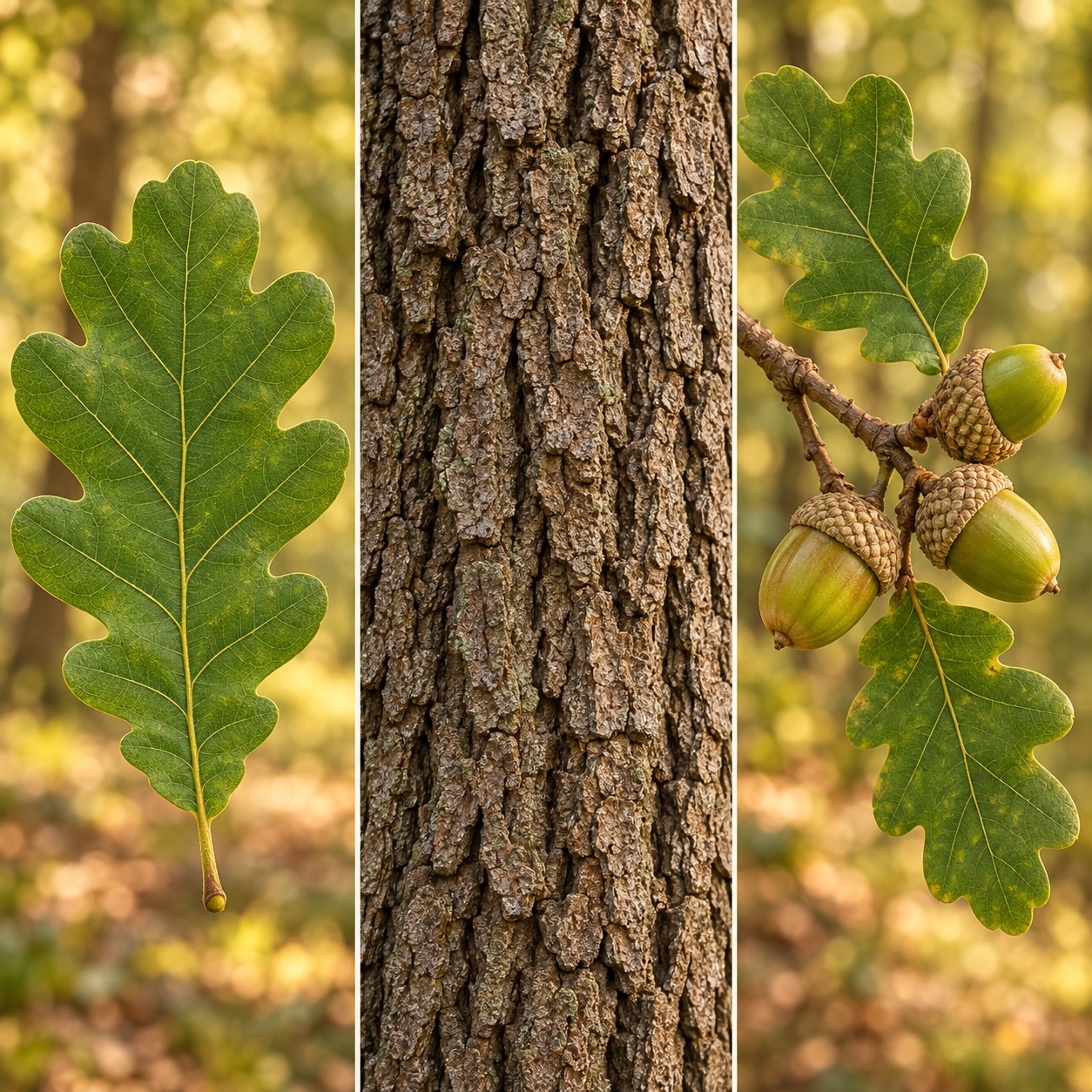
The short answer
The pedunculate and sessile oaks shown here have leaves with rounded sections separated by notches. The projecting sections are called lobes. Older trunks have deep grooves in the bark. Acorns in small cups are another clue. Other oak species can look different.
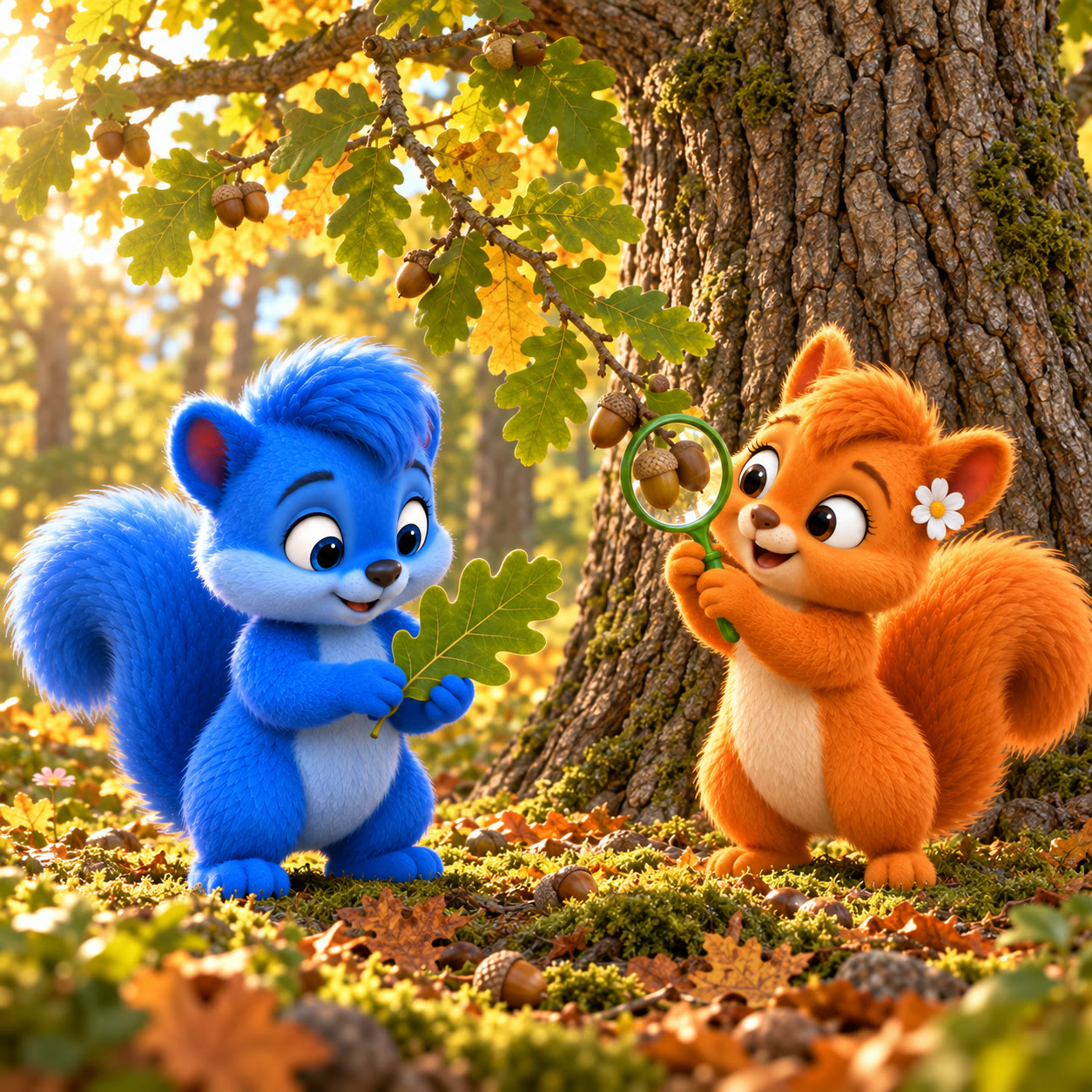
An imagined Wusel scene
Puschel and Flauschi investigate
Puschel finds deep bark grooves on an old trunk. Flauschi sees a leaf with rounded lobes on the path. They compare it with leaves on the tree and find the fruit shape in the picture. Several clues now fit oak.
The leaf
The native pedunculate and sessile oaks shown here have leaves with rounded bays and lobes. Other oak species can have differently shaped leaves.
The bark
On older oaks, the grey-brown bark is usually thick and rough, with deep furrows.
The fruit
The oak’s fruit is an acorn. Each acorn sits, at least at first, in a small scaly cup that looks like a tiny hat.
Mini quiz
What do you remember?
1. Which fruit belongs to an oak?
Choose one answer: a), b) or c).
- a)Acorn
- b)Cone
- c)Chestnut
Show answer
Correct answer: a): Acorn Acorn
2. What does the leaf edge of a pedunculate or sessile oak typically look like?
Choose one answer: a), b) or c).
- a)Rounded and lobed
- b)Needle-shaped
- c)Smooth and heart-shaped
Show answer
Correct answer: a): Rounded and lobed Rounded and lobed
3. What is noticeable about the bark of an older oak?
Choose one answer: a), b) or c).
- a)Deep furrows
- b)Smooth grey surface
- c)White papery bark
Show answer
Correct answer: a): Deep furrows Deep furrows
Word help
- lobe
- A projecting part of a leaf’s surface.
- germination
- The young plant inside a seed begins to grow.
Explore in more detail
Here you will find longer explanations and further details. You can explore them together.
Three tree clues
Why does every oak not have a forest of seedlings?
An acorn contains a seed with a tiny young plant and stored food. Germination means that the seed begins to grow. It needs water, air and suitable warmth. Later, its leaves need light. Many acorns are eaten first; others dry out or land somewhere unsuitable.
Compare and understand
A jay hides acorns as food stores. An acorn it does not retrieve may grow into a tree. The bird is not planning a forest: storing food also helps spread seeds. Compare an acorn with a winged maple fruit: an animal often carries one, while wind helps the other.