How does your brain help you?
Recognizing a ball, planning a movement and learning something new involve many nerve cells working together.
The short answer
You see a ball rolling towards you. Your eyes send messages to your brain. It processes them and helps you move your hands into place. Nerves carry signals between brain and body.
Many brain areas also work together when you remember and plan.
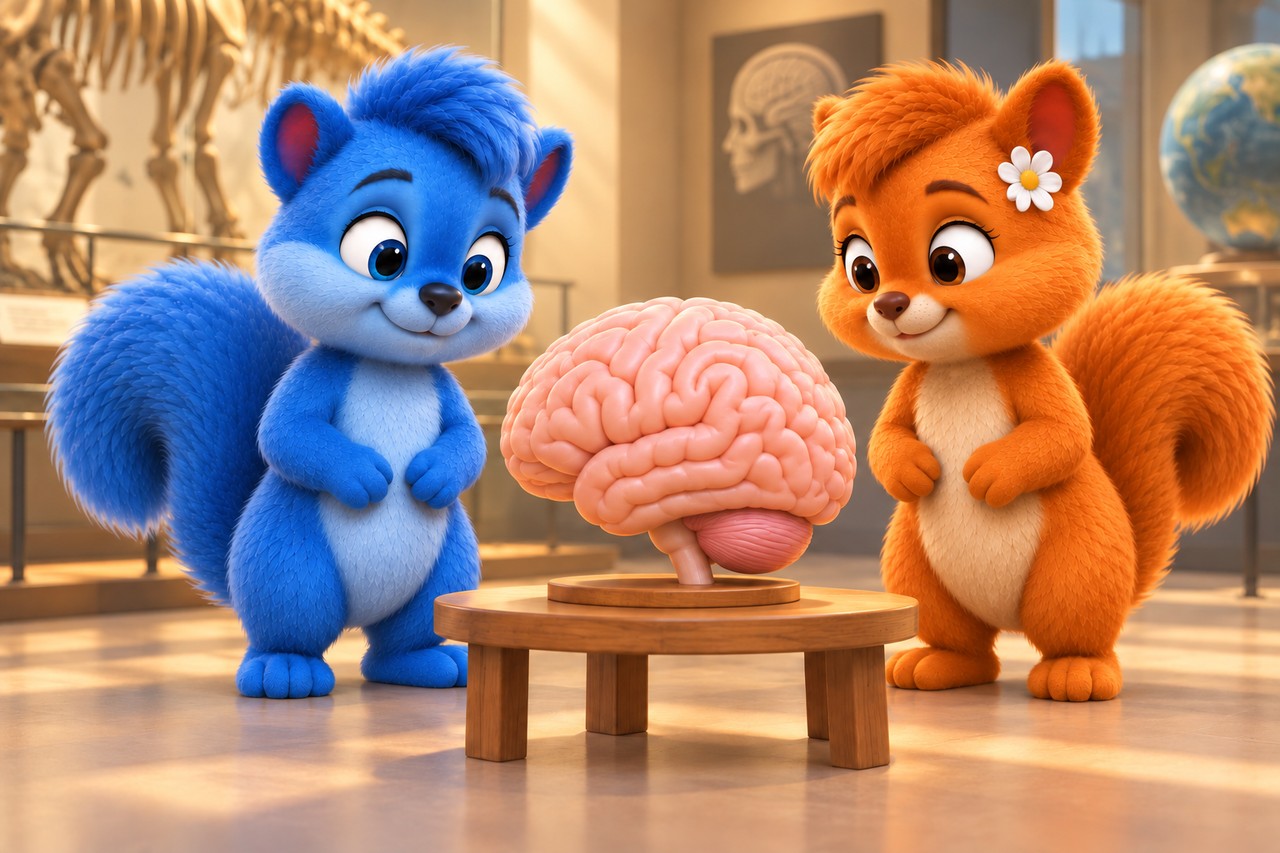
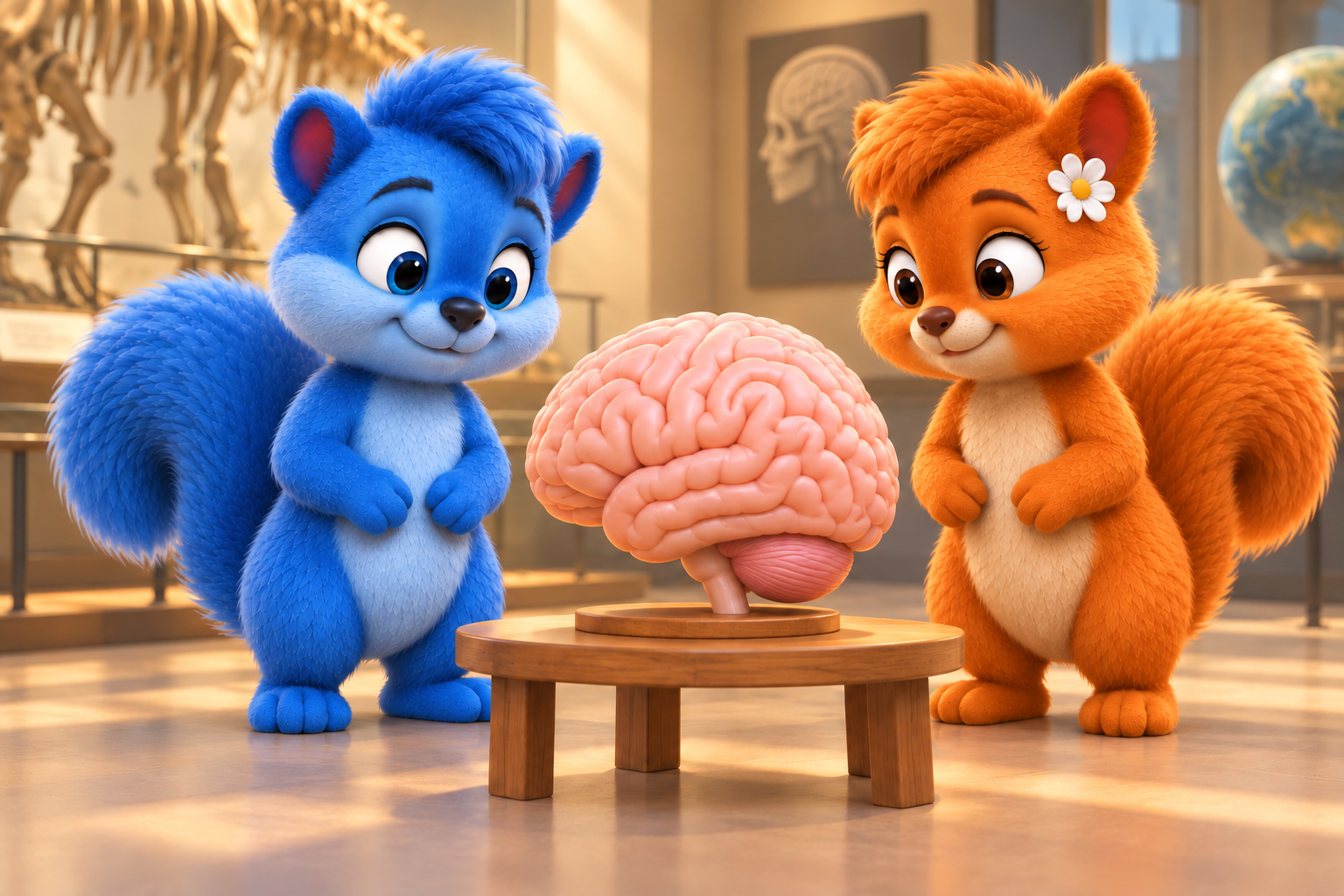
Two equal-sized adult Wusels examine a pink human brain teaching model on a low museum table. Invented museum model, not a real tissue specimen. The diagram shows a greatly simplified information pathway without anatomical scale. AI-created illustration, not a photograph of nature.
What the diagram shows
The diagram simplifies the process. First compare its shapes and arrows. You can read its labels in larger text below.
Read the picture labels
These are the words and sentences from the diagram above. The full explanation follows below.
- I see the ball and want to pick it up
- Eye
- Brain: process
- Move arm
- Also back: information about body position
- Arrows are information pathways; many nerves and cell groups contribute.
- A greatly enlarged junction between two nerve cells
- Nerve cell
- Signal in axon
- Messengers
- Next cell
- Chemical junction as an example; no wires, not complete anatomy.
An imagined Wusel scene
Puschel and Flauschi investigate
Puschel sees the ball and reaches for it. Flauschi lays out cards for seeing, processing and moving. They arrange the message paths. He keeps the senses in the plan: the brain does not work without information from the body.
Look closely
The Wusels examine an invented human brain model. Upper folds belong to its large part; smaller regions appear underneath. The labeled boxes in the separate diagram help explain the information pathway.
An example to help you understand
Place three paper cards side by side: Eye – Processing and planning – Arm. Draw arrows between them. Explain: I see the ball, want to pick it up and move my arm. Add a return arrow for information from the body, such as arm position. This models a sequence, not the layout of nerves. It omits many connections and does not show reaction time. You do not need to catch anything quickly or frighten anyone.
Try explaining it
What does the brain do with messages from the senses?
Choose a), b) or c), then explain your choice.
- a)It processes them and helps guide actions.
- b)It stores every message unchanged rather than interpreting it.
- c)It forwards every sensory message directly without processing it.
Show the explanation
Correct: a): It processes them and helps guide actions.
You see a ball rolling towards you. Your eyes send messages to your brain. It processes them and helps you move your hands into place. Nerves carry signals between brain and body.
Many brain areas also work together when you remember and plan. The brain interprets messages and coordinates responses; it does not simply forward everything without processing.
Word help
- cell
- A tiny living unit. Living things are made of cells.
- nerve
- A bundle of fibres that carry signals through the body.
- axon
- A long extension of a nerve cell that carries signals.
- neuron
- Another word for a nerve cell, which processes and passes on signals.
- synapse
- A junction where a nerve cell can pass a signal to another cell.
Explore in more detail
Here you will find longer explanations and further details. You can explore them together.
1. Information arrives
You see a ball on a table. Your eyes receive light; signals travel through nerves to the brain. Information is processed and connected with familiar things: that could be my ball! The brain is inside your head. Together with the spinal cord, a long structure of nervous tissue within the spine, it forms an important part of the nervous system. This system receives information, processes it and passes signals onward. Many nerves connect it with other body parts.
Checked against: [1]
2. Tiny cells communicate without words
Your brain is made of tiny living building blocks called cells. Nerve cells are particularly important for messages. They are also called neurons.
A nerve cell receives signals through branching extensions. A longer extension carries electrical signals onward. This is an axon. Think of it as a route for passing a signal on, not a hollow pipe.
The handover point to the next cell is a synapse. At many such points, chemical messengers cross a tiny gap. They act on the next cell and affect whether it passes on a new signal. Boxes and arrows help us compare; no real letters are sent.
3. From recognizing to reaching
You want to pick up the ball. Different regions help with perception, planning and movement. Signals can travel from the brain through the spinal cord and nerves to muscles. Muscles contract and move your arm. The cerebrum is the large folded part; it contributes to thinking and perception. The smaller cerebellum helps coordinate movements. The brainstem connects important regions with the spinal cord and helps regulate breathing and other essential functions. No one part does everything alone.
Checked against: [1]
4. Learning changes connections
Practice changes how nerve cells work together. Some connections become stronger or work more effectively. A movement that was difficult can gradually become easier. But the brain is not a muscle that simply grows thick through thinking exercises. Repetition, experience and suitable feedback support learning. People learn at different speeds; a mistake does not mean you cannot think well. The ball example is greatly simplified: many groups of cells work together in a real brain.
An optional question for further exploration
You can use the longer explanation above. This is extra, not needed for the first quiz.
An extra question
Why can a movement that was initially difficult become easier after repeated practice?
Discover the answer
Learning can change connections and their effectiveness between nerve cells. Practice often improves coordination of a sequence. The brain processes sensory and movement information and can adjust the sequence; practice is not just about making muscles stronger.
Pictures and sources for adults
Sources for further reading
Facts checked against the specialist sources below on 12 October 2026. The Wusel scene is fictional; comparisons and simplified models are explicitly explained. Sources are in English.