How does a robot know what to do?
Measuring devices, instructions and motors work together. Robots do not have to look like people.
The short answer
A robot follows instructions. Sensors measure things such as distance or brightness and provide information. A program determines what movement or action follows. Measuring does not mean understanding like a person.
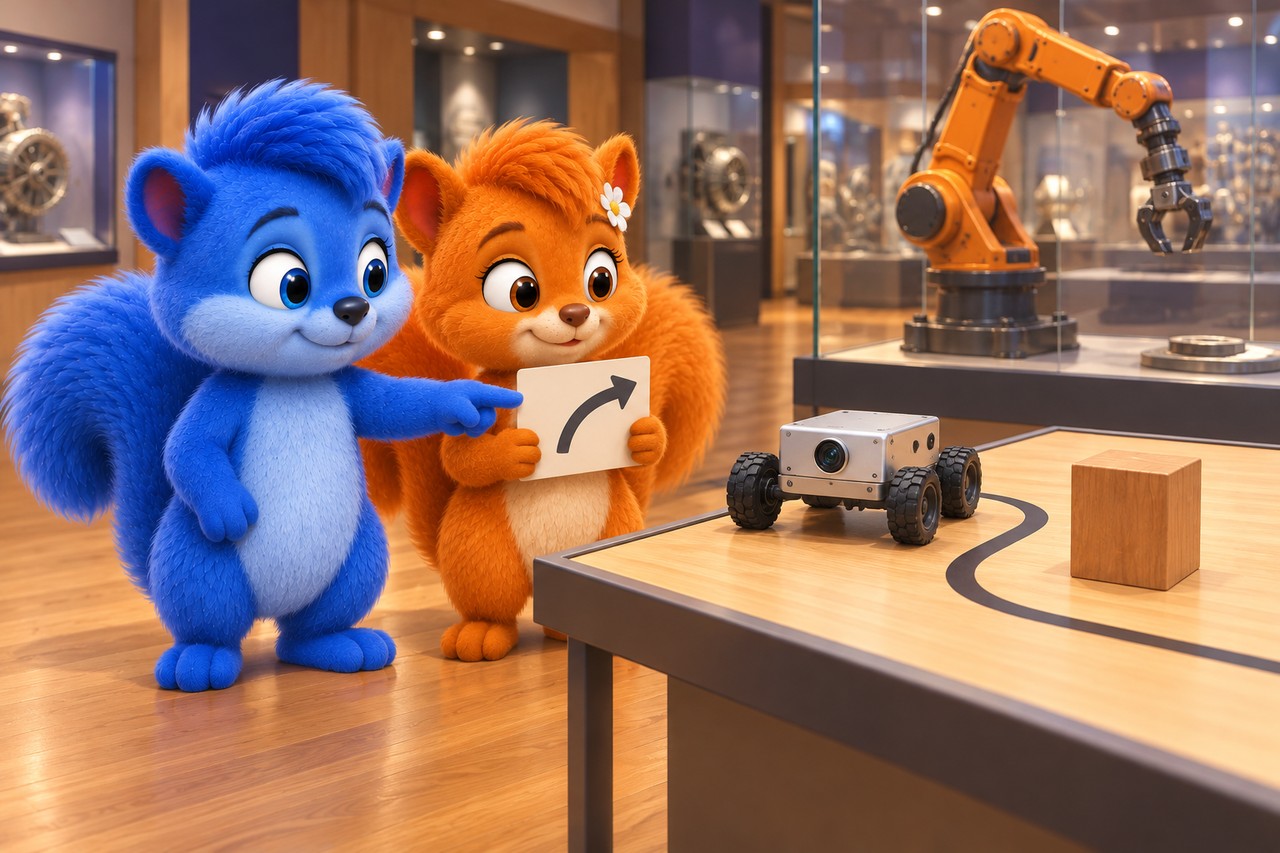
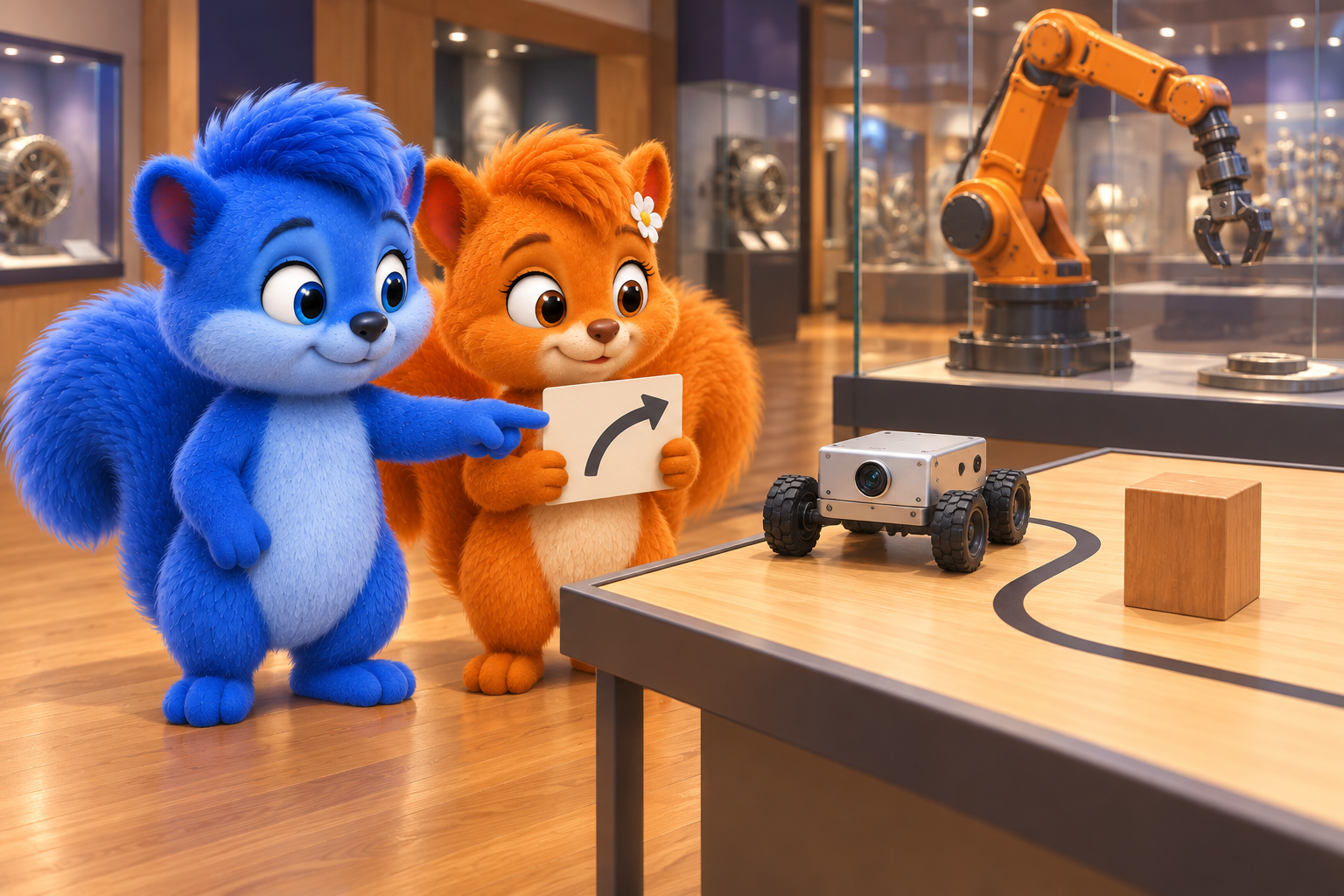
Equal-sized Wusels examine arrow cards beside a parked rover model and obstacle. Imagined museum scene. The painted route and parked model are not a recording of active obstacle detection. AI-created illustration, not a photograph of nature.
What the diagram shows
The diagram simplifies the process. First compare its shapes and arrows. You can read its labels in larger text below.
Read the picture labels
These are the words and sentences from the diagram above. The full explanation follows below.
- Measurements, instructions, movement
- 1. Measure
- Sensor measures distance.
- 2. Program
- Too close? → Stop
- 3. Move
- Wheels move or stop.
- Measure and check again
- Example driving robot. Other robots can work differently.
An imagined Wusel scene
Puschel and Flauschi investigate
Their paper robot should move until it reaches an obstacle. Puschel writes only “Be careful.” Flauschi asks what should be measured and when it should stop. They replace the wish with clear steps and test the figure's route.
Look closely
Find the small rover, obstacle and arrow card. Puschel points towards the card. This parked museum model illustrates an idea; the picture does not demonstrate a sensor detecting the obstacle.
An example to help you understand
Draw a grid with a start, a goal and a blocked square. A paper token is your robot. One child writes three clear steps, such as move one square, turn right, move one square. Another follows only those steps. If the token enters the blocked square, improve the program and test again. A person reads and moves the token; the paper does not measure anything and is not a real computer.
Try explaining it
Why does a robot need precise instructions?
Choose a), b) or c), then explain your choice.
- a)So its measuring devices decide alone without a procedure.
- b)Its program must specify what follows from measurements.
- c)So it can guess the order of tasks without measurements.
Show the explanation
Correct: b): Its program must specify what follows from measurements.
A robot follows instructions. Sensors measure things such as distance or brightness and provide information. A program determines what movement or action follows. Measuring does not mean understanding like a person.
Word help
- sensor
- A device part that measures something, such as light or distance.
Explore in more detail
Here you will find longer explanations and further details. You can explore them together.
1. A machine with a task
A robot is a machine that can carry out tasks using instructions. Some are remotely controlled; others perform certain steps independently. A robot might be a factory arm or a vehicle on another planet. It does not need human-like eyes, a mouth or legs.
2. Measuring instead of guessing
A sensor is a device that measures something, such as distance, temperature or movement. A camera supplies images. A suitable robot’s distance sensor may report an obstacle ahead. It does not feel like a person; it processes measurements. Sensors can detect only the things they are designed to measure.
3. A program sets out the steps
A program is an ordered set of instructions for a computer. A simple driving program might say: check the distance; stop if it is too small; otherwise move a little further. People must also define what too small means. Other robots use other programs. Not every robot has obstacle detection.
4. An instruction becomes movement
A motor can move wheels or an arm. The controller sends suitable commands. Measuring again can allow the next action to change. Measurements, obstacles or incorrect instructions can still cause problems. People therefore test robots carefully. Independent operation for one task does not mean being able to do everything.
An optional question for further exploration
You can use the longer explanation above. This is extra, not needed for the first quiz.
An extra question
Why is telling a robot to do it correctly not enough?
Discover the answer
The machine needs suitable, precise instructions and, when required, suitable measurements. Correct behaviour must be defined and tested for its task.
Pictures and sources for adults
Sources for further reading
Facts checked against the specialist sources below on 12 October 2026. The Wusel scene is fictional; comparisons and simplified models are explicitly explained. Sources are in English.