How can devices make the night visible?
Some devices amplify faint light. Others turn invisible thermal radiation into a picture.
The short answer
A night-vision device can brighten a dark view by amplifying the little light available. A thermal camera works differently: it shows warmer and cooler areas differently. Its bright image colours help us compare; the night is not really those colours.
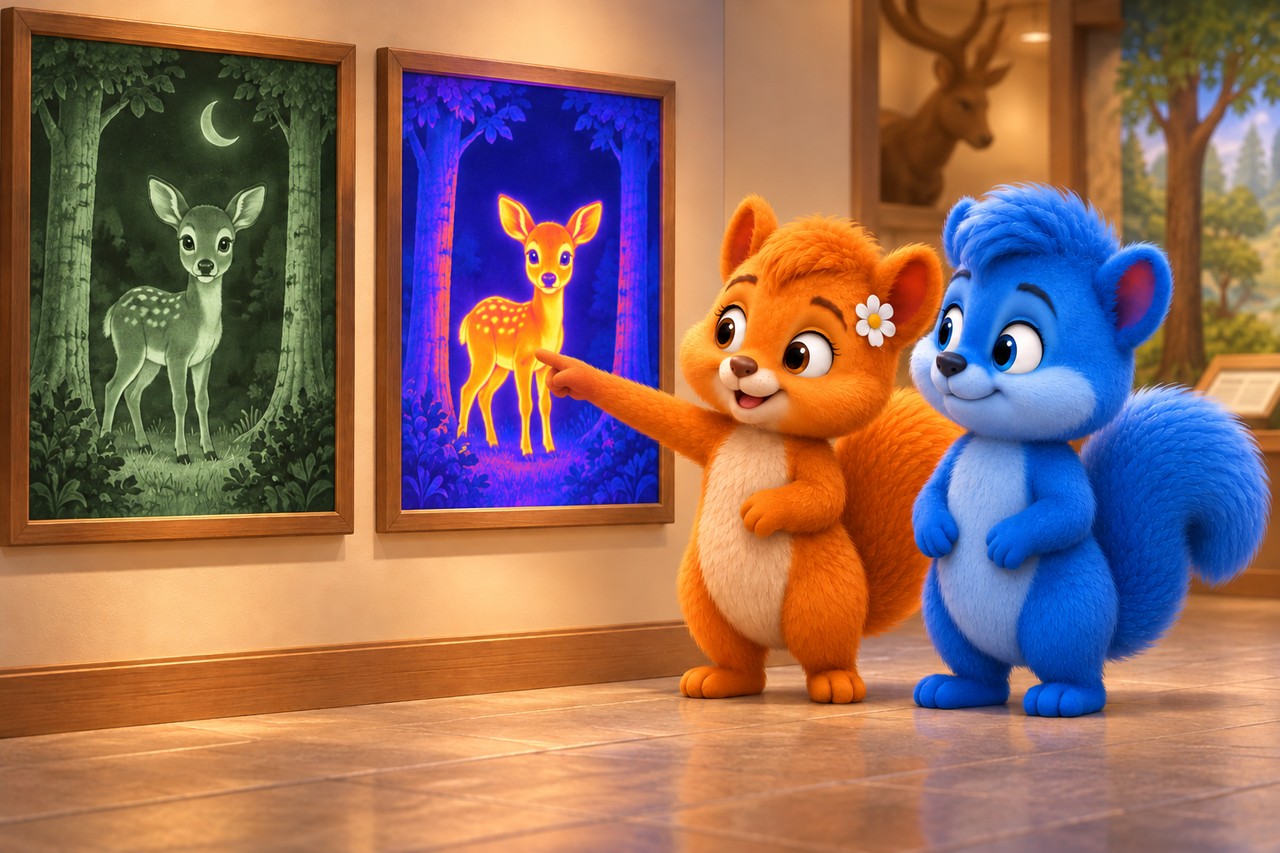
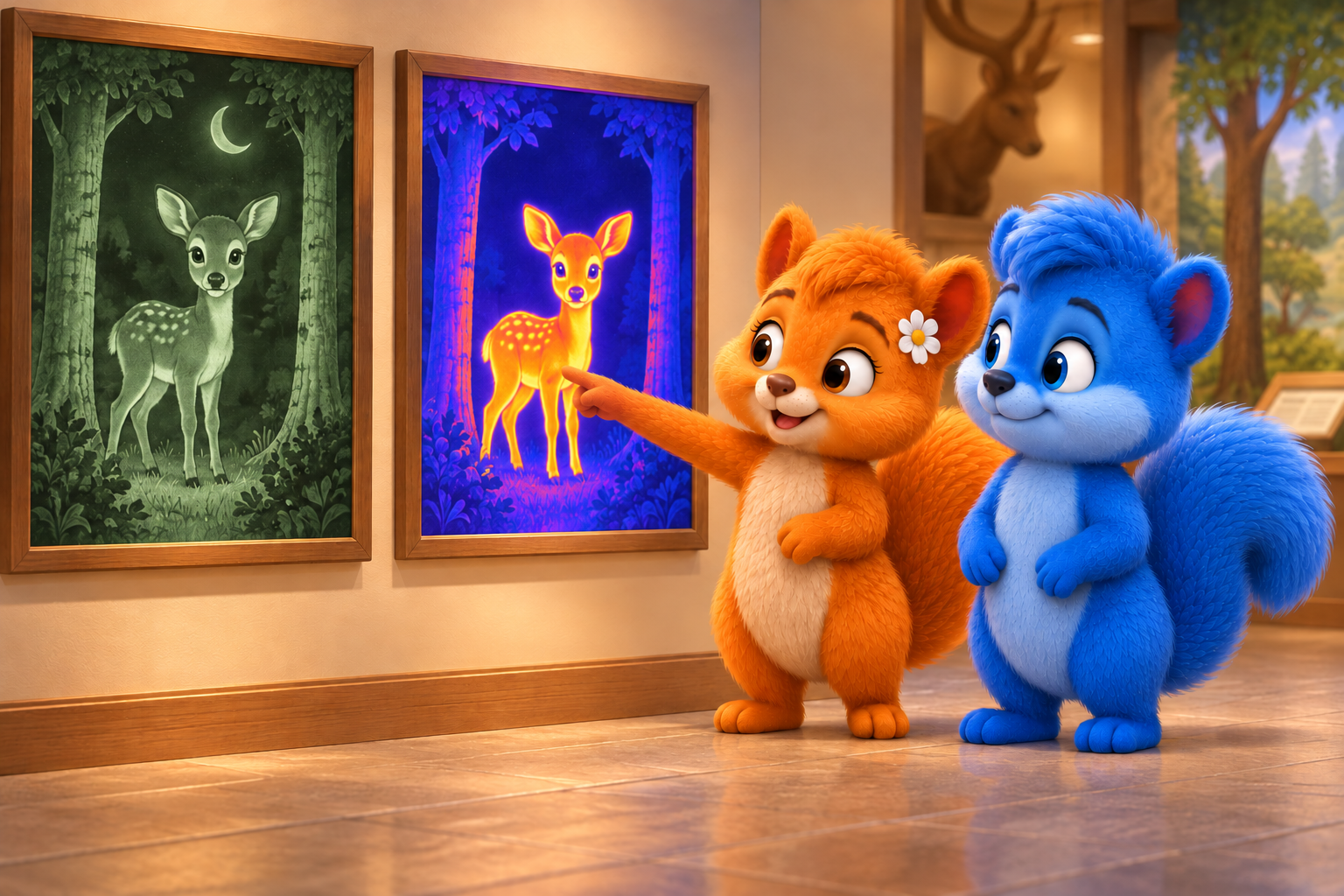
Equal-sized Wusels compare a green intensified picture and a false-colour thermal animal picture. Invented museum pictures, not real camera images, readings or a fixed temperature scale. Green is only one possible intensifier display. AI-created illustration, not a photograph of nature.
What the diagram shows
The diagram simplifies the process. First compare its shapes and arrows. You can read its labels in larger text below.
Read the picture labels
These are the words and sentences from the diagram above. The full explanation follows below.
- Two methods – different image signals
- Faint incoming light
- Image intensifier
- Brighter image
- Infrared radiation
- Thermal camera
- Assigned colours
- An ordinary thick wall remains an obstacle.
- Comparison of principles, not a radiation or temperature measurement.
An imagined Wusel scene
Puschel and Flauschi investigate
Puschel thinks red areas in the device image are red paint on an object. Flauschi finds the temperature legend. They compare thermal and ordinary images. He labels the colours as aids for displaying differences.
Look closely
Flauschi points directly at the orange animal. It also appears in the green picture. Both frames contain invented teaching illustrations, not real temperature readings.
An example to help you understand
Draw two cards showing the same animal. Colour one in shades of green, the other with an orange animal on a blue background. Compare: the subject stays the same while its display changes. One represents an intensified image, the other thermal imaging. Paper measures neither light nor temperature; it only helps distinguish pictures. Real measurements need a suitable sensor.
Try explaining it
What do a thermal camera's display colours show?
Choose a), b) or c), then explain your choice.
- a)Bright and dark areas based only on available visible light.
- b)Differences between warmer and cooler areas.
- c)The colours we would see there in daylight.
Show the explanation
Correct: b): Differences between warmer and cooler areas.
A night-vision device can brighten a dark view by amplifying the little light available. A thermal camera works differently: it shows warmer and cooler areas differently. Its bright image colours help us compare; the night is not really those colours.
The display colours stand for warmer and cooler areas. They are not ordinary daylight colours.
Word help
- sensor
- A device part that measures something, such as light or distance.
Explore in more detail
Here you will find longer explanations and further details. You can explore them together.
1. Eyes need light
To see an object, light from it must reach our eyes. Little reaches us in darkness. An image intensifier uses remaining faint light, perhaps from stars or the Moon, to produce a brighter image. Without enough incoming light, this method alone is insufficient.
Checked against: [1]
2. Measure invisible radiation
A thermal camera works differently: it detects particular infrared radiation. Infrared lies outside the light range our eyes can see. A warm animal surface emits such radiation too. A sensor, a device that detects a physical quantity, records it. The camera processes the readings to display differences.
Checked against: [2]
3. Orange is a display colour
Our diagram assigns a warm colour to the animal and a cool one to its surroundings. False colours are assigned display colours; the animal does not actually glow orange. Other cameras can display differences in black and white. Readings also depend on surfaces and surroundings. This is not a measurement of temperature inside the animal.
Checked against: [2]
4. Not a view through every wall
A thermal camera cannot look through an ordinary thick wall like a film gadget. It detects the wall surface. A warm pipe behind it may warm that surface, revealing a warmer patch rather than the pipe itself. Trees and weather can limit the view too. Image intensification and thermal imaging are different methods.
An optional question for further exploration
You can use the longer explanation above. This is extra, not needed for the first quiz.
An extra question
Why does the animal look orange in the thermal picture?
Discover the answer
The display assigns colours to readings. Orange is a display colour here. The animal emits invisible infrared radiation; that does not turn its fur orange.
Pictures and sources for adults
Sources for further reading
Facts checked against the specialist sources below on 12 October 2026. The Wusel scene is fictional; comparisons and simplified models are explicitly explained. Sources are in English.