How did researchers find distant Neptune?
Calculations guided the search. Familiar blue pictures do not always tell the whole colour story.
The short answer
Uranus moved around the Sun a little differently from predictions. Researchers suspected another planet was pulling on it. They calculated where to look. A telescope observation confirmed Neptune there. A calculation gave the clue; an observation tested it.
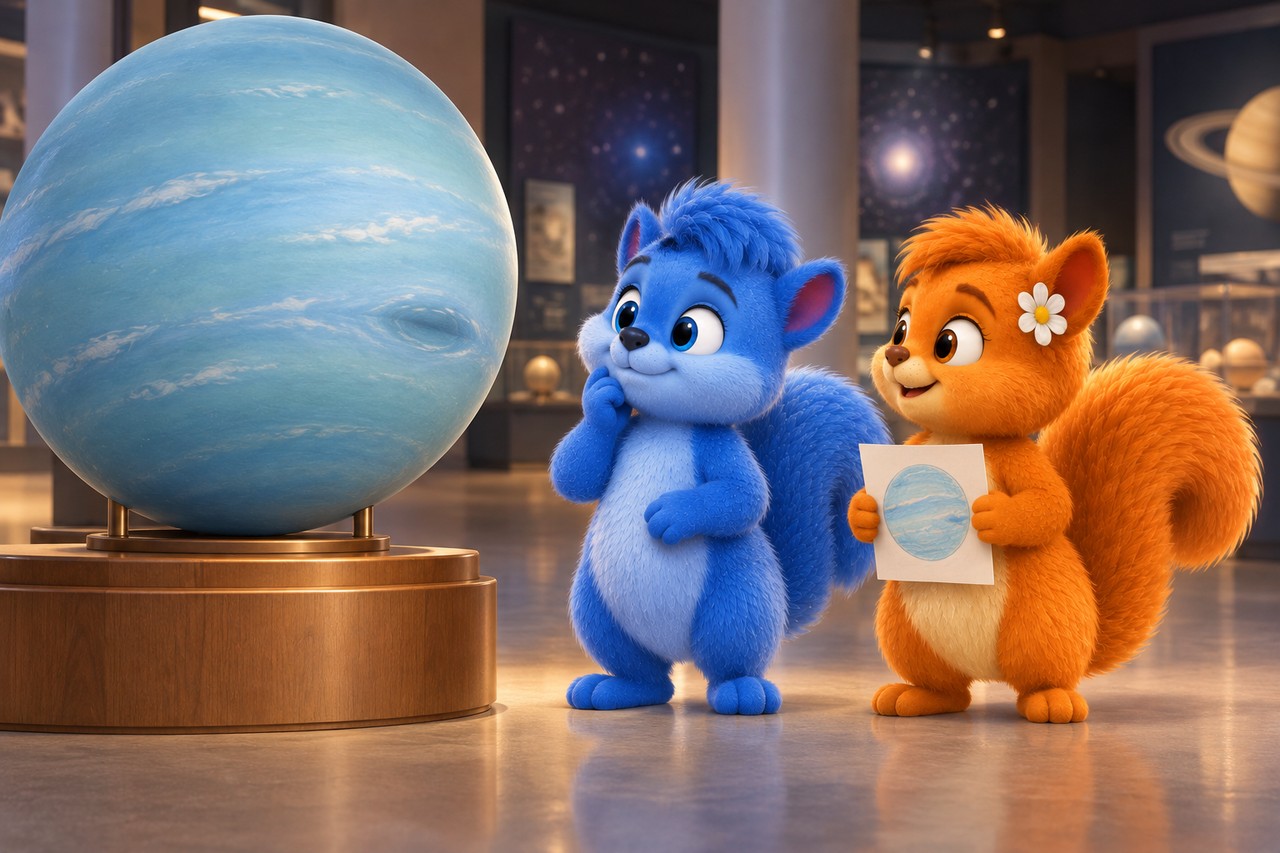
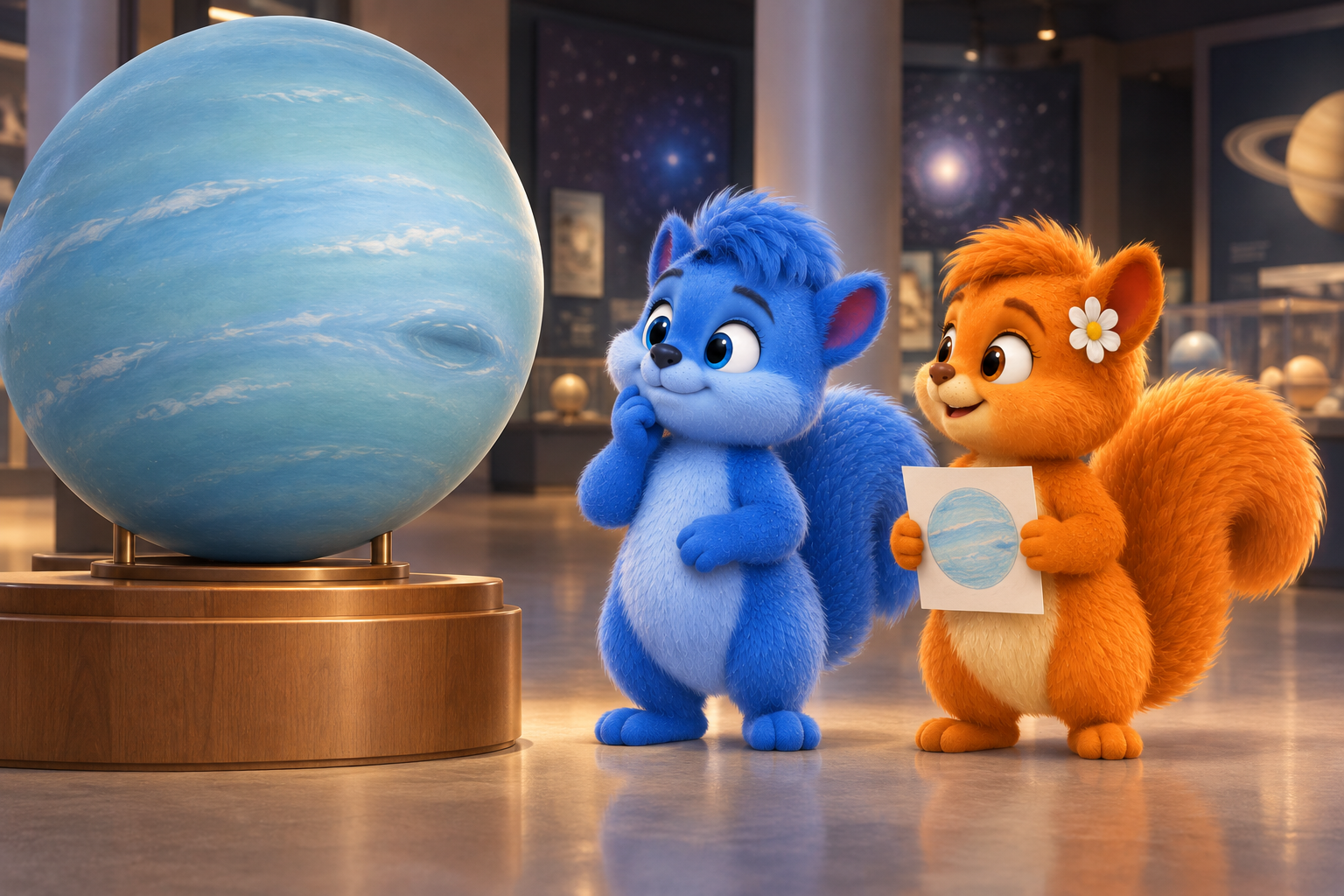
Equal-sized Wusels discover a pale Neptune museum model. Artistic pale blue-green appearance, not a colour measurement. Cloud patterns are simplified. AI-created illustration, not a photograph of nature.
What the diagram shows
The diagram simplifies the process. First compare its shapes and arrows. You can read its labels in larger text below.
Read the picture labels
These are the words and sentences from the diagram above. The full explanation follows below.
- A prediction is tested
- Notice a difference
- Uranus does not move quite as expected.
- Calculate a position
- Another planet could contribute its gravity.
- Search the sky
- Observation finds Neptune and tests the prediction.
- Science compares explanations with observations.
- Simplified thinking model, not a complete research procedure.
An imagined Wusel scene
Puschel and Flauschi investigate
On the planet chart, Puschel finds a mismatch between observation and calculation. Flauschi adds a card for a still-unknown planet. They follow the predicted search position and then the telescope picture. Their sequence shows how a hypothesis was checked.
Look closely
Find the pale blue-green sphere and its light cloud streaks. These simplified patterns are not a current weather report.
An example to help you understand
Draw a pale blue-green paper planet and a second copy with stronger colours and clearly highlighted cloud stripes. The second drawing makes patterns more noticeable without turning the planet into another object. This comparison explains image processing; it does not measure real planetary colour.
Try explaining it
What helped in the search for Neptune?
Choose a), b) or c), then explain your choice.
- a)A calculated search position and a telescope observation.
- b)The calculated location alone, without looking for the planet.
- c)A random star chart without calculation or looking through a telescope.
Show the explanation
Correct: a): A calculated search position and a telescope observation.
Uranus moved around the Sun a little differently from predictions. Researchers suspected another planet was pulling on it. They calculated where to look. A telescope observation confirmed Neptune there. A calculation gave the clue; an observation tested it.
Word help
- atmosphere
- The gas layer around a world; on Earth it is the air above us.
- orbit
- The path of one body around another.
- rotation
- Turning around one's own axis.
Explore in more detail
Here you will find longer explanations and further details. You can explore them together.
1. Outermost of the eight planets
Neptune is the eighth and outermost planet in our solar system. The system does not end there; more distant bodies include dwarf planets. Neptune averages about thirty times Earth’s distance from the Sun. One orbit takes roughly 165 Earth years; one rotation takes about 16 hours. Distance and orbit time are different from rotation time.
Checked against: [1]
2. A prediction to investigate
In the nineteenth century Uranus did not move exactly as expected. Researchers considered whether another planet’s gravity might contribute. Urbain Le Verrier calculated a possible position. Johann Gottfried Galle found Neptune in 1846 during a search at the Berlin observatory, a place for observing the sky. The calculation was a testable prediction; observation confirmed the sought body.
Checked against: [1]
3. Clouds, winds and no solid ground
Like Uranus, Neptune is an ice giant, not a planet with a solid outer ice surface. Its atmosphere merges into deeper dense layers. Clouds move in powerful winds; dark storm regions can appear and disappear. Researchers continue studying the precise interior structure. A solid museum sphere must not be mistaken for walkable planetary ground.
Checked against: [1]
4. Why do pictures look different?
Many familiar Neptune images had colours and contrast enhanced to reveal clouds and patterns. Reanalysed measurements show Neptune and Uranus look more similarly blue-green to human eyes than often assumed; Neptune is slightly bluer. Atmospheric methane particularly absorbs red light. An intensely blue research picture can be useful if its processing is explained, but it does not simply show what human eyes would see.
An optional question for further exploration
You can use the longer explanation above. This is extra, not needed for the first quiz.
An extra question
Why can an enhanced picture be useful without showing a natural colour impression?
Discover the answer
Enhancement can make faint cloud patterns clearer. Displayed colours may be altered, so the caption needs to explain how the image was produced.
Pictures and sources for adults
Sources for further reading
Facts checked against the specialist sources below on 12 October 2026. The Wusel scene is fictional; comparisons and simplified models are explicitly explained. Sources are in English.