Earth & Space
Why does the Moon sometimes look like a banana?
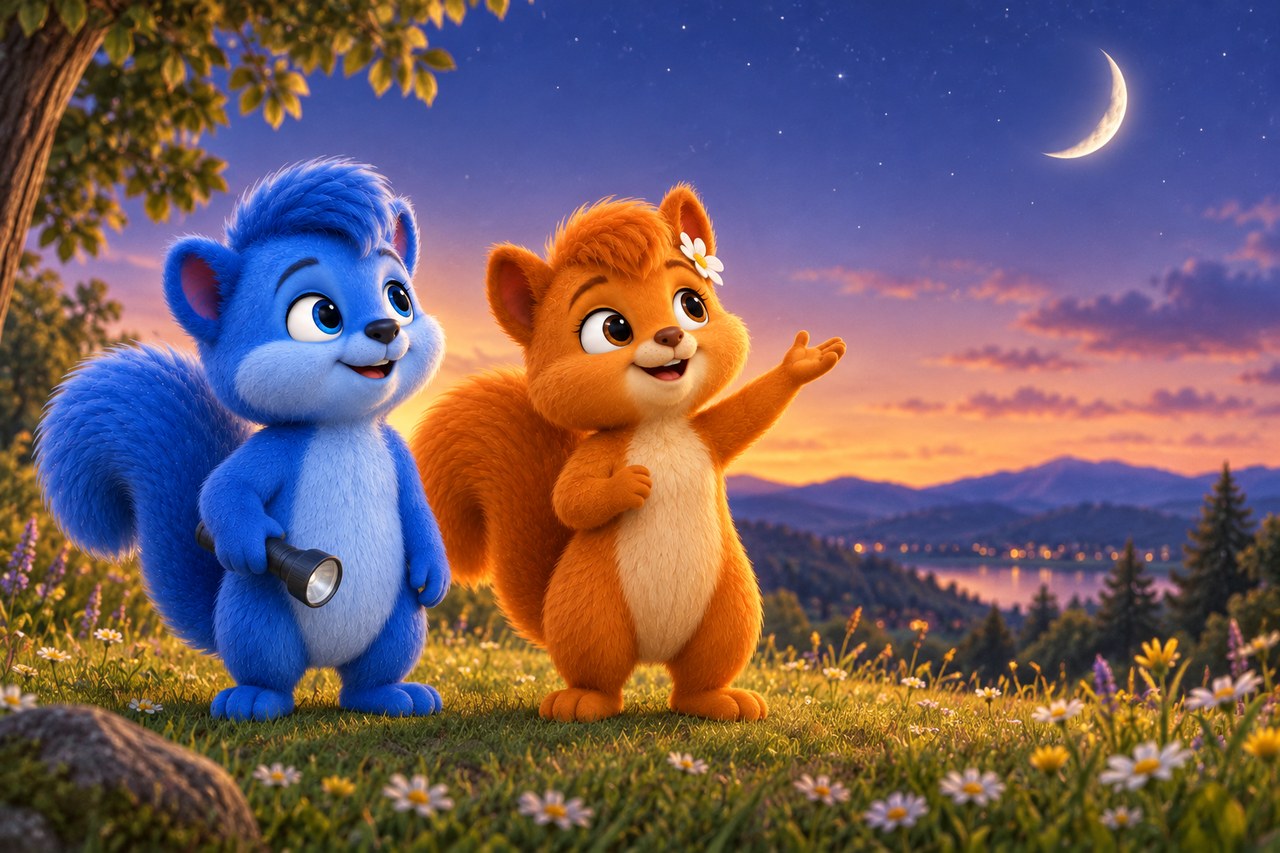
A thin crescent gives Puschel a tasty idea.
The short answer
The Moon remains a ball. The Sun lights roughly half of it. As it orbits Earth, we see different amounts of that lit half. This creates crescent, half and full Moon shapes.
One Moon, two views
1. New Moon
Above: The Moon is between the Sun and Earth. Below: From Earth we look at its dark side.
2. Crescent Moon
Above: The Moon has moved a little further round. Below: We see just a thin bright edge. The dark part is not a missing piece.
3. Half Moon
Above: The Moon is to the side of the Sun–Earth line. Below: Half of the disc we see is bright and half is dark.
4. Full Moon
Above: Earth is between the Sun and Moon. Below: We look at the bright side of the Moon.
Above, we look from outside at the Sun (yellow), Earth (blue) and Moon (small). The arrow shows the direction of sunlight.
Below the line is our view from Earth. The dark part is still there.
The pictures show different times; the whole cycle takes about a month. Sizes, distances and the tilt of the orbit are omitted.
The straight lines here therefore do not show eclipses.
Why does the round Moon look like a thin crescent?
The Sun lights one half of the round Moon. As the Moon orbits Earth, our view of that half changes. At a crescent we see only a narrow part of the bright half; the rest of the Moon has not disappeared.
An imagined Wusel scene
Puschel and Flauschi investigate
The two spot a thin crescent one evening. Puschel“Who has bitten the sky banana?”
Flauschi“Nobody. The Moon is still round. We can only see a narrow part of its illuminated side just now.”
Puschel“So it is not a space snack?” Flauschi“No. The Moon reflects sunlight.”
They agree to look again on other evenings. Sometimes clouds may hide the view.
Puschel“Then I will draw what we really see. No invented bite marks!” Flauschi laughs and fetches their little observation book.
Little Wusel quiz
Does the Moon’s real shape change with its phases?
Choose one answer: a), b).
- a)No, it stays roughly spherical.
- b)Yes, the Moon itself becomes narrower and wider again.
Show answer
Correct answer: a): No, it stays roughly spherical. No. We see different amounts of its illuminated half.
Does Earth’s shadow cause ordinary Moon phases?
Choose one answer: a), b).
- a)No.
- b)Yes.
Show answer
Correct answer: a): No. No. Earth’s shadow on the Moon belongs to a lunar eclipse, not the usual phase cycle.
Word help
- orbit
- The path of one body around another.
Explore in more detail
Here you will find longer explanations and further details. You can explore them together.
Understand step by step
How it works – simply explained
Sunlight illuminates the Moon
The Moon does not make its visible light. The Sun normally lights half its sphere.
Our view changes
As it orbits Earth we see different amounts of the lit half. A crescent and full Moon are different views, not different Moon shapes.
Earth’s shadow is not the cause
Ordinary phases come from viewing the lit half differently. Earth’s shadow reaches the Moon during a lunar eclipse.
A round ball can appear differently lit
Imagine a ball lit from one side. Looking at its bright side, it looks fully lit. From a different direction you see only part of the lit surface. The ball stays round. Our view of the Moon’s lit half changes during its orbit. The comparison explains viewing direction, not real space distances.
References for this explanation: [1]
Additional specialist reference: NASA Space Place: Mondphasen
The key points again
Discovery 1
The Moon stays roughly spherical. It shines in the sky by reflecting sunlight.
Source: [1]
Discovery 2
As the Moon orbits Earth, we see different amounts of its sunlit half. This creates the phases of the Moon.
Source: [1]
Discovery 3
Ordinary Moon phases are not caused by Earth’s shadow. That shadow is involved in a lunar eclipse.
Source: [1]