Body & Senses
Why do we remember some things?
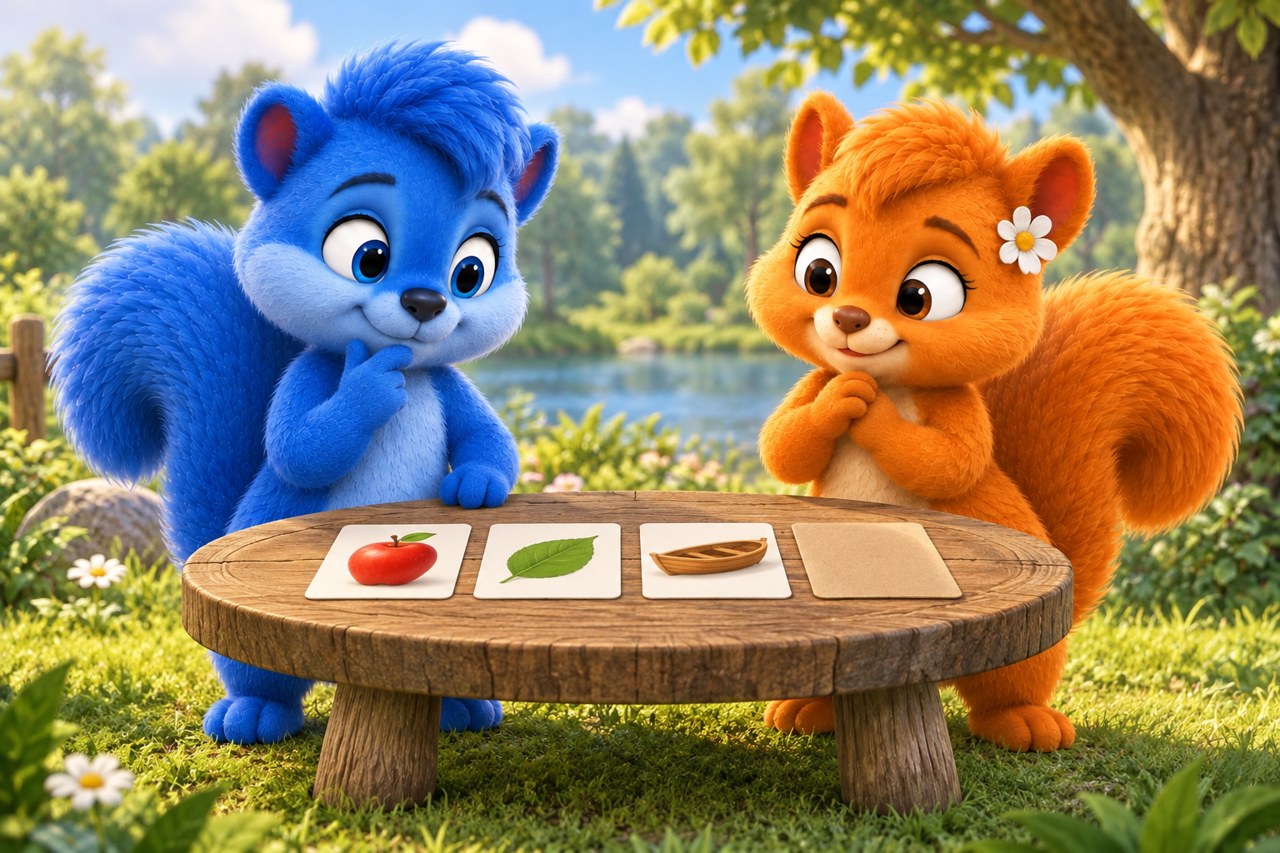
A face-down picture card makes Puschel curious about memory.
The short answer
Remembering involves many nerve cells working together in the brain. Attention, meaning and repetition can affect what we retain. A memory is not an unchanged film recording and can change.
An imagined Wusel scene
Puschel and Flauschi investigate
Three picture cards lie on the table: an apple, a leaf and a boat. Flauschi turns one over. Puschel“Now my head has to look behind the card.”
Flauschi“Or remember it. What was there?” Puschel thinks. Puschel“Perhaps the leaf. I am not sure.”
They turn it back over. Puschel“The boat! My head did not keep everything.” Flauschi“That does not prove you are bad at thinking.”
Puschel“Then I can try again later if I want.” Flauschi leaves the cards face up.
They say which card they like. A little memory activity does not become a contest over whose head is better.
Little Wusel quiz
Is memory a perfect film recording?
Choose one answer: a), b).
- a)No.
- b)Yes.
Show answer
Correct answer: a): No. No. Memories can be incomplete or change.
What can help learning?
Choose one answer: a), b).
- a)Attention and repetition.
- b)Only glancing once.
Show answer
Correct answer: a): Attention and repetition. Attention and repetition can help. Nobody has to remember everything immediately.
Word help
- cell
- A tiny living unit. Living things are made of cells.
- nerve
- A bundle of fibres that carry signals through the body.
Explore in more detail
Here you will find longer explanations and further details. You can explore them together.
Understand step by step
How it works – simply explained
An experience begins
The brain processes information from your senses when you notice something. Attention helps. Doing many things at once may leave fewer details noticed.
Connections are used
Many nerve cells work together in learning and remembering. Repetition can strengthen learning. The brain does not store a perfect movie to replay unchanged.
A clue may help
A photograph or familiar sound may bring a memory back. Details can still be missing or different. Forgetting does not prove that a person or event was unimportant.
Why memory is not a photo album in your head
A song may remind you of a trip because the brain links it with parts of the earlier event. You need not remember every colour or word. Two people describing a trip differently are not necessarily deliberately lying. Memories can be incomplete; a written reminder helps with precise information such as meeting times.
The key points again
Discovery 1
The brain helps us remember experiences and things we have learned. Many nerve cells work together. Nerve cells are cells that pass messages onwards.
Discovery 2
Attention and repetition can help learning. But remembering is not like playing a perfect recording of a film.
Source: [2]
Discovery 3
We can forget details or remember them differently. A clue, such as a picture, may help recall. Forgetting does not make a person less valuable.
Source: [2]