Why does my heart beat faster when I run?
Your heart pumps blood through two connected routes. Follow its journey to the lungs and body cells.
The short answer
Running muscles need more oxygen. Your heart usually beats faster to pump more blood around the body. Blood carries oxygen to the muscles. After a rest, the heartbeat usually settles again.
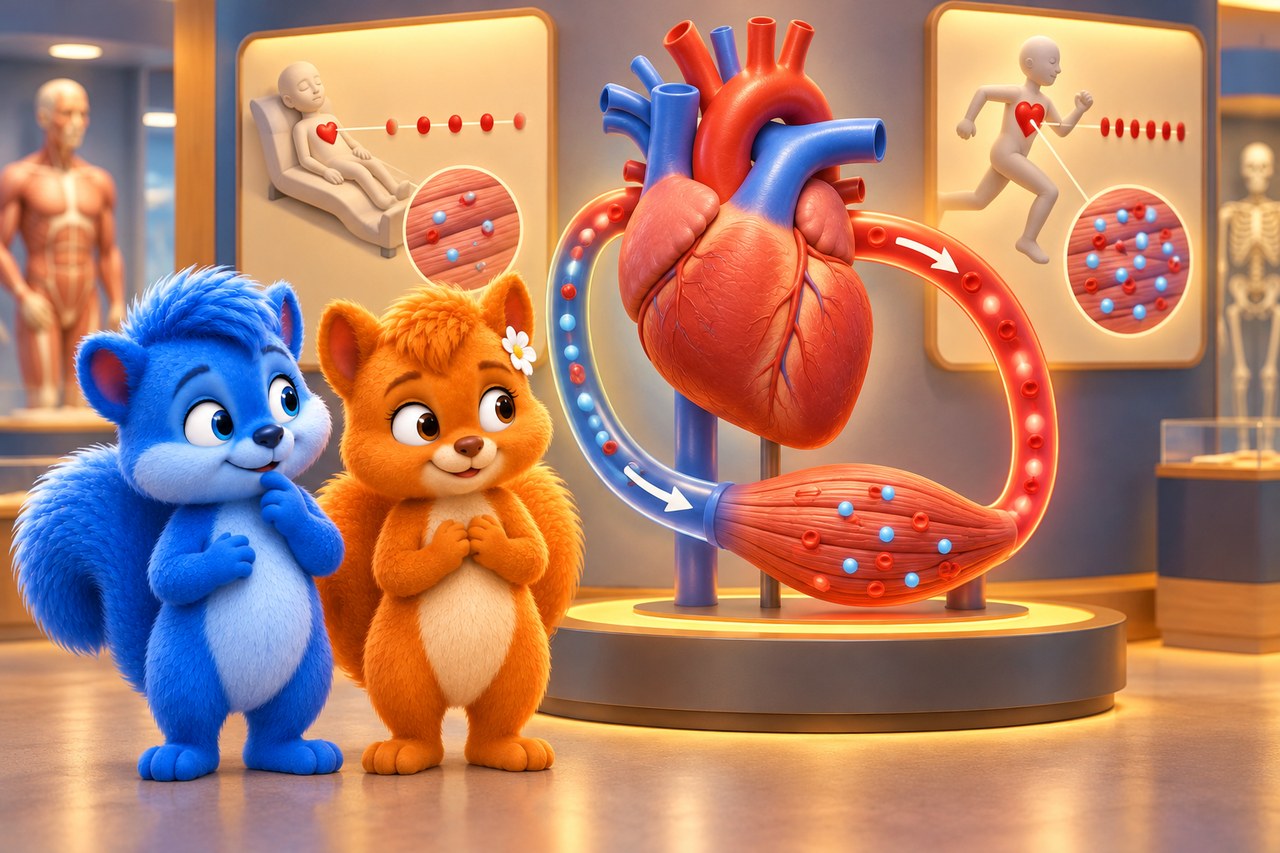
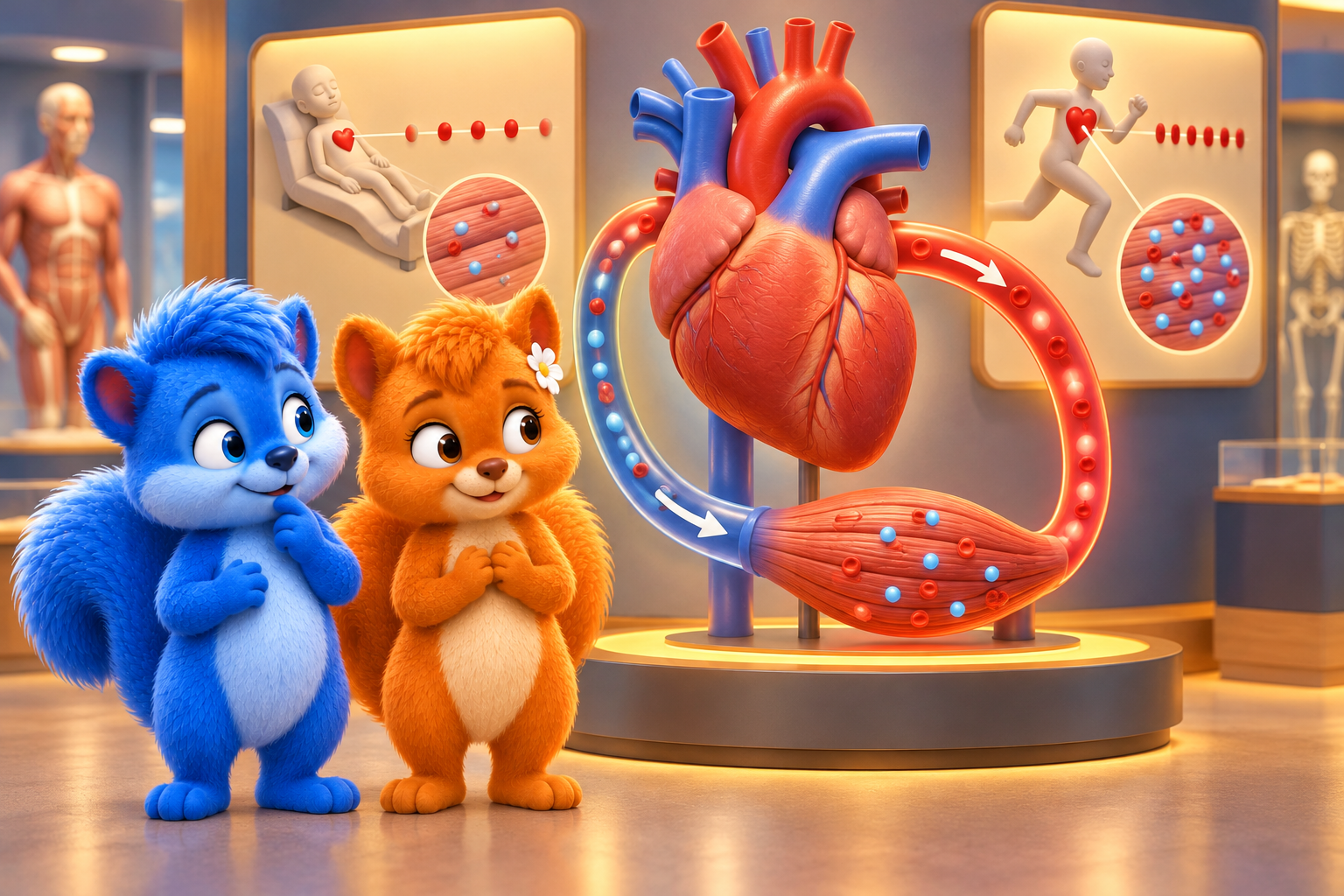
Puschel and Flauschi in the museum. Heart model with a closed blood circuit and a comparison of rest and running. Circuit and pulse dots are simplified, not exact anatomy or a measurement. AI-created illustration, not a photograph of nature.
Explained in three pictures
1 At rest
Even at rest, our cells need oxygen.
2 When running
During running, muscles work harder and need more oxygen.
3 The heart pumps more often
The heart usually beats faster and moves more blood per unit of time.
More about the picture
When running, muscles work harder. Blood brings oxygen and nutrients and carries substances away. The heart usually beats faster and pumps more blood per unit of time. Dots and peaks only compare demand and frequency; they are not measurements.
An imagined Wusel scene
Puschel and Flauschi investigate
After a quiet game, Puschel rests and notices his heartbeat. Later he compares it after a little movement. Flauschi records only “calmer” and “faster,” not a winning number. They connect the difference with the muscles' work.
Look closely
Compare the museum model with the three picture steps. During running, muscles work harder and need more oxygen.
An example to help you understand
Draw six large boxes on paper: body, right atrium, right ventricle, lungs, left atrium and left ventricle. Connect them in that order with arrows, then return the final arrow to the body. Trace the entire route with a finger. Where does blood pick up oxygen? At the lungs. Where does it deliver oxygen to many cells? In the body. Beside it, draw an air sac and blood vessel: one arrow for oxygen toward blood and one for carbon dioxide back toward air. Colors are only route guides. They are not separate red and dark “blood types” in two independent systems. The model omits many vessels and details.
Try explaining it
Why does your heart usually beat faster when running?
Choose a), b) or c), then explain your choice.
- a)It sends more oxygen-carrying blood to working muscles.
- b)So blood mainly stays still in the arms and legs while running.
- c)So muscles receive more oxygen with less blood.
Show the explanation
Correct: a): It sends more oxygen-carrying blood to working muscles.
Running muscles need more oxygen. Your heart usually beats faster to pump more blood around the body. Blood carries oxygen to the muscles. After a rest, the heartbeat usually settles again.
Word help
- cell
- A tiny living unit. Living things are made of cells.
- nerve
- A bundle of fibres that carry signals through the body.
- oxygen
- A gas in air that our bodies take in through breathing and need for their work.
- carbon dioxide
- A gas produced, among other ways, by working body cells and breathed out.
- nutrient
- A substance a living thing needs to live and grow.
- artery
- A blood vessel carrying blood away from the heart. The name does not tell you its oxygen content.
- vein
- A blood vessel carrying blood towards the heart.
Explore in more detail
Here you will find longer explanations and further details. You can explore them together.
1. A muscle pump with four spaces
Your heart sits in the chest behind the breastbone, slightly toward the left. It is a hollow muscle that contracts and relaxes. It has two halves, each with an atrium and a ventricle: four chambers altogether. An atrium receives arriving blood; a ventricle pumps it onward. Heart valves work rather like one-way doors and help prevent backward flow. They are living parts of the heart, not wooden doors. The diagram arranges chambers as boxes, not their real shapes.
2. Right side to lungs: gases change routes
Blood from the body enters the right atrium and then the right ventricle. This pumps it through the pulmonary artery to the lungs. Arteries are blood vessels carrying blood away from the heart. At tiny air sacs in the lungs, air lies beside very small blood vessels. Oxygen passes through thin walls from air into blood. Oxygen is a gas many body cells need for their work. Carbon dioxide moves from blood into air inside the sacs and is breathed out. Carbon dioxide is a gas produced during body cells’ work. The entire breath is not sent through the heart as an air bubble.
3. Left side to body: deliver and return
Blood containing more oxygen travels through pulmonary veins to the left atrium and then the left ventricle. Veins carry blood toward the heart. The left ventricle pumps through the aorta, the main artery, into the body. Smaller vessels branch into capillaries: tiny blood vessels close to cells. Oxygen and nutrients are delivered there. Nutrients are substances the body uses for energy and building. Blood picks up carbon dioxide among other substances and returns through veins to the right atrium. Oxygen-poor means less oxygen, not completely without it. Arteries and veins are named by flow direction, not oxygen content.
4. Running increases demand
Body cells need supplies even when you sit quietly drawing. During running, muscles work harder and need more oxygen. The heart therefore usually beats faster and can move more blood each minute. After a break, the heartbeat usually becomes calmer. Its rhythm normally begins with signals from special heart cells; nerves and the body’s chemical messengers influence it. Messengers transmit information inside the body. You do not consciously command every heartbeat. This needs neither a socket nor an external wire.
An optional question for further exploration
You can use the longer explanation above. This is extra, not needed for the first quiz.
An extra question
The pulmonary artery leads from the heart to the lungs and carries blood with less oxygen. Is it still an artery?
Discover the answer
Yes. Artery means blood travels away from the heart; vein means toward it. The pulmonary artery is therefore an artery despite lower oxygen content, while pulmonary veins return oxygen-richer blood to the heart.
Pictures and sources for adults
Sources for further reading
Facts checked against the specialist sources below on 12 October 2026. The Wusel scene is fictional; comparisons and simplified models are explicitly explained. Sources are in German and English.