Why is Mars red, and what do its rocks reveal?
A cold desert world preserves evidence of ancient water. Evidence for water is not proof of life.
The short answer
Iron-bearing materials in Martian dust have changed and give it a reddish colour, somewhat like rust. Some rocks and landforms show evidence of ancient water. That does not itself prove life once existed there.
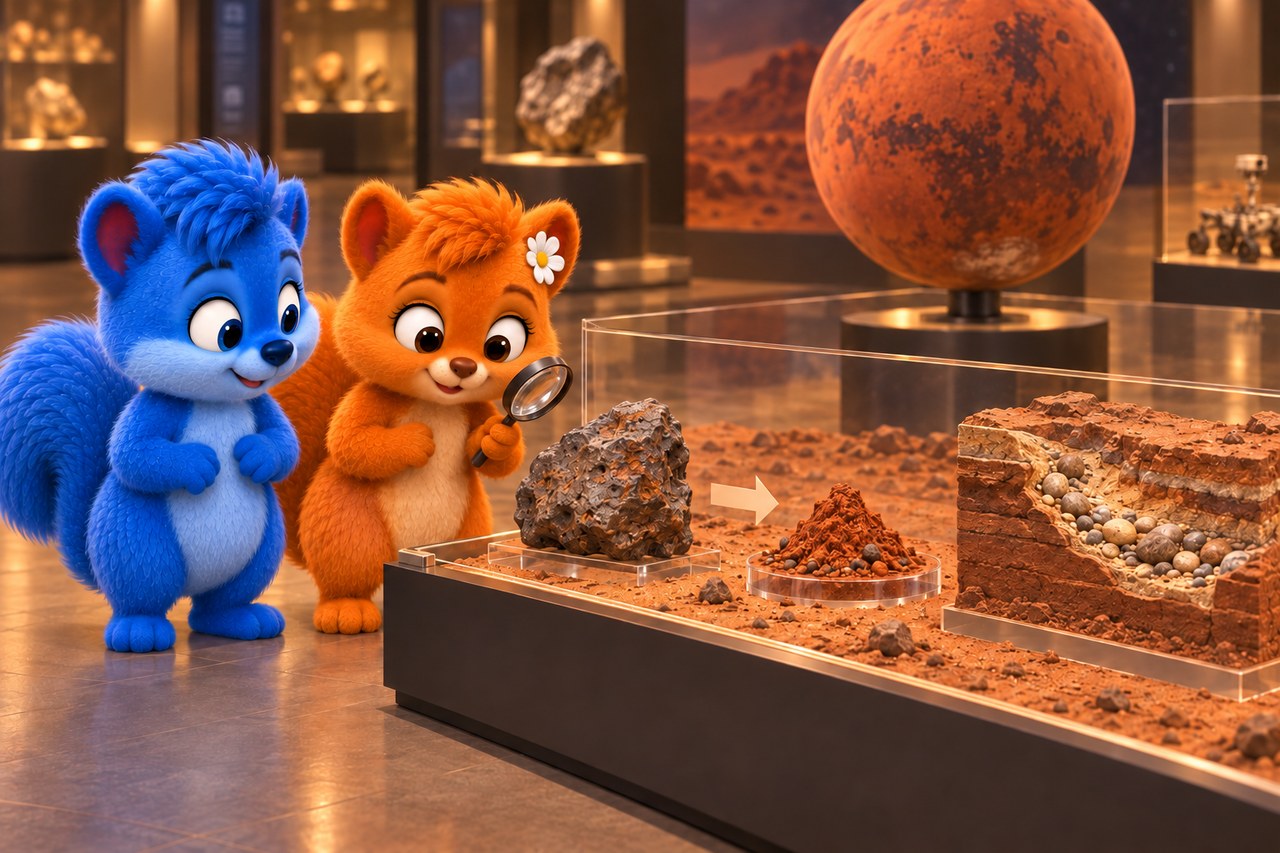
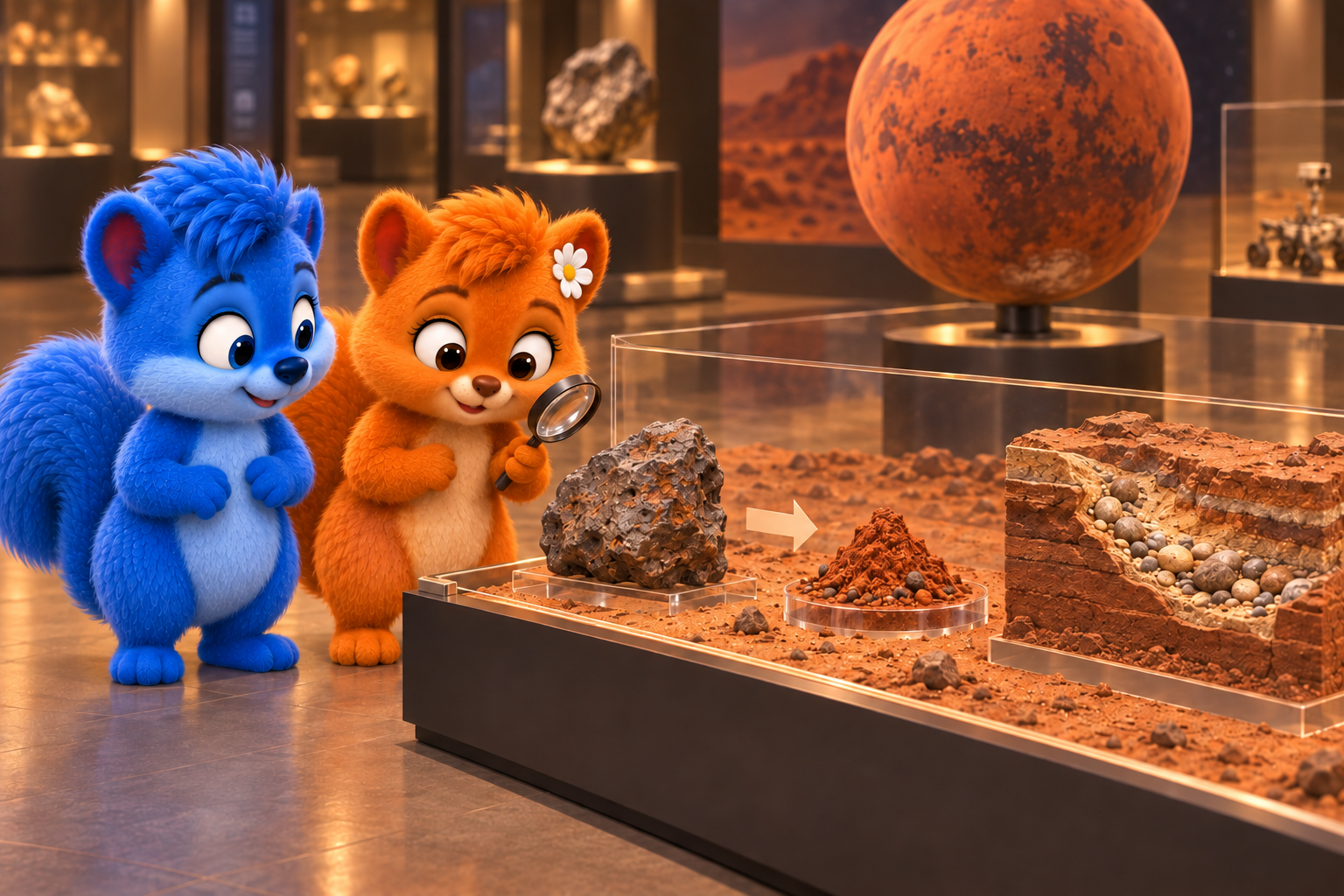
Puschel and Flauschi in the museum. Mars model with iron-bearing rock, red rust and an old water channel. Simplified inanimate museum model; arrows and colours help explain it. AI-created illustration, not a photograph of nature.
Explained in three pictures
1 Iron and oxygen
Iron-bearing materials react with oxygen: they oxidise.
2 Red dust
The resulting iron oxides make much Martian dust reddish.
3 Traces of water
Rounded pebbles and deposits can reveal past water.
More about the picture
The red colour is not caused by fire: iron oxides in the dust contribute to it. Some rocks preserve clues to past water. Water or habitable conditions alone are not proof of life.
An imagined Wusel scene
Puschel and Flauschi investigate
Puschel sees a red Mars picture and writes “Fire planet.” Flauschi points to the label about iron-bearing dust. He revises his guess and searches for water traces. On separate cards he records that colour and ancient water channels are different clues.
Look closely
Compare the museum model with the three picture steps. The resulting iron oxides make much Martian dust reddish.
An example to help you understand
Draw a winding riverbed and a round hollow. Could water once have been there? Perhaps. Add rounded pebbles and layers of deposited mud. Discuss why several matching observations are stronger than one shape. Your paper is a thinking model, not proof about a real Martian rock.
Try explaining it
Why is evidence of ancient water not proof of life?
Choose a), b) or c), then explain your choice.
- a)Water can exist without life being confirmed.
- b)An ancient water site already proves animals lived there.
- c)Water traces already show which organisms lived there.
Show the explanation
Correct: a): Water can exist without life being confirmed.
Iron-bearing materials in Martian dust have changed and give it a reddish colour, somewhat like rust. Some rocks and landforms show evidence of ancient water. That does not itself prove life once existed there.
Word help
- oxygen
- A gas in air that our bodies take in through breathing and need for their work.
- carbon dioxide
- A gas produced, among other ways, by working body cells and breathed out.
- atmosphere
- The gas layer around a world; on Earth it is the air above us.
- orbit
- The path of one body around another.
- mineral
- A natural substance with a particular composition and ordered internal structure.
Explore in more detail
Here you will find longer explanations and further details. You can explore them together.
1. Colour in the dust
Mars is the fourth planet from the Sun, with roughly half Earth’s diameter and a rocky surface. Iron-bearing material in its rocks and dust has reacted with oxygen. This kind of change is called oxidation; rust is a familiar example. Reddish dust makes Mars look red from a distance. Close-up pictures also show brown, grey and yellowish rocks. The whole planet is not uniformly red.
2. Different living conditions
Its thin atmosphere, the surrounding gas envelope, is mostly carbon dioxide. People could not breathe there without special equipment. Modern Mars is mostly cold and dry. Wind can move dust and produce large storms. One orbit takes about 687 Earth days; a day lasts roughly 24 hours and 40 minutes. A similar daily rhythm does not make the other conditions Earth-like.
3. Rocks record ancient water
Old valleys, deposits and particular minerals provide evidence for former liquid water. A mineral is a natural substance with a particular composition and internal structure. Curiosity found rounded pebbles probably moved by an ancient stream, and rocks formed from former lake mud. Several observations support the explanation; it is more than an interesting shape. Water is also confirmed on Mars today in the form of ice.
4. Water and life are separate questions
Water and suitable chemicals can make a place habitable for some organisms. Habitable means conditions might suit life, not that life definitely existed. Robots continue studying rocks, taking photographs and making measurements. Interesting patterns and substances must also be compared with non-living processes. A rock containing possible clues is not a confirmed discovery of Martian life.
Checked against: [2]
An optional question for further exploration
You can use the longer explanation above. This is extra, not needed for the first quiz.
An extra question
Does evidence for ancient water prove there was life?
Discover the answer
No. Water matters for known life but also exists without organisms. Researchers need additional evidence and must investigate other explanations.
Pictures and sources for adults
Sources for further reading
Facts checked against the specialist sources below on 12 October 2026. The Wusel scene is fictional; comparisons and simplified models are explicitly explained. Sources are in English.